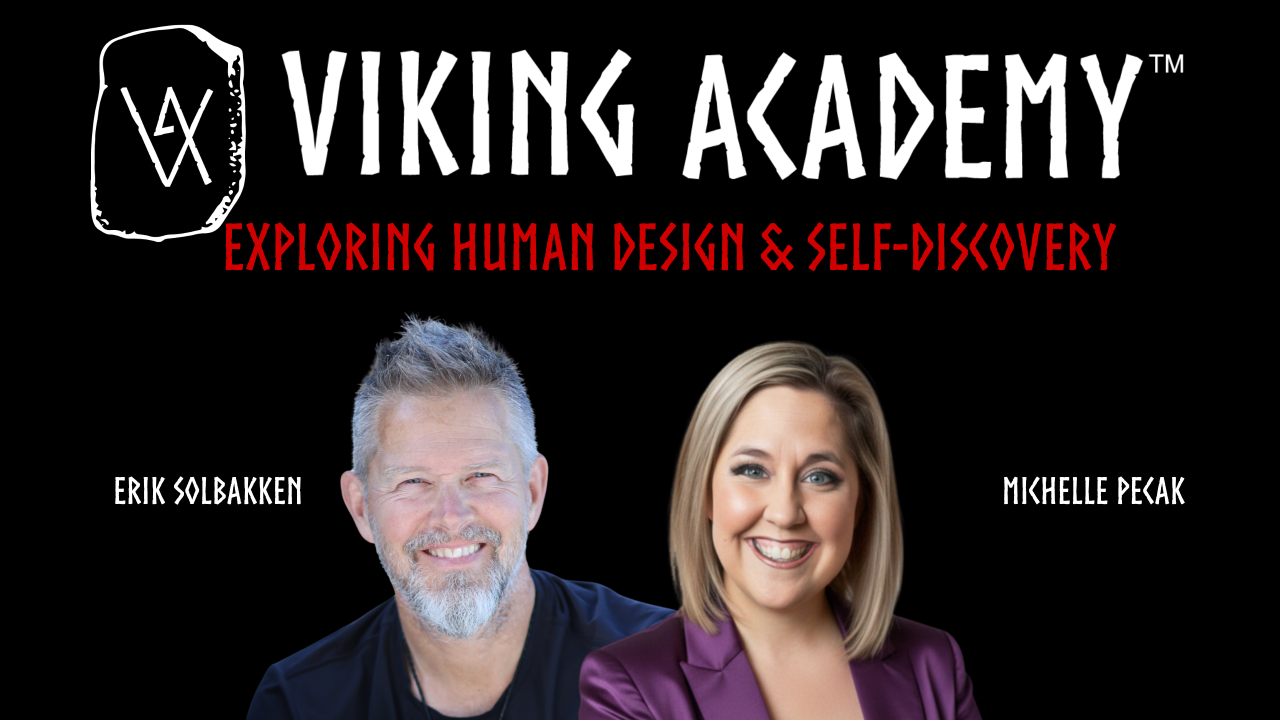
#56: Exploring Human Design & Self-Discovery with Michelle Pecak
What if understanding how we're wired could change the way we approach life, work, and relationships?
In this episode, we sit down with Michelle Pecak, a systems strategist, pricing specialist, and Human Design guide, to explore self-discovery and the many layers that shape who we are. Michelle shares how her 22-year career in corporate pricing led her to Human Design and a deeper understanding of her own strengths and purpose.
We explore how Human Design complements traditional personality assessments, offering new perspectives on decision-making, relationships, and our unique abilities. Michelle also shares how she created Coach ALI, an AI-powered alignment coach designed to make Human Design more accessible and help people explore their own charts.
Together, we discuss the importance of focusing on our strengths, embracing different paths to self-discovery, and exploring who we are and what we're here to do.
Topics We Explore:
- Michelle's 22-year career in corporate pricing and strategy
- How she discovered Human Design
- Human Design and traditional personality assessments
- Understanding our strengths, decision-making, and life purpose
- How Human Design can offer new perspectives on relationships
- Making self-discovery more accessible through AI
- Creating Coach ALI and empowering people to explore their own charts
Connect with Michelle Pecak: https://www.linkedin.com/in/michelle-pecak/
Explore Human Design & Coach ALI: https://www.myvibehumandesign.com/
Learn More about The Viking Academy: https://www.vikingacademy.com
Episode Transcript:
Erik Solbakken: Hi, everyone. Welcome back to the Viking Academy Podcast. Today on the podcast we have Michelle Pacak. Now, Michelle is a systems strategist, um, and she's actually a m- a pricing specialist with big corporate. But what the interesting thing is that she's created a new, uh, what she calls her joy job, and it's called human design.
It's all focused around human design. And if you've heard me talk about, uh, Kolbe and StrengthsFinder and the PRINT, these are all personality profiles. Human design takes that and puts it on steroids. This conversation we had went quite a long time. This, this is a longer podcast than normal because I found it so intriguing to get down into the deep, uh, edges of what human design does.
You take your, uh, birth date, the time you were born, and the place you were born, you enter it into there, and it is uncanny how it actually unpeels the same personality profiles that you get on these other, shall we call it, she calls it one directional, uh, personality profiles. It's because these are the inputs that you put in yourself for the Kolbe, the StrengthsFinder.
The interesting thing that comes down to it at the bottom for me is that I think this is like the epitome of the ethos of the Viking Academy. It's like, who are you and why are you here? What are you here to do? This is the ethos of the philosophy of self-discovery. We had a great conversation. We went down a whole bunch of different avenues when it came down to human design.
She also has like four different websites when I first saw it and I was like, "Holy shit, you've got more businesses than I have." So she's got four different websites. She's created an AI agent that you can work through for free to help you analyze your human design, to help you decide and... or help you discover, sorry.
Discover not decide, 'cause this is all about discovery. Discovering who you are and what you're here to do. This is, this is self-discovery in its finest. This is self-exploration. This is so fun, and I love the fact that Michelle likes to say "fuck" every once in a while as well because, you know, you gotta throw in a couple swear words.
It's great. So there you go. Michelle Pacak, here we go. Let's go explore
Erik Solbakken: Welcome to the podcast.
Michelle Pecak: Well, thank you, friend. It's nice to be here.
Erik Solbakken: So we've never met before.
We were just, we were just talking about that.
Michelle Pecak: Mm-hmm.
Erik Solbakken: Um, the connection came through LinkedIn, correct? There's a conversation you had with
Michelle Pecak: Erin. Yeah. It came through one of my really good friends, Jackie Joy.
Erik Solbakken: Oh,
Michelle Pecak: yes. And... Yeah, yeah. And she knows my human design work and is one of my biggest cheerleaders, and we were talking, and she was like, "Oh my gosh, you have to be on Eric's
Erik Solbakken: podcast."
Michelle Pecak: So she made the intro, and then Erin sent me the link, and I was like, "Oh, that, that's it? We just, we just start talking? Okay, great." I don't, I don't even knows what human design is, but we'll figure it out.
Erik Solbakken: No, exactly. Well, the interesting thing, 'cause I w- I was looking at the, the, um, the calendar invite that I had here, and you had where can the audience find you, and I started looking at all the different websites you have, and it's like, here's one.
Yeah. Here's two. Here's three. Yeah. Here's four. Here's Andrea. And I was like- ... holy shit, she's got, like, more businesses than I do. This is great. Yeah. We're gonna have a lot of fun, but-
Michelle Pecak: Well, yes, and it's so funny because I'm newer to, like, where do people find me. I'm newer to that question- Mm-hmm ... because I'm very multi-hyphenate.
And I have my day job in corporate, and I have my joy job, which is the work I truly love, but then the way I connect with different audiences with human design is also different. So that's where it's like, are you corporate? Okay, modern wiring. Are you a student? Okay, let's talk about dog vibes. Let's talk about, like, what type of dog are you, and how to relate to family and kids.
Or are we talking about, like, connection class, and now I'm working deep one-on-one with executives? That's, like, the adventure map of you. So I have several websites so that I know where to point people depending on really what audience I'm talking to.
Erik Solbakken: Okay, so l- let's, let's unpack this. And so you're in corporate.
Let... tell me a little bit about the corporate. I wanna hear a little more about the background, and then what got you into- Sure ... these different joyful expressions. Yep. And Jackie boy, see what I did there? Yeah. Okay. I
Michelle Pecak: do. Yep.
Erik Solbakken: Um, and then we can... 'Cause I'm very curious on that. Like, where, what's the- Yeah
corporate job, and then what got you into the, the business, the first business, shall we say?
Michelle Pecak: Yeah, for sure. So I have 22 years in supply chain electrical distribution, and really my focus area that I really love is pricing, so scaling billion-dollar companies through pricing strategy. And I loved that work, and as I kinda...
My life purpose is to help people build things, and then I move on. And so I didn't know that when I was back in corporate, but now I know that's my life purpose. And so I moved to a couple of different companies, helped them build a pricing team, and then I leave, and then I go help another company build a pricing team, and then I leave.
And during merger and acquisition time, it was like, yeah, it's time to leave. Like, this, I don't wanna go do what... You know, the company that bought us, like, I don't wanna go and... They have a pricing team. I don't need to build for them, right? So then I started my own consulting company doing B2B, uh, pricing consulting, and so that is kind of the background.
And, um, while I was an executive, I joined a group called Chief, which is the world's largest women executive network in the world, and, uh, 'cause I wanted more women. Like, most of my background is supply chain. It's all m- male dominated, so I was like, "Okay, I need some women in my life." And when I joined Chief, I really realized that I'm really good at bringing people together.
Like, nobody really, l- like, c- When you're in a woman executive group, um, we're not talking supply chain pricing. We're talking about, like, everyday problems, and teamwork, and connection. You know, we're not talking about my, my day job. And so I realized I would host different events on different topics. I'd bring people together.
Probably 200 of my friends have written amazing books, so then I started hosting book signings and bringing them into clubhouses, and feeling... You know, 70 women come together to have a book chat. And so then there was this duality of, like, yeah, I, I have this corporate job, and I really bring people together very naturally.
That's w- just something I love to do, and that's how I found human design is one of the events that I was hosting. I, I was very original. I called it Body, Mind, and Spirit because I was very new to woo.
Erik Solbakken: New to woo, yes. And then- New to woo.
Michelle Pecak: It was. I was totally new to woo. Everything... You know, I was raised Christian, and, like, all that stuff was, like, voodoo devil stuff.
So, like, I was very... I was... I wouldn't say I was judgmental, but I was very, like, woo curious of, like, I'm gonna dip my toe in the water, but I'm still leaving my outfit on. Like, I'm not in a swimsuit. I'm not going swimming. I just need a minute to, like, see if this is my vibe. And so that is when I learned about human design, is I was hosting a Body, Mind, and Spirit event, and it was all about...
We brought in Pvolve, um, my friend's company, from, from our group, right? So we had, like, workout, and then, like, um, I was new to this. I was like, sound bath, Reiki, meditation, great. And then the mind piece we brought in a human design reader, and that's when I learned what human design was. I- it just looked good on an event page.
I was like, oh yeah, sure, people... Like, assessments, all that, like, perfect. I love assessments. And that's when I really got into it and learned that I was a projector. And then when you really start to go down the rabbit hole of human design, it's kind of this moment of like, wait a minute- Why have I never thought about that before?
Oh, that is why I'm successful. And I just started having brand new words for things that I had never, ever understood before. And then that was the first pivot, and then I'll, I'll pause here for a lot. But that was kind of the path of like, okay, well now I need to know all the things. Because I've done all the assessments, Culture Index, Myers-Brigg, DISC, iMap, Kolbe A, all, all of them.
And I love them all because they're directionally accurate for what you know about yourself. They're self-reported, right? And human design was not self-reported.
Erik Solbakken: Oh, that's- It- Okay, that's what I wanted to find out about that ...
Michelle Pecak: totally. It was just my birth date, time, and place. And I was like, sure, I know a little bit about astrology.
I'm a Pisces with a rising Cancer something or other. Like, you know? And so once I learned that there was this modality out there that gave me this level of detail about my life purpose and my blueprint of the human soul, I was just... I, I was all in to figure out what this was. Because it taught me things that I didn't know about myself.
I can only do... You know, all the assessments are what you self-report, and I only could self-report... And I am, for one, for one, I am honest on those things, but I've also come to realize most people are not honest on self-assessments because they're trying to look good to their boss who they're taking it for, or they're trying to look like a high achiever or look like something that they're not.
Mm-hmm. And so people that try to trick those assessments end up, like, not even self-reporting who they really are, 'cause they, they, they're reporting who they think they want, their boss wants them to be.
Erik Solbakken: Yeah, I like that 'cause actually Kolbe will- Yeah ... Kolbe will actually pick up on it. It actually has a- Mm-hmm
release valve in the Kolbe. So if you're actually- Yeah ... trying to answer it, uh, in the way that you want it to, it'll show you as, like... It won't give you a number. It'll just say, oh, you're in- Yeah ... It'll say you're in transition. And not in, like, transition from male to female or female to male. Like, you're just- Right
in a transition phase of your personality. Which is another- Yeah ... way of saying you're probably trying to game the system, right?
Michelle Pecak: Yes. I love that. I love that. And so the, like... I love all of the assessments. And then, but human design, because it was based on birth date, I was like, holy crap, I, nobody can fake this one, right?
Yeah. And so when I was really digging into it, I mean, I, I went down the deep end of, like, me and my ex, me and my kids. Let's put the four of us together. What does our chart look like? So to me it was just this level of self-awareness I had never experienced anywhere else. And all of the assessments are great.
What I believe about modalities is that- The one that you're drawn to is what your soul is ready to hear in that moment. And so if you're drawn to DiSC, and D-I-S-C, great. That's all your body, soul, that's all you can handle right now is four things. If you're drawn to astrology, you're more creative, complex flow, y- you like a lot of ambiguity, great.
Like, that one never called to me. And so if human design calls to you, you're probably looking for a level of depth beyond, um, you know, anything that you could self-report out.
Erik Solbakken: Okay, so when you ta- when you were saying modalities, you're just talking about- Yeah ... the different, the different things. Like, like I've done a print...
What have I done? We do Co- so in Strategic Coach, that's where I also- Yeah ... I work through Strategic Coach. We do print- Yeah ... Colby- Yep ... Clifton strengths.
Michelle Pecak: Yep.
Erik Solbakken: Uh, and Working Genius is actually another one that they've been talking about too. So with Working Genius is another one. I've
Michelle Pecak: done that, yeah. I'm an IG-
Erik Solbakken: Yeah
Michelle Pecak: in, in Working Genius. Yeah, no, they're all amazing, and I do think that they all bring a different level of how you work or how... It, it gives a, it gives a common language. Yeah. And so when you find one that you like, great. Like, I like all of them. I think they're all directionally accurate as long as people report out, you know, who they really are.
Erik Solbakken: Where I'm... Where I... The reason for myself having so much interest in these, uh- Yeah ... is that this kinda ties directly into the ethos of the Viking Academy, which is-
Michelle Pecak: Wow ...
Erik Solbakken: it's a philosophy. Viking Academy is a philosophy of self-discovery
Michelle Pecak: So
Erik Solbakken: I truly believe that every person was put on the planet for a reason, but we're the only species that doesn't know why we're here, right?
Oh
Michelle Pecak: my gosh, yes. Mm-hmm.
Erik Solbakken: And so- Yep ... but that's the adventure. Like, let's go and actually, um, let's go and actually explore this. Let's go check it out. Let's go... Th- so this is an active exploration. And I love all these different, as you call them, mo- m- modalities. Is that what you would
Michelle Pecak: call... you like to refer to them as?
Yeah, that's what I was calling them, just 'cause they're assessments or- Yeah ... you know, like, people are into yoga, some people are into reiki. I mean, those are modalities. And what I think of as a modality is just, like, something that your soul calls to you that it can help you, whether it's self-awareness or- Right
like, an exercise of kinds. Like, for example, I didn't know that I was gonna love cryotherapy, which is like freezing yourself. Like, I thought, "I don't like being cold," right? Let's be a Viking. And I was like, "Well, it's, it's part of this wellness package I'm trying," and I fricking love it. I'm obsessed with it, because it, like, wakes up all your cells in a way that I was like, "Oh, I didn't realize that I was so tired and, like, droopy."
And when all of a sudden you freeze it all up, it's, like, super great. So to me, it's just trying different things, and then, you know, I run a conscious marketplace that I call My Vibe, because I believe that some things are your vibe and some things are not. And we do not... What I'm really against is, uh, putting shade on something that you don't like just because it's not your vibe, right?
Like, I don't particularly get a lot out of disc. That's okay. That's not my vibe. That language doesn't work with me. But Clifton StrengthsFinders and IG... You know, uh, not IG, uh, Working Genius, okay, that is more my language. I've, I resonate with that deeper. It doesn't mean one is better than another. It just means that they're not your vibe.
So that's why I like to say that people find different modalities that speak to them.
Erik Solbakken: Right. So the, the- Human design. Human design takes your birthdate, your time, and your place. Yep. Um, and so that one is, is outside of the realm of the other ones. I call it... That's like, that's, that's woo woo. Like, you just, you c- you brought in woo curious, new to woo.
I, I, I love this, this, this talk because I've... This is one of the areas that, like, I'm, I, like, I'm in the woo woo space now but I never was before, and I would have shunned it and said forget it, 'cause I'm a corporate guy as well. Yeah. And when you were actually talking about your past and the pricing, that you do pricing with B2B, like literally I was almost drowning in my own drool listening to you-
'cause I'm like, "This is beautiful." Pricing.
Michelle Pecak: Mm-hmm.
Erik Solbakken: Yes. Pricing is the key to profitability- Yes ... and value creation. I love it, right?
Michelle Pecak: Thank you. And you know, it's so beautiful that you say that. I feel so seen. I feel so seen, man, because, um, there's a lot of vice president of pricing and strategy roles that are starting to get out there in the world now, and I'm like, finally people are taking pricing seriously.
It is the number one driver to profitability. Mm-hmm. Right?
Erik Solbakken: Mm-hmm.
Michelle Pecak: But yet you're buried under some 30-year-old kid that knows spreadsheets and Excel that can unbreak formulas under the CFO, and I'm like, "Oh my God, no." Or y- or even worse, you have it reporting to sales, and I'm like, oh my God. You, like, how can you pay people and then tell them they can do pricing?
I'm like, I... There's just so many boundary layers in pricing. And so what you'll realize, there's a common thread between pricing and human design for me that actually one of my, uh, one of my friends pointed out, is I love the complexity, how everything is very five-dimensional. It's all very connected, 3D, four...
You know, all of the, the pieces are, are very connected. So when I first started learning human design, I was like, well, you can be a type and a profile, and then you have an environment and a motivation, and then you have a life purpose. Wait, but that only kicks in if you're after 30, and the north node and the moon.
Oh, wait, I... And I'm, like, going crazy on all these layers, right? And then I took a step back and I was like, wait a minute. This is like the pricing for the human soul. Because when you're pricing something, it's this customer and this item, and it's selling this many to this job at this timeframe, but we only bought this many, and we did this, and here's the margin we need to make, and right?
And here's the customer strat they're in. Yeah. I was like, "Oh my gosh. I'm just gonna build a pricing algorithm of the human soul for human design." So as I started to learn it, I just took AI and paired it with all of the human design, and funny enough, I trained it on all the other, like, modalities that I love to work with too, like my, um, my disc and my Clifton StrengthsFinders are in there.
Because then I was like, "Okay, now I can put it all together, and I can just start basically asking questions to my higher self," for lack of better word, right? Yeah. And so I started looking at pricing as complex, and one of the, the things that human design kind of gets a bad rap on sometimes is it's very complex.
And I'm like, "Yeah." Yeah, I guess it can be when you start adding all the layers. I said, "But aren't humans the most complex being on the planet?" Like, why try to simplify something that just is complex? And I don't think everybody can handle the duality of that, and so that's why some of these other, uh, assessments are so great, 'cause they, they really boil it down with some of the science into words that people understand.
'Cause I like to, to describe, um... Human design describes itself as the science of differentiation, but it's really five things put into one. So it's the I Ching, which is, you know, the, the, uh, the 64 gifts. It's the Kabbalah Tree of Life, which are really your 32 different life path kind of channel combinations.
It's, uh, quantum physics, which is why I got so obsessed with it, because I studied engineering and quantum in college. And so I was like, wait a minute, there is a reason why some people do you just click with, and some people it's like nails on a chalkboard. There's just like, ah, I don't know what it is, I'm just not vibing with them.
And that's how all of the different science behind connection happens. So then there's quantum physics. What's the other one? Uh, the chakra system, so how all of your chakras align up with your wisdom. And then the last one is astrology. So there is a little bit of astrology in it, which I was like, oh, I don't touch astrology.
That's like, it's just got too many variables for me that I need a decoder ring for. But when I learned human design, I was like, oh, well your values is Venus, so whatever gift you have in Venus, oh, that just means that's what you value. That's, like, your core beliefs. I'm like, well shit, when you read all these books and they're like, "What's your superpower and what are your core values?"
I'm like, wait, everybody, just look at Venus. It'll tell you what your core values are. And so then I started unlocking why we're all so different, and that's where the piece of astrology to me finally made sense. So that's why human design is like all these different things that are kind of put into one, but you have to kind of know where to look or you do get a little bit lost in it.
Erik Solbakken: Okay. So couple things. Yeah. One, I found my human design. Ooh. So a friend of mine, Nikki Hughes, actually did one for me. She's been on- Love ... the podcast lots. So she did my- Love ... she did that. But I wanna go back to the, the part, all the different combinations of things that are in human design. So-
Michelle Pecak: There-
Erik Solbakken: Could you l- l- li- name them off again for me?
Sure.
Michelle Pecak: The first one. So the first one is your chakra system.
Erik Solbakken: Okay, so your chakras. Okay.
Michelle Pecak: Yep. So all of your different centers. Those are in human design. Those are kind of where you store wisdom. And, and,
Erik Solbakken: and how many centers are there?
Michelle Pecak: Uh, there's nine centers in
Erik Solbakken: human- Nine centers.
Michelle Pecak: Yeah ... but there are seven chakras.
So as we've ev- I won't get too deep on you here, but as we've evolved as humanity, some of the chakras are actually more advanced in human design. So your self-direction center actually in 1781 broke off, and we have this ego center. So we're a little bit more ego, imposter syndrome, proving our worth and our value.
That broke off as a little bit more advanced version of the chakra. And the same thing, like we have spleen and solar plexus. Those are really just your, like, intuition centers, which is your solar plexus in, uh, the chakra system.
Erik Solbakken: Okay. So we're gonna have to keep this really simple for now- Okay ... 'cause I'm...
The thing is I can follow where you're going, but I don't wanna- Yeah ... over, I don't wanna over, uh, oversaturate the listener either and going... They're going- You're right.
Michelle Pecak: You're right ... what the fuck
Erik Solbakken: are these guys talking about? Like-
Michelle Pecak: You're so right. I get so excited.
Erik Solbakken: Like we'll- Yeah, I can see that, and you love it.
Yeah. This is your thing, right? I do. But let's just go... So there's... So we got chakras, and then there's seven chakras, right? So and I... And, and, and so there's the chakras. What's the next section that's in there?
Michelle Pecak: The next one we have the astrology piece.
Erik Solbakken: Okay, the astrology. Okay.
Michelle Pecak: Mm-hmm.
Erik Solbakken: Okay. Well, I'm very aware of-ish of astrology.
So astrology. What's the next one?
Michelle Pecak: Yep. The I Ching.
Erik Solbakken: I Ching.
Michelle Pecak: Yeah.
Erik Solbakken: Now fill me in a little bit more about what the I... What is the I Ching?
Michelle Pecak: Yeah, so the I Ching is basically the 64 gifts that we are all gifted in this lifetime.
Erik Solbakken: 64 gifts- Yep ... that we are all gifted? So we have all these 64?
Michelle Pecak: Great question. We do technically have all 64, but some of them are activated, and some of them are triggers.
Erik Solbakken: Now you, okay, now I wanna learn, I wanna learn a little bit more about this, the I Ching. So The 64 gifts that we all have, some of them are activated, which means they're activated gifts, and some are triggers. So in other words, if someone triggers us, is that what we're talking about here?
Michelle Pecak: And you... You got it.
Yeah. It's like your shadow. So we have all 64.
Erik Solbakken: Yeah.
Michelle Pecak: 26 of them are actually ours to keep. Like, these are our wisdom. 26, right? But-
Erik Solbakken: And are they diff- is, is... Does each person have a different 26?
Michelle Pecak: I... 100%, yeah.
Erik Solbakken: Okay, okay. So I got... Okay. I'm, I'm- Yep ... I'm following now. We're following.
Michelle Pecak: Yep, and that, the 26, is split into two.
13 of them you're conscious of, because that's your personality.
Erik Solbakken: Yeah.
Michelle Pecak: The other 13, you're un- it's your subconscious and your unconscious.
Erik Solbakken: Okay. Got
Michelle Pecak: it. That is where, how other people see you, but you don't really know that about yourself. So it's this beautiful underlying layer of like, "I don't get why people think I'm this."
Well, it's your unconscious layer that you don't really see until you're awakening at age 40.
Erik Solbakken: Okay, that's interesting, because I've actually got a quote on the Viking Academy website that-
Michelle Pecak: Yeah ...
Erik Solbakken: it's, it's, it's... I've paraphrased it from Ralph Waldo Emerson, but it's- Uh. I say, "Who you are is yelling so loudly that I can't hear a word you're saying."
Mm. Because who someone is screams at me so loud when I'm listening, when I'm having a conversation with them. But the words they're saying, I can't hear the words because who they are is just... it's, it's, it's filtering through the words. The words they're... They could be saying, "I really like dogs," and I'm like, "No, you're a cat person."
Like, I just know that, 'cause it's screaming. That's that unconscious- Yeah ... subconscious- You got it ... tri- the gift that you have that's actually screaming to the world.
Michelle Pecak: Yeah. And it's
Erik Solbakken: interesting, like- So beautiful ... where, where a lot of these self-assessment or these modalities that you're talking about- Yeah
we think, "This is how I am," but, um, it's actually how do people perceive us is the- Yeah ... other part of it is... And so these are- Yeah ... the unconscious that are filtering through- Yeah ... that everybody else picks up on, but we don't pick up on them necessarily.
Michelle Pecak: That the... And... Oh my God, it's so beautiful that you tied that together.
Thank you for seeing that that's how it works. Because that's the... That's why I believed all the assessments are directionally accurate, 'cause it's really only focusing on your personality. That's all you know how
Erik Solbakken: to- That the 13 conscious ones that you're aware of.
Michelle Pecak: No. I know.
Erik Solbakken: And that you're saying, "This is how I take action on this.
This is what I care about," so, 'cause you're answering it. Yeah. But if you could actually have the one where someone else is actually telling you what they see from you, this is the unconscious ones.
Michelle Pecak: Yep. Okay. And that's why I think a lot of, um, you know, consultants out there will do like, "Well, let's do a 360 review."
'Cause you, we can use your self-assessment, and then we'll use a 360 to ask your peers how they view about you. So I do think that, like, some of those, um, consultants or people out there that do, like, a 360 review, I do think they're trying to get at the holistic person. Because it, it really is the complexity of how others see you is not always how you see yourself.
Right. And that's why human design is so... To me, it was so eye-opening of like, oh my gosh, there's so much that you can know in your unconscious, in your unconscious side. There is a lot to peel back there, but that is really what the I Ching is all about.
Erik Solbakken: Cool. Don't- Yeah ... but you only hit 26 of the 64. What happened to the other chunk?
Michelle Pecak: Well, all the other ones are gifts that will be activated by other people in your life.
Erik Solbakken: So there's, if I'm doing the math right, we got another 38.
Michelle Pecak: Yeah.
Erik Solbakken: Another 38 gifts- Yep ... that will get activated?
Michelle Pecak: By other people in our life, yeah.
Erik Solbakken: Okay.
Michelle Pecak: Now, it acti-
Erik Solbakken: Or activated or triggered.
Michelle Pecak: Bingo. Yep.
Erik Solbakken: Okay. Talk to me about that.
Like, activated when- Yeah ... someone comes and they activate that gift, so then I'm there- Yeah ... or I'm triggered. What's the difference and how does that differentiate?
Michelle Pecak: Honestly, it depends on... There's a, there's a light side of every gift and a shadow side, and this is
Erik Solbakken: where- That's, that's like the print
Michelle Pecak: Okay.
I don't know what print is-
Erik Solbakken: Print- But great ... print is- Yes ... print is, print is, uh, I'm looking at my print on the wall here. Uh- Love ... print is your unconscious motivators, and they can, and they... This is, like, what's unconsciously motivate you, motivating you. Yeah, yeah. But it can also turn into a shadow, a potential shadow- Mm
if someone talk... And it's really been cool, because I've worked in a couple of my businesses where we've talked about prints, and then everyone would start going, "Wait a second. When I said this, it triggered your shadow, and then that's why- Yeah ... you said that, and it triggered my shadow, and that's why we got in a big fight."
Yeah. And they're like, "Oh my gosh, this makes so sense." And then- Yeah ... what happens is, is that they, the, the team members started to finally use the verbiage, which is, "It's not personal, it's just your personality." Exactly. And that's why they started to kinda rub, rub, rub the wrong way. So-
Michelle Pecak: Yeah ... it- And every connection, like every person that you're with, will trigger different channels in you.
And so certain people with... Th- 'cause you've got 26 gifts and I've got 26 gifts. You put those together, and some people will click. There's four different types of connection channels. So it can either be, like, electromagnetic, where, like, it's like butterflies and bombshells. Like, "Oh my gosh, I'm so obsessed with you," and then the thing that you love most about them, you end up hating later.
That's called an electromagnetic channel, because they're just gonna be around you, and then all of a sudden it's gonna switch and it's gonna rub you the wrong way. So there's those. Then there's companion channels, where you're just very similar. Like, do you ever meet somebody and you just both love cats, and you both love pumpkin spice?
And like, you're just, you're kind of boring when you're together because you're so alike, but that's great. You connected because of that, right?
Erik Solbakken: Okay.
Michelle Pecak: And then there's another level of dominance, and those get a little tricky because that basically means that one person is kinda gonna trump the other. And those are a lot of trigger points for us, because, like, who wants to be, like, dominated?
Not r- I mean, in most s- situations, those can be our triggers. So if you have a relationship with a lot of dominating channels between the two of you, you're probably gonna have a lot of things to argue about. And so it's the combination of that, but then there's a beautiful layer, Eric, that those are the two of you.
The more people you add to a group, the entire aura of a group changes every single person you add. So you can have two people not get along very well individually, but when you put them in a group setting, all of a sudden there's a whole new activation and they actually get along a lot better, because they're not triggering each other at the one-to-one level.
They're actually activating each other's geniuses. And then all of a sudden in the group dynamic, they're totally fine. But just don't put them together one on one. And so reading- Hmm ... those type of dynamics is s- like, that is where I get all lit up inside. Because for example, I'll give a personal example.
My family- with my ex-husband and without are two totally different auras. Which d- makes sense, right? Oh,
Erik Solbakken: I, I, I c- I pick up that r- you know, I've... totally understand that But- I've got one of those T-shirts as well. I've got the ex as well
Michelle Pecak: Yep. Yep, and so it's like, it's a... but, but I actually have so much grace and love for my ex because he brought an energy and an activation to why we created that family, but he was just a season.
It wasn't a lifetime. Yeah. There were just too many dominant channels in there. We were just never... We were there to teach each other a lot of karmic lessons that I now really appreciate that I learned those lessons, and we are r- I can appreciate why we didn't get along, and I can appreciate now why we just are better off as friends.
And so it helped me forgive a lot of bitterness, which is my not self, is bitterness. It helped me forgive a lot of bitterness because now I can appreciate the skills that he brought to the family when we were together, and the things that were just too close too long.
Erik Solbakken: Here's, here's a... I totally understand all of that.
Here's a question, though, on are you bringing this teaching into the corporate world? Are you having these conversations now inside the corporate world? Because when you were- Yeah ... explaining the way that interdynamics works with team members, I mean, I've been in corporate... well, not... I've been in the entrepreneurial space for, for 37 years now.
Yeah. 37 years and, and, uh, in finance and corporate, uh, and coaching and finance and that, that's my area. Working with entrepreneurs- Yeah ... they all have these teams, and the teams just sometimes don't gel, and they don't work and all the rest of that. It would just... I'm, I'm finding also the woo woo space, new to woo, people are more and more open to having these conversations, way more than they were even 30, 30 years ago.
Like way more, right?
Michelle Pecak: Yeah.
Erik Solbakken: Yeah. And so these conversations about going, "Well, why are we not meshing using some of these..." shall we call it directional modal— modals— modalities that we're talking about will help point in the way. But this, this human design seems to integrate it all, and just... it shows it at s- at a much deeper level on why- Yeah
there's friction between these different people- Yeah ... and, and the groups. 100%. But, but I- I... just come back to my question. Are you finding these conversations easier to have, and are you actually implementing them in... Are you working... When you're working in corporate, are they open to it?
Michelle Pecak: It's a really great question, 'cause I'm on the cusp of breaking through those barriers- Yeah
because I teach this to executives every week in my communities, and they are all in as individuals. And then there's the layer of how do I bring this to my team? How do I, how do I bring, pack, you know, get it through HR? And so I haven't had as many breakthroughs yet on that front, but the place- Mm ... that I am having a lot of breakthroughs on that front is in the private equity M&A space, because we have a exercise that we can literally build the two teams that you're buying, and we can, like, plug them in.
I call it kind of people intelligence. We can tell you who's gonna get along, who's not. We can l- I can literally look at the aura of the team you're buying so that you know what you're buying, basic- And it's not good or bad, right? It's literally the dynamics of who and, and the skillsets of the, of the company that you're buying.
As you start to intermingle teams, we can really take these assessments as a third party and kinda plug it into the private equity space. That's right now the, I'll call it the, uh... And now I'm talking about it publicly, but that's more the underground, like we're doing it- Mm ... kind of phase. I do have a corporate workshop called Wired to Win, because we're all wired and we want to win, but there are these layers of you're individually wired one way, but you're, as a team, you actually have a different interaction.
Like, you're actually, like, you could short circuit in certain teams. But you need to be self-aware of that, right? And so you can look at different team... It's, it's called a penta chart. I'm trying to think of a better name for it, but that's what it's called. You can look at small group teams and be like, "Oh, no, no, no, no.
You've got two alphas in here. Uh-uh. That team's gonna implode real quick." Or some- or it's gonna be dramatic. Like, that is not a healthy team. So I can really give an assessment- Mm ... without knowing any of the people-
Erik Solbakken: Okay ...
Michelle Pecak: how functional and dysfunctional the team is going to be. And I'll say, for example, I started working with a group on a project, and while I was working on that group, the three of us were building something and I looked at our penta.
I'm like, "Guys, time out. We only have 5 of the 12, like, gifts needed for small group work. We are gonna be very highly dysfunctional." Meaning we're all brilliant at what we do, but we are gonna spin in circles and lose focus because we don't have accountability. We don't have, uh, somebody keeping track. We don't have somebody doing all the admin tasks.
Like, we're all, like, visionary pie-in-the-sky thinkers who are not, as a group, are not gonna get anything done. Truly.
Erik Solbakken: Yeah, that's... We- We very much clear... Like, I find the Kolbe really helps for that as well. Like, you have a bunch of- Love that ... like, you have, like, a... You know, my coach, Dan Sullivan, he's... I think he's, like, a 33102 or something like that, and it's like- Yeah
it's, it's super quick start, and if you're in a room with a h- ton of quick starts with no follow through, they're not dangerous. Yeah. They're just gonna come up with all these different ideas, but nothing's gonna happen. Exactly. Nothing gets done. Exactly. So, and-
Michelle Pecak: Yeah ...
Erik Solbakken: sorry, we just- It's okay ... kind of, again, this is...
See what I mean about these, these podcasts is you can end up going down a rabbit hole. Mm-hmm. So let's just- Well, and we- Let, let- Yeah ... me... I just wanna bring back to, to the areas here. So we... First we talked about the four... There's four areas. There's chakras- Yep ... astrology-
Michelle Pecak: Yep ...
Erik Solbakken: I Ching. Yep. Thank you for expanding on the I Ching.
And then- Yep ... what else?
Michelle Pecak: The, the last two is, uh, the Kabbalah Tree of Life.
Erik Solbakken: Okay. Uh, n- I need to hear about this. Kabbalah Tree of Life And...
Michelle Pecak: Yep. And so that is the one, I will be honest, I've studied the least individually. Okay. But where it shows up in human design is your 32 life path channels.
Erik Solbakken: What
Michelle Pecak: those-
Erik Solbakken: 32 life path channels?
Michelle Pecak: You got it. Those are basically your superpowers. Those are gifts that you have access to your entire life. So what I like to say is you are here on this earth for a certain purpose, and your life path gave you exactly the skills you need to accomplish that purpose. Ta-da, welcome to earth. Like, you're supposed to do this on this planet, and we c- set you up for success, and now it's your job to figure out how to get from here to there.
You're welcome.
Erik Solbakken: Didn't we- So these thir- these 32 life path channels are all different for each one of us, or they have different- You got it ... or they're the same 32 channels and we all have different de- gradations of them?
Michelle Pecak: Great point. They are the same 32 channels, and what it means though, think of this, it's the two sides of the channel are gates.
So it's two of the gates come together on the I Ching to make a channel. So the 64 gates all are paired together to have different channels. There's only a couple of gates that are part of multiple channels for self-empowerment.
Erik Solbakken: Oh, hold on. That's where we get the 64 and the 32, so these, the Kabbalah Tree of Life ties in with the I Ching on that from the channel- Yep
and the gifts. Okay. You...
Michelle Pecak: Yeah, you got it. So
Erik Solbakken: it's- And that becomes... So if they're open, so if the channels open between those two gifts, and you have them- Consciously or even consciously, subconsciously- Right ... unconsciously- Exactly ... then it becomes a super gift.
Michelle Pecak: Exactly. And, and it's what people are attracted to you for.
They're like, "Oh my gosh, I am so attracted..." Like, people love being around me because I bring good people together. And I'm like, "Well, yes." I have the channel of 3740, 20- Like, you look at my channels, and I am like an energy vortex for people wanting to be in the same room as me, not because of just me. They know who I bring, and the content and the resources that I bring together are incredible.
Erik Solbakken: Okay.
Michelle Pecak: And then as the more I learned that, I was like, "Oh, that's why I'm good at hosting events. That's wh- oh my gosh, it makes so much sense now." I'm not great at like party planning and events and food and like the right venue. I just bring the right people, the right resources and the right timing and the right rooms.
That's my superpower. But it wasn't until I actually learned about my four superpowers, and I literally... I kid you not, Eric, I went to my friends. I was like, "Guys, did you guys know that my number one gift is bringing people together? Did you guys know that?"
Erik Solbakken: And they're laughing at you saying, "H- why did it take you so long?"
Michelle Pecak: Hysterically. They're like, "Oh, honey, how did you not know?" But it... Honestly, when you really start looking at your superpowers, it wasn't that I was unaware of that that was a gift. I think it's the fact that the things that come so naturally to us aren't hard, and so we don't even realize they're a gift.
So I had an Elle Woods moment of like, "What? Like it's hard? Like I just post a book signing, and 70 women show up on a Tuesday. Guys, that's so easy. It takes me 10 minutes." Like how can it take you 10 minutes to throw a 70-person book signing event? And I'm like, well, I mean, I guess I oversimplified it. But yeah, I really just post it, and people show up.
It's just not hard for me. But it's not hard for me because that is my superpower. That is my gift. And now- Because
Erik Solbakken: the channel, the channel's connected with the gifts, and therefore the-
Michelle Pecak: Yep.
Erik Solbakken: Okay.
Michelle Pecak: And when other people are like, "No, I'm not good at that. I could post an event, and no one will see it. No one will come," or you know, and I'm like, "Oh, I guess that I've never thought of that as a gift before."
Right? Like I'm a master connector, but it's because I have this channel of 1944... or no, I'm sorry, 1949, which connects people to the resources they need. So not only do I bring the right people together, but then another channel that's activated together with that brings people with the right resources they need.
And I'm like, "Oh, that's why I always meet people at the right time." And people are like, "How do you know everybody?" I'm like, "Honestly, I meet people for other people." And then later in life, it's the game for me to figure out why and how, and then those connections come to me. And so again, but it's two of my channels coming together, and that's what makes it so magnetic
Erik Solbakken: Okay, my brain's exploding right now.
Don't mind me.
Michelle Pecak: Okay.
Erik Solbakken: Um-
Michelle Pecak: Do we need, we
Erik Solbakken: need to take a- No, no, no, not explo- not exploding in a bad way. This is, this is, like, the, the... I don't know, it's... You may have... Let's go, let's go to our ver- uh, I was gonna call it- Can I go to quantum? ... the verb- verbology, but, or to, or... 'Cause I think you're activating one of my gifts here, because I'm, I'm getting lit up like a Christmas tree, literally.
Not a Kabbalah tree, but a Christmas tree. Ah, just,
Michelle Pecak: that's- Love it ...
Erik Solbakken: another little religious joke in there. Okay. Love it. So we've got the Kabbalah tree of life, the last one.
Michelle Pecak: Quantum physics.
Erik Solbakken: Ah, favorite. Let's quantum.
Michelle Pecak: So this is really, this is really the science, and science is catching up. I'll, I'll call it, to put it plainly, science is catching up to woo.
Erik Solbakken: Yes.
Michelle Pecak: We finally-
Erik Solbakken: Oh, yeah ...
Michelle Pecak: science, science is now proving things that a lot of these spiritual teachers have been teaching about forever. Now they have words for it. Now they call it quantum jumping. We just call it being in flow. Like, there are so many words now that science can prove that used to be very woo, very out there.
And honestly, I don't think I would've leaned into human design so much if there wasn't scientific foundation. Because I'm very, like, prove it. In fact, I actually met with this amazing friend who has these amazing spiritual gifts, and I was talking to her about human design, and she was like, "But why do you need to know all of that?"
And I was like, "Because I, I don't know why I can do what I do sometimes." When people ask me, "Why are you such a good connector?" I want a reason. I want to explain it. I... But I also have in human design it's called a one line, which just means that I have to know all the things. Like, when I go deep on something, I have to know everything.
So I, I don't get pass- I don't know everything about everything, duh, but the things that I want to know on... Like, when I first started learning human design, I went and read all the books and was like, "This doesn't make sense. It doesn't tell me how to use it in everyday life." Like, you can't give this amount of human power to somebody and then not tell them how to use it.
So then I went and studied with the original creator of it. He's passed, but he has a community. And I studied 2,700 hours because I wanted to know how it all worked, and that's to me the depth of, like, okay, now I know how it all works. For me, that's kinda that quantum pull, was like this is something my soul is craving.
It's craving the knowledge of why humans are so complex in their interactions. So again, everyone's pulled to something different, but there's that magnetic pull, it's called, like, the magnetic monopole in, in, um, human design and... Oh, my gosh, why is my son texting me? Okay. on a podcast. Sorry, motherhood
Erik Solbakken: Hey, hey.
It's,
Michelle Pecak: uh- Um, so yeah, and it, and it's also the neutrinos of, like, some people you're just really pulled to. Like, you ever walked into a conference room and you just knew the right two people to talk to? Somehow you just gravitated towards them. Like, sometimes for me it's a vibe. Sometimes for me it's I love your shoes.
Like, that's my kind of my vibe and my armor that I kinda talk about in my books. But there's, like, a level of, like, just why you're connected to some people, and there's some people that walk in the room, and have you ever been like, "Ugh, ugh," like, "No," like, they're just, they're not my vibe, right? Yeah. And that's where I think people can get catty of like, "Oh my God, did you see what she was wearing?"
No, stop, stop. They triggered you. They're not your vibe. Just let it go. We don't need to start... Like, they're not your vibe. You can be in a huge room with a lot of people, and those triggers are real, and they have a physical quantum physics way of activating an actual feeling in us. Like, some people that walk in the room, I just get the heebie-jeebies, right?
Or I'm walking down the street, and I just have a feeling that that person is just, they're bad vibes, right? We feel this. That's the quantum energy that we feel in other people.
Erik Solbakken: We, we... That happens all the time with my wife and I. We'll drive, and she'll go- Yep ... "That is a weird street." I said, "Yep, that street has some really wild energy."
Like, you'll go down it- Exactly ... and it just, it just like you're, "Oh, I don't wanna go down there." Yeah. Exactly. Or you meet someone- Awesome ... you're just like, "No, no, no, no." Yeah. It... The, the thing that I've found too is, like, when I meet someone and I get that whoa feeling, but then my cerebral overthink tries to override the gut feel and-
Michelle Pecak: Yeah
Erik Solbakken: pushes me into the, to the interaction anyways.
Michelle Pecak: Yeah, yeah, yeah.
Erik Solbakken: Always turns into a shit show.
Michelle Pecak: Well, here's the thing. There's other... There's more layers to human design, but one of them is how you make decisions, okay? There's, there's seven different ways people make decisions. You sound like a sacral, which is trusting your gut, right?
Your gut will tell you every time. Oh, it
Erik Solbakken: does.
Michelle Pecak: So
Erik Solbakken: in hu- I, it tells me, but I don't always listen.
Michelle Pecak: I know. So this is the funny thing. When we say in human design all seven of the types, all decision-making is made from the neck down in your body. In human design. So to your exact point, the head and the ajna, the two centers up top, they start kicking in, and we start overriding what our body already knew was a yes or a no.
Erik Solbakken: Mm-hmm. Mm-hmm.
Michelle Pecak: Now, I'm an emotional strategy. I don't love it, but it's just who I am. 51% of the world is emotional. So we process our, um, decisions through emotions. I'll get really excited about something, or really... or I'll... I cry. I cry for good, and I cry for bad. So when people say in corporate, like, "Oh, you shouldn't cry, it shows weakness," I'm like, "No, it doesn't.
You're just a sacral being." You don't cry to make decisions. You trust your yeses and your nos, your guts. And a lot of really powerful CEO and, and vibes are sacrals. They have a lot of that judgment. But 51% of the world, we actually process our decisions through our emotions, and we have to ride the wave to know how we actually feel.
So I like to say... Ooh, I have a naughty word for this. What's a better word? Um, we are a marketer's best friend because if you get us in the moment- Yeah ... where we're all excited, we will buy anything at 3:00 AM. Anything. But a sacral would be like, "Who falls for that shit? I wouldn't buy. Who does that?" Well, 51% of the world, if you get us in an emotional spiral, and, and 75% of the world has an undefined head center, so we want inspiration.
If you inspire us and get us emotional, we're an instant buyer. But now I've learned, Michelle, no, no, no. If I'm an emotional strategy, I gotta wait 24 hours, and then I will know if that supplement or that Pilates machine or whatever the hell they were... That, that pair of grounding shoes that looked so great.
If I can't get it out of my mind, okay, it's for me, but don't make decisions in the moment. And that's where a lot of times in corporate- Mm ... I got... I would get burned, is people want a decision right there in the boardroom, in the moment. And I would be like, "Something's not feeling right. I know that person's lying.
I don't know why. I just gotta let the emotions go. I gotta figure this out. Like, I gotta let my body and my mind reconnect to themselves." But if you have to make a decision in the moment, you might make a bad decision because I didn't have the emotional space to process all of the information that was kind of flowing through me.
Erik Solbakken: Mm-hmm.
Michelle Pecak: And so then, and I won't get too deep on this, but people with emotional strategies and certain profiles are very easily gaslit. I'm a very easily gaslit. I'm a 5/1 projector with an emotional strategy. I'm very easy to gaslight because I don't wanna make decisions in the moment. I'm very intuitive.
I need time and space to feel why something feels off. So if I make a decision in the moment with the best information that I have in that moment, I'm, I'm only gonna be, like, 25% accurate because that's not success for me to make a decision in that moment, so...
Erik Solbakken: I, I'm- And tell me if this is a fairly accurate assessment of the- Okay
human design, um- Yeah ... model. I, I'm gonna... I'll tell you what mine is in a second, 'cause I've just pulled it up on the side here, so I'm looking, I'm looking through it, and I didn't quite understand. It seemed to really overwhelm me when she sent me all the screenshots of everything. I was like, "Holy fuck knuckles, this is a lot of info."
Michelle Pecak: 100%.
Erik Solbakken: But, but if I'm grasping from all of this is these, these... Okay, so the areas is the chakra- Yeah ... astrology, I Ching. You've got Kabbalah Tree of Life and quantum physics, right? Yep. Those are our areas.
Michelle Pecak: You got
Erik Solbakken: it. It would seem to me that this is the most... By taking your birth date, your place, and the time you were born, putting it into here, and is actually bringing forth all the other modalities that we've talked about.
Like, I've went, "Oh, well, there's, there's Kolbe. There's Print." Yeah. "There's-" Yeah. "There's working genius. There's-" Yeah. Like, and I'm going, but human design captures all of it-
Michelle Pecak: Mm-hmm. Yeah ...
Erik Solbakken: and explains so much more of how it interacts with everyone in an integrated... Like, it seems to me like human design is an integrated methodology philosophy that the creator, the person that created this looked at all the different areas like the I- the chakras, the astrology, the I Ching, Kabbalah Tree of Life, quantum physics, all of it, and said, "It's all pointing to the same thing.
Let's connect it all together, and so we get a clear picton- picture un- of the human design," like who you are, what you're here to do. Like, that's the thing where you got me. It says, "This is what you're here to do." Like, that, the Kabbalah Tree of Life saying, "This is your path." Yeah. "This is what you're here to actually do."
Exactly. That's the whole point of the Viking Academy is, is, is self-discovery. Yeah. Like, I think that's the most exciting, joyful thing in the world is to figure out who you are- Yeah ... why you're here, and what you're here to do. Yeah. And when you're in that... In st- in Strategic Coach, we call it unique ability.
Dan coined it unique ability. When you're in your unique ability- Yeah ... and you do unique ability teamwork- Yeah ... where everyone's in their unique ability- Yeah ... you create amazing results in the world, and you're all... You've got batteries included, every single one of you, because you're doing what you're here designed to do.
And so-
Michelle Pecak: Exactly ...
Erik Solbakken: I really like this a lot. Okay?
Michelle Pecak: Well, and-
Erik Solbakken: So- ...
Michelle Pecak: here's the thing I want to s- I wanna add one little thing as you're talking, because I've done all the assessments and I freaking love them But if you can, like, add human design under some of this, then nobody has to get butt hurt that, like, there's another modality out.
Like, I don't believe in competition. I believe that, like, Kolbe can now be mapped to your human design to add another layer of how well do you know yourself, and what layers are you missing, right?
Erik Solbakken: That's-
Michelle Pecak: Or,
Erik Solbakken: or- That's where I'm nailing on ...
Michelle Pecak: or, or StrengthsFinder. I love StrengthsFinder. In fact, I actually got invited to speak at a StrengthsFinders conference because StrengthsFinder is your 34 gifts.
Wait a minute. Aren't there 32 channels and 64 gifts? Oh, wait a minute. We're onto something here. Because you can have these beautiful 34 gifts, maybe let's pair that with human design to go a little bit deeper. Does that make sense? Yeah. So to me, when people are like, "Oh, well I'm a Kolbe guy," or, "I'm a DISC guy," or, "I'm a Myers-Briggs guy," I'm like, you know, I'm all the guys.
I think it's all amazing. It's self-reported at a specific moment in time. Then you can get into the human design piece, and this is where the astrology piece really blew my mind, is you look at your life path, and different things activate at different times in your life. So the whole great awake- like, the whole midlife crisis is actually backed by science.
Between ages 38 and 44, this Uranus opposition kicks in, and all of a sudden, the left side, the unconscious side of your chart starts to light up like a Christmas tree, and that is the grand awakening. That grand awakening is saying, "Wait, I think I'm this. Holy crap, I now see what others see. Well, who am I?
What am I doing? What is my life purpose? What, what is my life path?" And then when people have this, like, dark night of the soul in the middle, it's almost by design. It's, it's, it's supposed to light up, but you have to have enough lived experience to activate how you're gonna turn that core wounding into the greatest wisdom of your life purpose
Erik Solbakken: I, again, it sounds like you're reading my mail, 'cause that was exactly- Oh
the time that I ended up going to rehab, and then- Very- ... crashing in alcoholism, and then that was the awakening of the soul for me.
Michelle Pecak: Yes, sir. And, and, and it's... And then you've got Chiron that activates, which is when you turn 49 to 51. Very small window. But basically, when you turn 50, it's no fucks given.
There's literally science. Like, it's funny. I have a lot of women in my executive groups that are, like, you go- going into menopause. I'm like, "Yeah, menopause is a piece of it, but when the estrogen drains and your Chiron kicks in, it's like a switch of like, 'Oh, yeah, I don't give a fuck anymore.'" It's literally backed by science.
It's right in your activation. It's not just hormones. It, it's all a piece of it, but everybody has this Chiron activation, and it's kind of like, I see, in the feminine terms, it's like your queendom. It's like this next level of superpowers that you get to turn the core wounding of this lifetime into your greatest legacy and life purpose.
It's, it's all right there, and it's, that's the piece of astrology that I get a little lost in. But human design, when I, when I learned about Chiron, I'm like, wait a minute. My core wounding in this lifetime is neglect. There's 12 different groups of trauma you get put into, right? And then- There's 12 different areas that it can show up in.
So you can be neglected at home, neglected at work, neglect... Right? There's 12 areas that you can show up. So when I learn my Chiron, and I'm not 50 yet, so I'm almost, but not yet. So my neglect shows up in my career and reputation. And I was like, "Oh, hmm, well, that makes a lot of sense why I left corporate, trying to build my own consulting, maybe going back, figuring out my business.
Oh, this whole awakening for me is all about what my career path is supposed to be so that I can have the biggest impact in the world." But some people's is a very different life path. And so that's why I, I look at some of these people with, um, frameworks and formulas. I'm like, I love that that worked for you, and you built a framework around what worked for you.
But what worked for you and your life path and your purpose and your Chiron comparing is, is gonna work for people like you. But there's 192 different life paths out there. So what worked for you to find your purpose in life isn't gonna work for somebody else, and that is just a... That's beautiful though to me.
It's beautiful that everybody has a book and a framework and a podcast, and that... I love all of it. People think like, "Oh, well, I have a framework." So do I. "I have a book." So do I. I'm like, we can all have frameworks and books because sharing what worked for us is hopefully attaching to the fractal line of humanity we're here to serve.
Yeah. I will get off my soapbox. No. I got excited.
Erik Solbakken: That's... That... You're, you, you, you got me. I, I'm completely in alignment with that. I, I truly believe that every human... Everything was created for a reason.
Michelle Pecak: Yeah.
Erik Solbakken: It's all created for a reason and a purpose. And the thing is, as humans, we've been given the greatest gift, which is the gift of forgetting.
Mm-hmm. Like, that is the greatest gift is the gift of forgetting. A tree doesn't sit there and have an identity crisis.
Michelle Pecak: True.
Erik Solbakken: A, a seal doesn't have a problem with, you know, its f- the, the way it looks. It, a, a- Yeah ... a, a, a bird is flying around going, "Geez, I really wish I could swim." Like, it doesn't- Yeah. Yeah, yeah
right? They're just doing their thing. But humans, we forget. Yeah. And we for- and we don't know. But that, I think, is the greatest adventure, is discovering who we are and what we're here to do. This is why I'm, I'm like so stoked about this because Nikki Hughes did this for me, and she sent me screenshots and fired it all off to me.
And I started reading it, and I'm going, "Oh, God, I'm a manifesting generator. Okay, well, what does that mean?" And I'm starting to read this and read farther, and I'm like- Yeah ... I was totally lost. Now I'm fired up about this because-
Michelle Pecak: Yeah ...
Erik Solbakken: I, I see this Everybody's here to figure out their own thing in their own- Yeah
time, in their own path-
Michelle Pecak: Yeah ...
Erik Solbakken: in their own way. The Viking Academy also is like it... That's why I call it a philosophy of self-discovery. Love it. It's not a system, it's not a methodology, it's not a process. Love it. It's a, I wanna create the world's greatest resource platform for self-discovery. Mm. Which is why I'm gonna have...
You will be on the website. You'll be in the membership site, sorry, not the website. Mm. But you'll be in the membership site as a resource for people to go and see and explore the work that you do, to see if- Yeah ... you're the right person for it. So I wanna create- Love it. Yeah ... I wanna create an entire platform where it's a resource platform, right?
For those that are not sure where to start, those that wanna explore a little deeper, and those who wanna figure out who they can become. Those are kinda like the- Yeah ... that's my vision that I have so far. And so this is- I love it ... this is what I love about this human design is like this is like- Let's go explore this
Michelle Pecak: Well, and, and here's what I love, is I'm in communities with all human design coaches and readers, and they, they wanna do readings for everybody.
And I'm like, "Oh, I don't." I actually don't wanna do a reading for everybody because you get people excited and down the rabbit hole, and then you don't let them be self-sufficient with the information. That drives me crazy. Because once I learned human design, I wanted like 20 readings, or I wanted to know all the things, and then it all of a sudden got really expensive.
It was like, well now I have to do these readings at 3, $400 an hour, and I'm like, oh boy. Uh, okay. Well, I don't know if maybe this isn't the right modality for me, or maybe this isn't it, right? And so what I want is I don't want to do readings for people, so I built Coach Allie. She's my alignment coach. All you have to do on my website is go to Coach Allie, copy just the text portion of your chart, none of your birthdate info, we don't wanna be creepy out in the world, put in your chart, and then ask Coach Allie any question about you without knowing anything about human design.
Erik Solbakken: Ho- hold on Even
Michelle Pecak: if-
Erik Solbakken: What are you putting into Coach Allie?
Michelle Pecak: Your human design chart. You just cop- Okay, but
Erik Solbakken: it... But where do... Oh, the one that I have, but where does anybody else get the human design chart?
Michelle Pecak: It's free on my website. They're free. They are free. Like,
Erik Solbakken: I- Oh,
Michelle Pecak: so you could... Oh.
Erik Solbakken: Yeah, you
Michelle Pecak: just... your chart.
And what I like to tell people is you can take an image of it. Sometimes images in ChatGPT will hallucinate a little bit, so I like to say it's, it's free on my website. Just copy the text. Like when you open my website you'll see just the text. You're a- And
Erik Solbakken: which we- which we- website are we talking about?
Just for the listener, 'cause I wanna be clear on this
Michelle Pecak: Or, m- this website is myvibehumandesign.com.
Erik Solbakken: myvibehumandesign, okay.
Michelle Pecak: You got it. And so then you just take the chart that you pulled, you copy paste it into Coach Allie, and then you say, "Allie, what's my life purpose? What do I do better than anybody else?
Why did my mom trigger me yesterday when I did something?" And she will know based on your questions. I've trained her on all the algorithm of you. Because it's the combination of all of these things, that's what makes you triggered and unique. And so what I love about readings is people that are intuitive can do readings and get that out of you, but there's just not enough human design readers in the world to self-empower- Mm
everybody to fully unlock this. Just like you, you got a report. And this is no dissing. Like this has come a long way. Without ChatGPT I wouldn't have been able to create this either, right? But it's building these, these ways of taking something complex and letting people use it for everyday life So yes, you can have a reading done, but the second you download that chart and you're like, "Okay, I'm a manifesting generator.
I just read two pages on that.
Erik Solbakken: Hmm.
Michelle Pecak: Okay. Now I'm a four six. Ooh, what does that mean? Now I gotta read all about that. Hmm. Oh, that's another layer." And then it's like, "Oh, my environment is, is caves. Oh, I do like to be in a cave and, and kind of feel safe and secure. Oh, but these are my superpowers. Oh, but this is my life purpose."
And people start to disconnect from the content because it's just, it's a lot of layers. Mm-hmm. And so I was like, let's just put it all into an AI and then just start asking everyday life questions. And it's, it's just been a beautiful journey of people being like, "Oh my gosh, I finally understand why I'm good at this."
Or... And the things that you're not good at are usually your open centers or gifts that are not part of your 26 gifts, right? And so now you have words to describe why you're good at some things and not good at others. And this is why I love Clifton StrengthsFinders, and I really loved learning about Clifton because it's like don't focus on your weaknesses and getting better at those.
Yeah.
Erik Solbakken: Yeah.
Michelle Pecak: Focus on your superpowers. Yeah. And I'm like, yes. Like, that... Like, so every mo- every modality and every group that I learned, I was like, yes, that's another layer. Yes, that's another layer, right? And so for me, like, humans are complex. And what I love about the Viking Academy, which I'm learning about now live, is that this is a journey.
I call it the adventure map of you, right? Mm-hmm. I mean, this is literally the human operating system. It's complex, you know? And we're all so different. And you can have a trillion different combinations. That's why every single person has... You know, your thumbprint is unique because look at all the different things in human design, right?
When you start combining all of the variables, I can tell you 1,080 different combinations of things that are different about each person. Holy crap, that's a lot. That's, that's, that's a lot of different variables, right? And so how do you make it accessible? Like, for me, I built Coach Ali as my alignment coach because now people can start combining all of the information to make it useful.
Erik Solbakken: That's so cool. How did... Where did you create Ali? How did you do
Michelle Pecak: that? I did it in ChatGPT. Yeah. And here's the thing that lit me up inside, why... Well, you s- you can tell I'm passionate about this. Remember what I did in supply chain? I have 25, 22 years building pricing algorithms for the l- Mm ... world's largest distribution and manufacturers.
So I just looked at that of like, oh, well, if I can sell to 2 million customers with 3,000 products and 427 manufacturers times different... Like, if I can take all that information and come up with one sell price on a PO, I sure as hell can take human design and give you the answer that's customized to you based on how all these variables are put together.
So funny enough, I use my pattern recognition and a lot of my unconscious gifts of why I'm so good at pricing to really build a decoder ring for human design to make it more useful for people in everyday life
Erik Solbakken: That's the fucking coolest thing I've ever heard.
Michelle Pecak: It's... But it's like- I s- I love it. I love pricing, and I love human design, and I have the ability to build the pricing algorithm of the human soul.
Ah, universe, thank you for giving me this gift. Because not a lot of people would know how to do that, and I did it like that. So, like, the universe gives you gifts so that you can fulfill your life's purpose.
Erik Solbakken: Completely on page with that. Yeah. Completely on page. But I love the fact, like, there's a mirror, I'm looking in a mirror right now, because you get this corporate, shall we call it the hard, heavy, the corporate, this is the w- Yeah
this world and the woo-woo world. Yeah. But they're coming together. There's a convergence of all of it. I see- Yeah ... like there's an actual, like, it's all starting to converge. It's starting to synthesize. It's starting to come together. We're realizing that the, the far left and the far right are meeting each other at the top of the circle, right?
Like, it's all just all one thing, and it's coming together with... It's not- Yeah ... woo-woo anymore. It's, it's actually- No ... whoa, this is real. Like, it's not- Well, I
Michelle Pecak: was...
Erik Solbakken: Yeah, I was in a- It's not explainable at a certain level because we can't wrap our heads around it, but that's because it's unfathomable to try and wrap your h- head around what we're talking about.
It's a technology that's beyond our human brains to currently comprehend.
Michelle Pecak: Well, and what you described so beautifully, and this is not a gender thing, is the feminine frequency is returning to this world. It is. It's, it's, it's being downloaded, and what that means is exactly what you just described. It's the masculine corporate and the woo, but it's not woo, it's just the feminine and masculine- Yeah
energy that all of us have. Yeah. This is not a gender thing. Yeah. And you know what's so beautiful? You can look at the yin and yang balance on your human design chart. I'm 65% male energy. Probably why I get along so well in a male-dominated industry. You can literally look at the gates that you have in your chart, have a little bit more of a masculine or a feminine vibe.
So some people just are more masculine. I have certain women that are more masculine than some of the men that I know, right? And then you have all of the different identities in the world coming out, and it's like, yes, because we all have a different mix of feminine and masculine energy in us, and that's what makes us unique.
And that is kind of where all of this is coming full circle because there is a softness that's needed in the corporate world, and it's not even a feminine thing. It's, it's not even a woman thing, truly. I mean that genuinely. It's just coming together that we both have, we have both energies in us, and we have to balance them.
And that's why some... You have some amazing female leaders and some awful female leaders. You have some amazing male leaders and some awful male leaders. It's, there's a balancing act in all of us. Right? And so sometimes when things are just brought down to, like, the woman or man level, I'm like, "Ugh, it's so oversimplified."
Erik Solbakken: Oh, I can't, I can't fucking stand it. Yeah. Drives me fucking nuts. I'll say something and someone will jump on me as, like, 'cause I'm being, "Oh, that's about male and female." I'm like, oh my gosh. It's... I, every morning I get up, I have a Viking rise ritual that I do. So I go through the Viking and the, every letter and I do something.
I love it. I do vigilance, then invocation, knowledge, inspiration, nutrition, and growth. It's, so it's, it's my, my path. So, and the inspiration side I do, I meditate on 10 entities or people that have lived before that are currently living, and two attributes that they each carry that I'm trying to inter- integrate into who I am.
So I say- Yeah ... I am faith, I am courage. But the last dude at the end- is the one where I say, "I am wholeness." And meditating on wholeness- Yeah ... it's like that com- it's what you're talking about. It's the masculine and feminine energy. It's the- Yeah ... wholeness. It's the oneness of the all. That is the one that when I get to that part of my meditation, when I've gone through all 10 and I'm on the number 10, and I'm doing the last two, it's wholeness, and then the last one is teaching.
Mm. I'm, I'm wholeness. I'm teaching wholeness. And that's-
Michelle Pecak: Okay. Wait. Now I have to know what your profile number is. Are you a one... Are you a five-one like me? What are you?
Erik Solbakken: I have no idea where the profile number is. What are
Michelle Pecak: two numbers together? It'd be like a one, a one-three or a four-six or a- No.
Erik Solbakken: Well, I'm just looking at a screenshot.
A screenshot-
Michelle Pecak: Darn it. When you said teacher, I'm like, "Teacher is such a five line." So I'm a five-one, so I am a leader and a teacher. That's, that's kind of- Yeah ... I'm literally a leader guide is what my profile is.
Erik Solbakken: Um, yeah. That's okay. The... I don't have, I don't have numbers here right now, but what I'm going to do- Yeah
what I am gonna do is I'm going to get, uh, once we finish this podcast, I'm gonna be going onto your website, and I'm gonna be punching in my birthdate and my time and- Yeah ... my location, which I didn't know. And if anybody's not sure what date, what time they were born- Yeah ... you can go back to the records in your...
So I went back to the records, and I requested it. Um- Yeah ... and I got back the birth certificate, and it showed the exact time I was born, and... 'cause it makes- Yeah ... a big difference w- the actual time that you were born. Um-
Michelle Pecak: So a couple of things on that, 'cause I've gotten stuck on that with a few people and people that are adopted, right?
Erik Solbakken: Yeah.
Michelle Pecak: So I... There, just a little caveat there is if you don't know the time you're born, put noon.
Erik Solbakken: Okay.
Michelle Pecak: Most people, that is directionally accurate for the day of where the sun and the stars and all the things were. Now, yes, certain gates are gonna change if it was noon versus midnight. Yes, certain gifts are gonna change.
But what we can do in human design, like I have a professional software, when you put that in, we run what's called a 12-hour chart, and we can look at everything that changes in a whole day. And if you don't know, you're like, "I think it was the morning," or, "I think it was the afternoon", put it as close to the hour as you can get.
Okay. And then we can look at that 12-hour chart, and 90% of the time it doesn't change. So that's why I tell people, if I'm in a workshop and people just wanna, like, just get a vibe for it, it's usually pretty accurate to just put noon in. And then, yes, go get the specific time. It's way more accurate. Um, but that's how you can get started if you don't know it.
Erik Solbakken: Cool. So, um- I would just, just wanna cover off one last thing here before we- Okay ... before we wrap up, is so y- the work that you're doing... So people can go to the website and they can get their, uh, human design- Yep ... and then they can- Yep ... work with Ali to, to- Yep ... to figure out all the other questions you have.
But-
Michelle Pecak: Yeah ...
Erik Solbakken: what are you, what are the other things that you do and provide as well? Like, you've got multiple websites, but we're talking about human design.
Michelle Pecak: Yeah.
Erik Solbakken: Do you do readings one-on-one anymore, or are you still doing that? I- Or do you... working with people? Do you have group coaching? Like, what do you got?
Michelle Pecak: Thank you for asking. Um, my sweet spot is workshops.
Erik Solbakken: Okay.
Michelle Pecak: Because I like to work with groups of three to 15. It's right in my chart. A corporate, like a corporate off-site- Mm-hmm ... or a group of people. I can do a larger group if it's gonna be like intro to human design, and like we talk about a few things, and I like I welcome it to human design.
That's different. That can be a large group. That can be a keynote. Um, 'cause I, I have two keynotes that I give. One is on joy job, how to monetize your joy through the lens of your life purpose, and we need a joy job, right? That's how, uh, we monetize life. And then the other book I have is called Authentic Joy: The Me Behind the Armor, and that's kind of looking at your chart to say, h- what d- what authentically brings you joy?
And then I have a shield method... And again, you have to have a method for people, right? Of like how to use human design to build self-awareness so that you can take off the armor that makes life feel heavy, but you still have to have a shield of self-awareness to know who's for you and who's not. It actually goes perfect with your Viking vibe, actually.
I just thought of that as you were... 'Cause I have like, it's like the sh- you have to have a shield. Like, we are in this world, and there are people that are not for us. And so my shield method is like what are the shadows that you have to use, and they're all in your human design, right? What... I mean, we should talk more about that, 'cause it's just, it's, it's the level...
And that's in my new book. It's called The Me Behind the Armor. Because I had so much armor in corporate that I just didn't even feel like me anymore, right? It was like the very s- skills and things that I'm here to do, I had to put armor to protect myself against the gaslighting or against people that wanted to use my gifts against me.
And then I just stopped being effective, right? And but when you have a shield, you know, I have to get back to you tomorrow on that, because I know I'm an emotional decision-maker, right? Or, you know, my gift is seeing what others don't. You're just gonna have to trust me on this one. And leaning into those superpowers is kind of a shield so that you can put up boundaries and then let people kind of self-select in and out of your life.
So that's the method to... I'm getting too detailed, but there's, there's keynotes I can give to get people to be excited that there's a tool, right? Then you can go to my website. I want this to be accessible. Human design charts are free. I made Coach Ali free because I'm so grateful that I was able to build her, because I think it's part of my life purpose to make this accessible to people.
And once you get people excited, then the human design world can explode, where everybody wants a reading. I'm like, great, I have thousands of human design readers in all of these communities that are all amazing, and go find one who can do a reading for you, right? Mm-hmm. So it, like to me, it's like this activation of, hey, guys, there's another tool out there, right?
It's, it's Myers-Briggs. It's human design. It's giving people another option if that feels aligned for them. And some people are like, "No, that one's not for me." I'm like, "Okay, well, it's just another tool." And when instead of plugging in human design, when I give a keynote on authentic joy, plug in your strengths into that.
Like, no problem, just swap out the tool that you love, swap that out with my message. My tool is human design. You don't have to use that. You can use something else. So I would say it's keynotes, my free charts, my workshops, um, my book is, is a good way of just people getting an introduction to it, and, um, my reports.
Sorry, I knew there was one more.
Erik Solbakken: Yeah.
Michelle Pecak: Um, my reports, what I did is... You probably got a report from your friend because there's softwares out there that give them to you. I, I find them a little bit archaic and, um, you just, you read it once and you kinda don't get it. So I have reports that are called quests where you just go on a little quest to learn what's your money block, and I just teach you the 10 things in your chart that activate for money.
Not all 1,000, just the 10 you need to know for money. Or connection, how you connect with others. I did a... I taught, um, at Iowa State, or Iowa, Iowa University, I taught a communications course, how to activate one of the 11 gates of your throat. That shows how you naturally connect with people. So I teach, um, TEDx coaches how to, you know, connect with people, uh, through their authentic throat chakra.
So it's, it's... I customize the reports to very topic-specific things. Is it all of your human design? No. You can go download that report as well and get to know that, but that's like 100 and some pages that you get lost in. I love it, but you still get lost in it. So what I say is get the report and then upload the report into Coach Ally, and then just start asking everyday questions.
That to me is where human design just comes alive, right? Is it's, it's not a report. You can... If you wanna learn human design, great. I mean, I'll teach you that too, but I don't think everybody needs to know human design to know that there is a blueprint of your life out there if somebody would just show you how to read it.
Erik Solbakken: And Allie can help you read it
Michelle Pecak: Exactly
Erik Solbakken: So there's-
Michelle Pecak: She can, and sh- and she's GPT. She'll make mistakes, but at the end of the day when you h- when you s- when you... I believe when your soul hears something that's true, you know it's true.
Erik Solbakken: Oh, a hu- 100%, 100%. I, I feel that way. You, you just know it. Yeah. You can feel it.
Again, that's that, that sacral center for me when
Michelle Pecak: it says- So when Coach Allie says... Yeah, when Coach Allie says something about you, you're gonna be like, "Holy shit, that's good. I have never thought about it like that before."
Erik Solbakken: Yeah.
Michelle Pecak: I... And now it's so funny. When I meet people and I talk to them, and I'm n- I'm a networker so I network a lot, and I tell people things about me and they're like, "Oh, how, how are you so, how are you so confident in what you know about yourself?"
I'm like, "Well, I just know my human design." I know exactly now why I'm good at what I do or... And again, I've studied it for three to four years now, but there's a level of self-awareness where you can articulate... Like for example, I used to think I was a good problem solver. If someone said, "What's your superpower?"
I'd be like, "I'm a good problem solver. I'm visionary. I can see around the corner." That was my badge. I would, you know, write on my badge all the time. But when I learned human design I was like, "Oh, actually, no. That's not why I'm a good problem solver. I'm a good problem solver because I see what others don't, I connect people to the resources they need by bringing the right people together in the right room."
Okay, that is a definition of problem-solving, that it's because I build ri- the right teams. I know what's connected. I... Okay. So I'm actually not problem-solving, I'm connecting people and resources, and activating things in people to make them the best version of themselves. And as I started looking at that, I'm like, "Oh yeah, that's way more badass than I'm a problem-solver."
Right? So it just gives you this, this, this language to unlock w- your unique superpowers. In fact, it's funny, when I read... It's funny you bring this up. I didn't know this. Um, the book 10X is Greater Than 2X, and they were like, "What's your unique super..." I just built a Coach Ali prompt exactly for that book.
I was like, "Oh, here's what Dan talks about. Where in my human design, if you could define my unique superpower in one sentence, what would it be and why?" And then I say, "And tell me where in my human design it shows that." And that was... I mean, honestly, is reading books that have a formula like that and then pairing it with human design, that to me has been like, oh, when everybody reads the book, what el- what did they do?
What do they do when they wanna know their superpower? I just go plug it in to Coach Ali, and now I, I fully know. So I do believe that everybody's books and methods are absolutely accurate when you pair it with human design so that it customizes it for everybody out there.
Erik Solbakken: Yeah. That's- You know? That, that's brilliant right there.
So that's- Mm-hmm And this- Thank you ... again, ca- captures self-discovery. Yeah. This is about discovering the self. Well, who are, who are you? Why are you here? What are you here to do? Mm. And I love the fact that it's accessible, that you've been able to leverage your knowledge and your wisdom in Ali to be able to serve so many more people.
So- Mm-hmm ... I'm going to be doing the, uh, I'm gonna do my human design. I'm gonna go play around with Ali for sure. Um- Great ... and, and, and get to understand this a little bit more. This has been awesome. Remember when you, you asked the question, you sent the email, you're going like, "I gotta go pick up my kid-" Yeah
"at school. When is it... How long is this podcast gonna go for?" I said, "It's gonna go for as long as it wants to." And 'cause- Love
Michelle Pecak: it ...
Erik Solbakken: you know, we block off couple hours, and we're into it for an hour and 20, so this has been great.
Michelle Pecak: Um- Oh, thank you, friend. And I really, really love this. I never, I never planned on teaching human design, but I got really frustrated.
When you're out in the world and you are a problem-solver, right? I got really frustrated that I was learning this amazing tool, and it just didn't feel accessible to everyday life.
Erik Solbakken: Mm-hmm.
Michelle Pecak: Like, and I work with wo- you know, my, my, um, executive women's communities. I was like, "Oh my God, you guys all... Come on, we're on a retreat.
Go download your human design and we're gonna talk about it." And then they would download their human design, and I'd be like... They're like, "Okay, great. What do I do with this?" And I'd be like, "Oh- Oh yeah, you're probably not gonna go study 1,000 hours like I did. Shoot. Well, I promise you, it's really good if you really- Yeah.
Erik Solbakken: Yeah.
Michelle Pecak: And so it's just this level of like I was so... You can tell I'm excited about it, but it was this... It's like this rabbit hole that I went down, and then I realized, oh no, people aren't gonna... They're not gonna take the effort to get to know themselves through this way, so I gotta make it easier and more accessible.
So I never planned on it, and I'm still fig- honestly, I'm still figuring out how to monetize it. Like, everyone's really mad at me that Coach Ali's free. Everyone's like, "No, that is your 20 years." I'm like, guys, how do people buy something that they, if they don't know how it can change their life?
Erik Solbakken: Yes.
Exactly.
Michelle Pecak: So I have other coaches. I have 11 coaches that are very specific to, to topics. I have a wellness coach, I have a business coach, I have a marketing coach. Ali's free, you know? Like, I want people to have access to this, and I want the charts to be free. And most... I am not revolutionizing that. I mean, most human design charts on other people's websites are also free.
Um, this information's out there. But when you know, when you got your report, you're like, "Uh, Denise, what do I do with this?" You know? Yeah. And I want, I want everybody to have access. I want Denise to get more clients, 'cause now people know what human design is. Like, I just... I beli- I have a left angle cross, which is my life purpose, which means I am here to serve others, which is only about 30% of the world.
30% of the world has a left angle cross that's here to serve others. The other 70% has right angle cross. They are here for a personal karma journey. So I know that what I'm supposed to do is to serve the greater masses. It's not just for Michelle Peacock. Yeah. Otherwise, guess what? I built my higher self coach in ChatGPT, and I didn't tell anybody.
But my purpose is bigger than that, which is why I just... I'm grateful for podcast opportunities so that people know what it is, and they know that, um, that there are resources to make it accessible. 'Cause I want human design... Like, there should be human design at every corporate offsite. Uh, it just hasn't gotten there yet, you know?
Erik Solbakken: Well, there's... Let's, let's work on getting it there. Um, it will be, it will be in the Viking Academy membership, and this- Great ... podcast is gonna go out, and we're gonna make sure that everybody has access to it. It'll be in the show notes for the, uh, website. Go download your human design. Go upload it to Ally, and have a conversation with her, and so that you can figure out who you are, why you're here, and what you're here to do.
This has been a blast, Michelle. Mm. I've really enjoyed it. I, I appreciate you coming on to the podcast.
Michelle Pecak: Thank you for having me. Um, I get excited. I went a little deep, so thank you for bringing me back up to the water so that we could, uh, make it relatable. I really... You have a really gift of, um, taking complex things and making them accessible for users.
So thank you for allowing me to share my gift.
Erik Solbakken: Rock and roll. My pleasure. Talk to you next time.
Thanks for listening to the Viking Academy Podcast. Make sure to leave us your honest feedback by leaving a review on Apple or Spotify and hit subscribe so you never miss an episode.