#55: Exploring Brain Regeneration & Healing with Dr. Greg Eckel
What if healing begins with reconnecting to ourselves, rather than simply treating our symptoms?
In this episode, we sit down with Dr. Greg Eckel, a naturopathic physician and Chinese medicine practitioner, to explore brain regeneration, neurological health, and the body's capacity to heal. Greg shares how his work with Parkinson's and other neurodegenerative conditions led him to develop the Eckel Protocol, which focuses on detecting underlying imbalances, correcting them, and helping people thrive.
The conversation moves into heart-centered living, personal loss, and the connection between mind, body, and spirit. Greg opens up about losing his first wife to Creutzfeldt-Jakob disease and how that experience transformed his life and inspired his mission to help others facing neurological conditions. He also explains why deep presence, addressing underlying trauma, and listening to the body are central to his approach.
We also explore Greg's adventures climbing Mount Kilimanjaro, witnessing a solar eclipse in Greenland, and attending Burning Man, reflecting on how curiosity, connection, and following our hearts can shape the way we experience life.
Topics We Explore:
- Brain regeneration and the body's innate capacity for healing
- The Eckel Protocol: detect, correct, and thrive
- Understanding underlying imbalances in neurological health
- How personal loss shaped Greg's mission to help others
- The connection between heart-centered living, mind, body, and spirit
- Exploring consciousness, healing, and the role of technology
- Lessons from Mount Kilimanjaro, Greenland, and Burning Man
Connect with Dr. Greg Eckel: https://www.instagram.com/drgreckel/
Explore Brain Regen: https://brainregen.com/
Visit bVital: https://bvital.com/
Learn More about The Viking Academy: https://www.vikingacademy.com
Episode Transcript:
Erik Solbakken: Hi, everyone. Welcome back to the Viking Academy Podcast. So this week we have Dr. Greg Eckel on the podcast, and he is a physician, a Chinese medicine practitioner. He's got more than 25 years of clinical experience but he focuses on the brain and, and I met him at Strategic Coach. I call it the wellspring of all great guests that I seem to be finding.
And we were talking about how you can actually get your body to repair, reorganize, and recover its capacity, and I found this incredibly, um, fascinating and I wanted to have him on the podcast to discuss this. But what I didn't expect is that we were gonna talk about Mount Kilimanjaro, that we were gonna talk about Greenland, and that we were gonna talk about Burning Man.
And I don't know if you know what Burning Man is, but you listen to the podcast and you're gonna find out what it is. This is a true exploration podcast. We go into the mind, body, and spirit deep, and it bounces around all over different places. But if you're really interested in wondering what your mind can do, what your brain can do, once you connect your mind, body, and spirit together, it is absolutely fascinating and motivating to me to think about what we can actually accomplish as human beings, uh, when we f- finally unlock the riddle of why we're here and what we're here to do.
Greg and I scratched that surface. We didn't answer all the world problems. I didn't solve it all, but I'm gonna keep exploring until I can figure out at least a little bit more every single day 'cause I think that's what the whole key here is, that life is actually a gift for us to explore and experience, and that's what the Viking Academy Podcast is all about.
So without further ado, let's go explore.
Erik Solbakken: So tell me a little bit more about your summer
Dr. Greg Eckel: Um, we have had a summer of exploration and, uh, expansion. So we, we've been, I- the one way I would talk about it is we are creating in the quantum. So, um, I've found my job is to be in this vessel and keep my chakras open or energy channels or what have you.
Um, in the past I used to have to go out and, um, and get things done and now I'm learning I can actually, if I reside in my heart and fill my cup to overflowing, things actually are attracted to me. And so case in point, um, my team is asking me, "Doc, did you retire?" And I'm, I, I say, "No, I haven't retired." Um, i- but if you look at this last quarter, uh, Kitty, my wife and also co-founder of the clinic Be Vital here, um, we got to hike Mount Kilimanjaro.
This was on Kitty's bucket list trip. Um, I didn't know it was on her bucket list and she said, "Well, all you had to do was ask what's on my bucket list." I was like, "Oh yeah, that's pretty simple." Um, so we did some training for Mount Kilimanjaro. Uh, it's 19,341 feet. It's the highest I've been on the planet.
The concentration of oxygen isn't so great up there, so we did hypoxic training, um, which was cutting our pulse oxygen down to 80%. Usually should be, you know, 95% up to 99% in your o- oxygen in your body. We cut it with a rebreather. It's called a Hypox training. Uh, inventor David Grief out of Colorado, professional biker, uh, developed this for f- performance athletes.
Well, we did this and we created a white paper, so we do experimentation on ourselves. Um, this training, it increases erythropoietin which is then stimulating red blood cells to be made which then carries more oxygen so you have more buses for your oxygen. And lo and behold that training coupled with mindset and the group that we went up with, we had a 99% success rate getting to the top.
We had one gentleman turn around really early in the trip. He just wasn't ready to, to, to do it. Um- But we had, you know, K- both Kitty and I were really well, in great shape, great spirit. It was a massive hike. You know, you wake up, it's five days to get to the base, and then you wake up at 11:00 PM and start hiking at midnight.
So we hiked through the night, finally got to the summit at 8:00 AM, and, you know, the stars around 4:00 AM, it... This is, like, the fodder for Rumi poems, you know? Of, like- Yeah ... you can't even put words into how beautiful the majesty of creation is. Um, you know, and we- our guides were singing, uh, native songs, and Kitty and I in tears just from the feeling their heart energy on the way up the mountain.
Um, that's kinda what kicked off this quarter of, uh, you know, a bucket list trip and feeling, you know, really listening to our hearts and, and being in our heart space. So, uh, that was the beginning of the, the summer for us. Um, coupled with, we kept rolling into, uh, clinical outcomes research. Took a trip to Greenland to see a total solar eclipse with 190 other souls, and, um, just people that are up to stuff in the world.
It was called... The group was Wow, It's Now. It's the Agarwal sisters, um, Radha and Mickey, uh, who are into conscious capitalism, and they had a lot of creators on board with amazing musicians and elders. Like, we got to meet Laura Saw out of the Hawaii nation, an uncle from Greenland, elder, and Erica, uh, an elder with, uh, certain ceremonies.
And, um, you just get some really amazing wisdom, um, and dropped in with tantra and mantra, and got to sing with Devapremal and Miten every morning, and do movement and meditation and, uh, activations. Like, uh, you know, you couldn't... I couldn't have asked for a better week-long trip with, uh, c- uh, such a container Again, recharging our body battery, but also making these phenomenal connections for research, for, um, getting our mission out around brain regeneration.
You know, I got to give a talk. Mark Hyman was on that boat. That's how I got invited onto the boat, too, um, was to speak about what we're doing with brain regeneration to, um, kind of some top-notch entrepreneurs and people that are making change for the more beautiful world our hearts know and desire. So it really, um, when I talk about that quantum creation, is like, no, these were connections that I didn't know everyone that was gonna be on the boat.
But to really have that time out of the daily grind and really just being present with people in a heart space, it's kind of the theme for the summer, Eric, as you're seeing. And then, uh-
Erik Solbakken: Dude, do you like- Come back...
Dr. Greg Eckel: Yeah.
Erik Solbakken: You just shot me out of a bloody fire cannon in a hose, man. Like, what a... Oh, yeah. How was your summer?
Boom, Kilimanjaro. Boom.
Dr. Greg Eckel: Yeah.
Erik Solbakken: Greenland, boom. All these, uh, healers, boom. These elders, boom. Like, like- Dude, this is awesome. Like, th- th- the thing that strikes me the most about what you're talking about is, like, you're m- you're a medical doctor who is connected to his spirit in a deep and profound way, and you're exploring.
Yeah. You're exploring not only into yourself, but you're exploring the world, dude. Like, it's fully Viking Academy ethos. Like, literally, we could just, like, shut down the podcast right now, and it's like, yeah, there, Dr. Greg just gave us everything right there. Like, literally. Because it... But I'm, I'm curious on this.
With your... You're, you're talking about connecting to the quantum.
Dr. Greg Eckel: Mm-hmm.
Erik Solbakken: And letting your heart... Like, leading with the heart, heart, a heart-led life. As... I'm finding this happening more and more, because you and I, ag- you know, from the, I call it the wellspring of all beautiful people, as a strategic coach- Yeah
this is where you and I met.
Dr. Greg Eckel: Yes.
Erik Solbakken: And we had to start to have a conversation. I'm like, "I wanna have you on the podcast. We're gonna have a chat." I'm finding more and more people in the, quote, unquote, "hard sciences", or even harder- Mm-hmm ... spaces like accountant, lawyer, doctor- Yeah ... are opening up more and more to spirituality and the nature of reality in a sense, right?
Mm-hmm. We're opening our eyes. It's like we're becoming enlightened. We're waking up. And inviting that in and realizing that instead of leading with the brain, leading with the heart is where all the... That's where all the, the magic happens. That's where all the adventure happens, and you're doing it. Like-
Dr. Greg Eckel: Yeah.
Yeah. You know, in Chinese medicine, the, the ancients had it dialed. There is no word for mind-body medicine. It's all heart-centered. The heart is the emperor, empress. And so I really like that model, because I, I've been trained in it. But also, I just think it's fascinating, like, they had no word for that separation.
So at some point, with our numbering and engineering rational minds, we've separated ourselves from materia medica, um, from kind of that s- more spiritual aspect, and, um, I think kind of got lost along the way of thinking we can just be in our gray matter of our brains, not connected to our bodies, not in- Yeah
our home, our Earth, our, you know, Gaia, our ecosystem. Like, so- I've been charged as a naturopathic doctor, so not an MD, so it's an ND, naturopathic doctor, but full scope of practice out of Oregon, Utah, um, you know, around the globe. But about addressing the root underlying causes of dis-ease, or what I would call separation from source.
So I put a, a hyphen in there, dis-ease- Mm-hmm ... so you're no longer at ease. But you're not diseased, you're not a condition, you're not a diagnosis. And so it's a, it's a completely different way of understanding what symptoms are, what is the signal presenting in front of us. So I've kinda just taken that and embraced it as a life philosophy of, um, really the, the heart as the emperor.
I have to protect my heart. I have to fill this thing up. You know, the old way of healing was depletion and giving to exhaustion- Mm-hmm ... and at expense of self. But in a, this reality of, like, we're just pretending to be separate, right? We're, we're kind of expressions of the one or in a unity consciousness understanding, it's, no, I, I'm responsible for this.
Like, this is really my responsibility, and if I can run this body, this mind, this spirit, this heart on eternal energy, because we are eternal beings, and, um, really get in touch with that, well, one, it's an amazing longevity play. Like, I feel, uh, vibrant, alive, um, I've got a lot of energy, my sleep's good, I don't have pain, um, even with all of the activities that I've done.
But it also then is inspiring and attracting the right frequency vibration people and conversations like this so that we can accelerate the change of the more beautiful world our hearts know and desire of. Like, there's so much doom and gloom out there.
Erik Solbakken: I
Dr. Greg Eckel: know. And the painting of this nihilism is like wait, no, we need to start inspiring each other to create and w- 'cause we are creators, and so can we do that?
Like, I'm inspiring a whole, whole community of people with Parkinson's to, um- To let them know, like they're worth it. I see their value. They need to see their value. They're the ones that need to do the healing. I do a lot of nothing all day, but it is running it on that type of energy. That's, that's the, the fun way of like why I could just say, "Well, this has been my summer."
I kind of am pinching myself a little bit of like, "Wow, I've only dreamt of that life, and now it's actually happening," um, which is cool.
Erik Solbakken: Well, yeah, and, and so... Oh, there's so many different rabbit holes we can go down. But you said Kilimanjaro, Greenland-
Dr. Greg Eckel: Yes ...
Erik Solbakken: and Burning Man.
Dr. Greg Eckel: Yes.
Erik Solbakken: So for any listeners who hasn't seen what Burning Man is, go look it up and check this out.
Dr. Greg Eckel: I've seen- And it's not everything that the mainstream media- Yeah ... portrays, you know.
Erik Solbakken: Yeah.
Dr. Greg Eckel: There's a lot of heart-centered beings, amazing art, amazing music. It's a great expression of the human spirit in a very harsh environment.
Erik Solbakken: Yeah, and right in the desert.
Dr. Greg Eckel: Yeah.
Erik Solbakken: Full on. So, so here's... So this is where I wanna go, Greg, is that I want...
When you were talking about the work that you do, and I wanna dive a little bit more into that, be- it's this I- I've seen it, I'm feeling it. Let me just put it this way, I'm feeling it more. I've been a very in my head guy, right? Yeah. Became a CPA, all mathematics, but also I have a, a, a creative side. I'm a like entrepreneur and I'm a creative.
I play in a heavy metal band. We just did a- Yeah ... show at, uh, the Saanich Fair this year. A bun- in front of about 1,000 people. It was a lot of fun.
Dr. Greg Eckel: Fun.
Erik Solbakken: Playing '80s heavy metal rock. I'm- Yeah ... beating the crap out of the drums, and I'm a creative and it's expressive. I've been shifting from that to my heart, and I just see this...
And I haven't been able to quite articulate it yet, but I can feel that it's just all interconnected and, and-
Dr. Greg Eckel: Mm ...
Erik Solbakken: something that I can't shake, and that I... nor do I wanna shake, so I keep feeling like my... I can heal myself. Like I can heal- Mm-hmm ... the physical body.
Dr. Greg Eckel: Yeah.
Erik Solbakken: Like it's... There's a, there's... And, and the work that you do is so in around it allowing the body to heal itself.
Yeah. I really wanna go down that because that's something that's been... I don't know if it's been bothering me, but it's been just telling me, like I'm going, I'm... I just feel like we have the capacity and the, the ability to do it, but we've just forgotten something. It's that reset- Yeah ... we were talking about, like elevating our consciousness up.
I think we've had this over multiple millennia where we've had a consciousness and it's been a reset. Like we- Mm-hmm ... I think we've had technology that has been able to do what we're talking about, but then it had a reset. It's almost like, oh, that's, that iteration of human didn't work. Okay, boom, let's redo a reset.
Yeah. Like the, even like the, the, you know, the, the floods and all the different, um- human resets of, of life on Earth. It's, it feels like we've kind of gone on this blipping thing, and it feels to me like we're on that upward trajectory going, okay, are we gonna have a new reset, or are we actually finally gonna break through that ceiling and actually- Mm-hmm
wake up to what we're actually capable of? I'm curious about your thoughts on that.
Dr. Greg Eckel: Yeah. It's, um, I, I think some are talking about the fifth e- extinction, right? Um, I, I'm, I, I actually am in... I do think that is happening. I mean, it's like this is the hero's journey for all of us, and do we make it or not?
And I think in the past, we haven't made it. Um, and so looking at it of the full capabilities of human being, um, that actually I have a book deal for next year. Uh, kind of the placehold title is, um, Your Brain Younger. Um, yeah, a- along those lines, but coming at it from a nervous system front, but talking about what are we fully capable of in a healing realm as human beings.
And, uh, I think technology is not going to save us, and I can say that, like, there... I, we use AI. I'm developing my own AI, Prometheus AI. It's 25 years of my medical records. I have one of the largest integrative functional databases for people with Parkinson's and neurodegeneration like Alzheimer's, uh, dementia, progressive supranuclear palsy, multiple systems atrophy, all of these degenerative states of the brain Well, I'm seeing patterns, I'm utilizing technology, but it's not solving.
Like, what is solving is the heart connection, the deep presence and listening. And the keys to unlocking the majesty of kind of our, our greatness in that creator front is really around, you know, we only get one body. And so it is inhabiting it, staying in there. A lot of people leave or dissociate or, you know, if you've ever been driving somewhere and you forget how you got there, that means, you know, you were on autopilot.
Like, things were running, but you weren't conscious in the body. Uh, and so it's how do you unlock that majesty is, well, one, you, you can't have traumas that are lingering or replaying as if they're occurring now. Like, so moving out of the limbic and out of the amygdala, those kind of survival mechanism modes or default mode network, and really getting that healed, rebalanced, not turned off, 'cause that does keep you alive, but then to be able to migrate up and create from your prefrontal lobe, which gives you this expansive receiver.
Like, these receiv- these are receivers. Like, this is a receiver. Your cell phone, yeah. We all understand there's frequency coming into this phone, and you have all the apps and different things are coming in. Well, this is the mega, mega receiver, and we haven't been taught how it actually works or how to listen to it or how to clear the blockages.
Now, there is, there's ancient technologies through sound and resonance. Like some of the oldest... There's an 8,000-year-old healing mantra out of India that, uh, if you make these tones with your body, it helps keep you well I mean, I didn't learn about that until, uh, two decades into medicine. And, you know, it's like, what is going on here?
Like, this technology has been passed through time. Um, you know, we're now seeing 40 hertz of light and sound actually reverses Alzheimer's disease. So this isn't woo woo. Th- there's actually real science coming behind to support some of these things that the ancients knew about inherently. They just had it.
Right. Um, as I practice acupuncture daily, it's like, how did they figure this system out of putting a point here on my left hand treats my right toe? Like, the connection of the light bulb is here, and the switch is over there on the wall. I'm just baffled, like blown away. Like, this is so effective of a system.
It has withstood the time test, and it works. Like, we had a patient yesterday with a extreme debilitating migraine, and my acupuncturist, Tricia, uh, put some needles in, and it totally resolved it instantaneously. You know, um, how does that work? It's this technologies. So we're really bridging cutting-edge therapeutics like regenerative stem cells and, um, laser therapies with the...
coupled with these more ancient traditions with Chinese medicine and, um, sound healing, et cetera. So it's, it's a really exciting time to be alive. But these receptors, like our innate intelligence, uh, soul, spirit, however, whatever language makes sense to you, um, is really whole. It's meant to be whole, and it has full-on healing capabilities.
It's just, one, we have to remove obstacles to cure. Um, that could be environmental toxicity. That could be traumas, uh, mental, physical, emotional, ancestral traumas. And then there's infections, viruses and bacteria, and I would put mold and Lyme over there. Those three big buckets are really underlying issues for a f- full wide variety of chronic illness on the planet today.
And then you get into the thought patterns, and beliefs, and limiting beliefs, and, you know, your thoughts matter. Your cells are listening to everything, whether you say it out loud or not. So hopefully you have a kind voice up in there, um,
Erik Solbakken: in your- Uh, yeah, I don't know how m- how much of it is kind for most.
Dr. Greg Eckel: Yeah.
Erik Solbakken: Uh, yeah. That's, that's... Sorry to break your train of thought there. No,
Dr. Greg Eckel: no, I was fine. But when you, when you- I wanted to give you an o- opening. Yeah ...
Erik Solbakken: Yeah. Okay. Well, 'cause when you said that, like, I just, I, I... There's a phrase that has been coming up more and more for me that I've been saying, and I'm more and more convinced about it, is that I believe that the quality of my thinking determines the quality of my life.
Dr. Greg Eckel: Yep.
Erik Solbakken: End of stop. Yeah. Like, that is, that is something that I just keep saying over and over again. The quality of my thinking determines the quality of my life, and it seems to work from the inside out and the outside in.
Dr. Greg Eckel: Yeah.
Erik Solbakken: Inside out being regardless of what's happening around me, if my thoughts are, are, are bang on, I will experience being centered, right?
Mm-hmm. I will... Even chaos can go around me, I can be centered in this, in the middle, right? So I'm centered. But it- I'm finding it also works the other way, 'cause if my thoughts are- The quality of my thoughts are good, it attracts in the quality from the outside. You and me having this conversation, right?
Yeah. If I wasn't resonating on this frequency, you and I wouldn't have had the conversation and wouldn't have- Yeah ... resonated with one another, and then had the, the invitation to come on the podcast, and we wouldn't be having this conversation.
Dr. Greg Eckel: Yep.
Erik Solbakken: So it, it seems to manifest from without, but it manifests within.
But I'm fully convinced that the quality of my thinking determines the quality of my life.
Dr. Greg Eckel: Yeah. I'm wondering if, if you said it, um, d- does this mean the same thing for you around that, um, energy flows where your attention goes?
Erik Solbakken: Yes.
Dr. Greg Eckel: Would that be very similar to that, the quality of thinking is the quality of life?
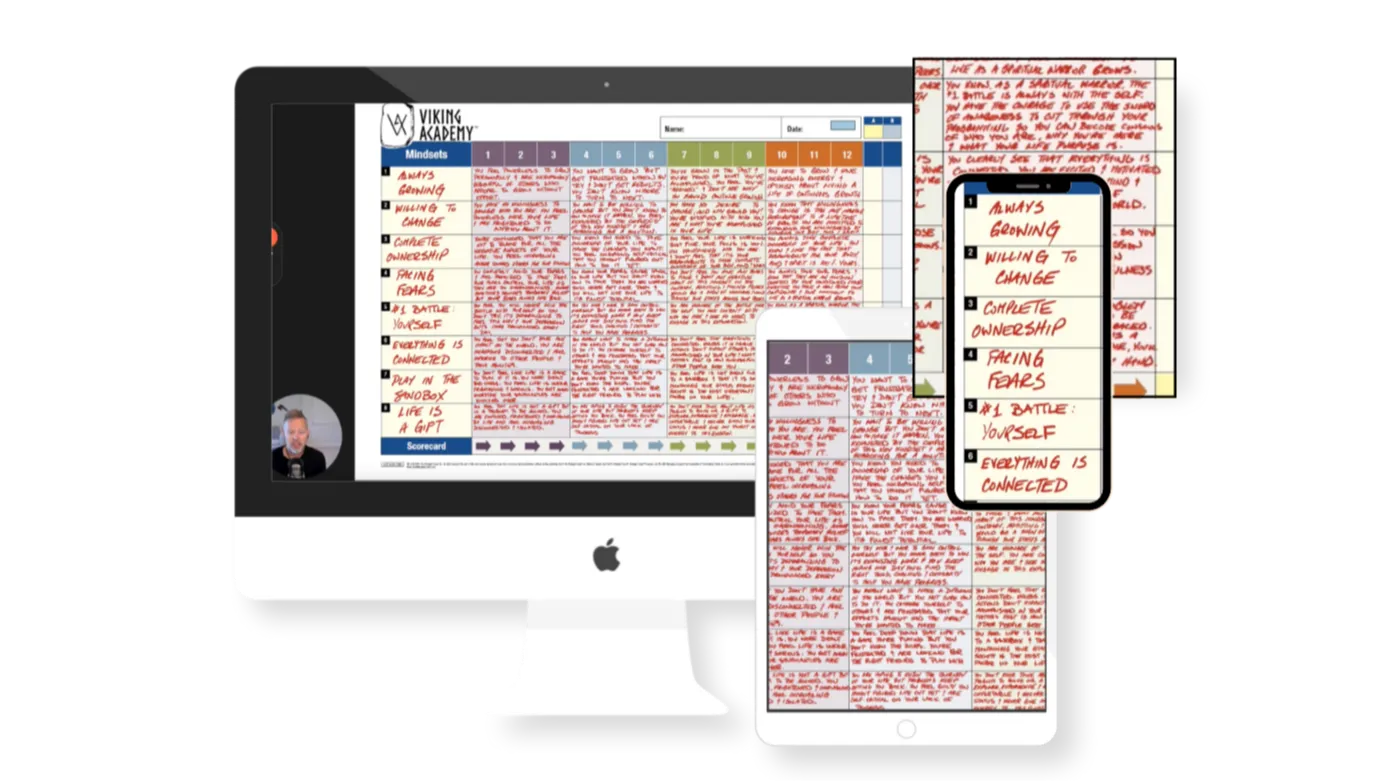
Erik Solbakken: Yes. Yes. Yeah, because if I'm thinking... I- if my energy is and my focus is on joyful, exciting, life is a gift, right? Yeah. For me, I'm, I'm... I, I'm working on a book as well, a Viking mindset book, and it's got eight mindsets. I'm using the scorecard, Dan's scorecard from, um, that, that we do at Strategic Coach. Yes.
So I got a mindset scorecard for the Viking mindset- Yes ... I call it, and it's actually on my website as a lead magnet so people can actually walk through this. The last one is life is a gift. I- Mm ... I know life isn't a problem to be solved. It isn't a problem to be solved. It's a gift to be explored, discovered, and enjoyed every day.
That mindset of thinking that way, that's where my energy's going. That's what I get back out of it. So everything I experience, the highs, the lows, the, the happiness, the joy, the pain, the sorrow, is all a gift, and I get to experience all of it, right?
Dr. Greg Eckel: Yeah. It's, it's happening for you, not to you.
Erik Solbakken: Yeah. Yeah.
Like, all of the pieces. Yeah. Like-
Dr. Greg Eckel: Yeah ...
Erik Solbakken: um, like I look back... So, uh, a- and, and I don't think you and I had talked about this. I didn't know this, but I didn't realize your wife, your first wife died.
Dr. Greg Eckel: Yeah.
Erik Solbakken: Um, and, and was that what got you into this medicine? Tell me a little bit more about that.
Dr. Greg Eckel: Yeah. Yeah, so eight years ago, um, my wife Sariah passed of Creutzfeldt-Jakob disease.
It's a rare neurodegenerative condition. Um, it's mad cow syndrome in people. Okay. Um, you know, every species has it. It's, um, scrapie in sheep, and, um, Kuru in, uh, the tribe off of Papua New Guinea. Um, you know, wasting disease in deer. Like, so it... What, what are... What is that? Um, it's misfolded protein. So how I picked Parkinson's as a, a condition to pick on is it's got alpha-synuclein, which is a misfolded protein.
But that process, you know, up to that point, um- It, yeah, was a, a rocket ride that I don't wish on anyone, uh, through navigating loss and grief and decline. I mean, it's tragic for somebody in the health field to, uh, think that we're doing anything. It, I mean, it- Mm ... basically it broke me in beautiful ways. Um, reinstated my faith in unity consciousness of, like, we must have written this story before we got here, 'cause I didn't know love could exist on the planet like that with, uh, the amount of free communication.
So I have found this area of my heart I didn't even know existed, and I'm forever grateful for that, to know, like, love can exist in this 3D manifestation like that. And I share that, you know, openly and, uh, wholeheartedly, uh, pun intended. Um- And I went looking for a solution for her, and, um, wasn't able to help her one iota.
I mean, we surrounded her with love, and she, she passed with grace. Uh, but it was 18 months. Like, she... It was rapidly progressing dementia. She lost the ability to speak and feed herself. I had to bring in hospice care, and I- with the kids and the practice and all... Juggling life on top of it, um, it, uh... Yeah, it warps you.
It warped me in a beautiful way. Um, you know, for a while, I was a grief magnet just because I was so, um, available to have the emotions. Like, I can even, uh, you know, feel it now. I mean, it's pr- profound loss that- Mm-hmm ... um, that one goes through, and it... But without that loss, I wouldn't, we wouldn't have this massive mission.
Um, I was playing it small up to that point, and, you know, I'm just looking to accelerate the change, speak into it. I have patients every week, they- they're shaking my hand, "Thank you for, um, taking a- a- a stand for us." Like, it's humbling, Eric. I mean, it just like, whew, there is more than enough suffering out there, and to have the mission from loss...
Like, I could have easily turned to drugs or dropped out of care or, you know, been a miserable failure. Like, I wasn't able to save my wife's life. Like, how effing tragic is that, like- Yeah ... as a, as a healer, as a physician? Um, but I, I, I don't know. Something in me just took it to as a catalyst for change. I, I knew I didn't want people to go it alone.
Um, even as a medical provider navigating the system, this was eight years ago, it's even more fractured and broken, um, I didn't want people going it alone because I couldn't, even knowing everything that I did up to that point, navigate it. Mm-hmm. It's just so fractured and not... It's not the people in the system, it's the system So it's-- it really, um, it really woke me up, and it really...
That's when we, we kind of planted the flag for brain regeneration and created the Echo protocol out, out of that, um, you know, kind of codifying what we're doing and how we think about a process of helping people get their lives back or becoming the heroes of their own journey. And I can speak now with such more certainty, um, and clarity of we don't close the door on anyone.
I've seen significantly severely disabled people get their lives back from, uh... You know, woman, Cindy, comes to mind. She wasn't able to get dressed anymore 'cause her tremor was so significant, and she stopped walking because she was falling even with a walker. Um, and she called me a, a year after our program from the park saying, "Hey, Dr.
Echo, guess what?" And I don't like getting calls like that 'cause you never know which way it's going. And, um, but she said, "My husband just told me to slow down walking in the park." I was like, "Wow, Cindy, that's amazing. When is the last time you've said he-- you ever heard anything like that from him?" And she's like, "It's been over a decade."
So I have just learned, like, it's not over till it's over. Life is so precious, and no one should be given up on. Um, had a 65-year-old retired pharmacist with stage two Alzheimer's, lost the ability to do one plus one math, didn't know who the president was or where he was really in the world And went through our brain regeneration camp.
Um, he immediately got his multiplication factors back, like within 30 minutes of a procedure. That's not supposed to happen like that. Um, one month later, his wife came in and said, "Well, he got his... Chuck got his sense of smell back." Like, what are you talking about? "Well, during COVID, the dogs died. It was in the Pacific Northwest.
The car smelled." She's like, "Well, he hasn't been able to smell for 15 years, and I don't mind it. He gets in and says, 'Oh, it smells like dirty dog in here.'" And, you know, she came back in tears, like, "We got him back with the grandkids around the dinner table. His wry sense of humor." Still didn't allow him to balance a checkbook, but, but got him back from a point where he was just kind of a vegetable.
Uh, so we're seeing this happen in our center. Um, we have imaging, so, you know, really it's really put the emphasis on us to, to quote unquote "prove it." Like, the people's lives is good enough for me, but I also... I'm not needing to prove it to the system, I'm wanting to prove it to people so that they can see more evidence and get more momentum and more hope for themselves that, "Hey, maybe that change could happen for me, too."
Erik Solbakken: W- what is the EKCO protocol? Like, let's, for the listeners- Yeah ... just to understand what's going on here, it's like th- so... And, and just to come back to your wife passing- Yeah ... and the pain and the suffering, and I can feel it for you. Like, I just I feel it, but I understand it was for you.
Dr. Greg Eckel: Yeah.
Erik Solbakken: Like, it's...
This whole life- It's a hard sell, right? It's, it's the hardest sell in the world. Yeah. Like, losing and hav- going through pain and suffering, and I've gone through my own levels of pain and suffering, and complete moral degradation. Sp- my alcoholism was probably the lowest point of my entire- Mm-hmm ... being, of who I was.
I c- it crushed who I was as a person. And l- l- losing loved ones, it's just that... But once you s- that you can see that from that, it's nature. It's what gets decayed creates the-
Dr. Greg Eckel: Mm-hmm ...
Erik Solbakken: nutrients- It regrows ... for new life. We see it- Yeah ... happening in nature. I've been going deep into Ralph Waldo Emerson's readings-
Dr. Greg Eckel: Yeah
Erik Solbakken: lately. I... Dude, I've never read his books before. Yeah. Anything. But I've always heard that people have been inspired by him. Yeah. I started reading about it, and he's talking about nature, and it's exactly what we're talking about here.
Dr. Greg Eckel: Yeah.
Erik Solbakken: If we just look at nature, if we just focus on nature, it will show us how to be.
Dr. Greg Eckel: Yeah.
Erik Solbakken: Right? Yeah. The tree falls in the forest, and then it decays, and it creates the energy for the next tree. Like, it's-
Dr. Greg Eckel: Yeah ...
Erik Solbakken: this is what we're talking about here with y- like, the analogy of your life, and it crashes down, and it goes, decays. Mm-hmm. Y- you then used it as energy to create new life- Yeah ... and for others, right?
Like, it's beautiful. Right. Yeah. Absolutely things... Absolutely beautiful.
Dr. Greg Eckel: Yeah. Yeah, that, that component is a tough sell to say, "Hey, this is... That happened for me." It's like-
Erik Solbakken: Yeah ...
Dr. Greg Eckel: ugh, fricking tragic, and I wouldn't wish it on anyone, but it's been my path. And so you get to choose how you react, like you're saying, like in light of whatever's swirling around you, if you've got that connection to God and centered self, uh, really you can move mountains.
And, and that's what we're, what we're seeing. Like, we're on this hockey stick curve of really just inviting people to be the heroes of their own journey because they're worth it. And but giving enough evidence and support and transparency of outcomes to show, like, it's isn't faith-based. Like, you gotta have some faith in yourself that you've got the energy, trust in yourself, and if you don't have those, then you know you have limiting beliefs, and we can uncover those.
But it's not just all in your head. There's a thing happening in your body. Can I claim everybody's gonna be cured and we're gonna have no more disease on the planet? No, I cannot. Like, the, there's a component, like I wouldn't wanna take that away from anyone. That's their responsibility. Their... You have a responsibility to make different choices to get different results, and there's multiple levels to that statement.
And so that's just the, the approach that I'm taking is because of my life experiences, like look, li- life is precious. We don't know how long we're on the planet. Um, I want this vessel to serve in such a great way of, you know, really being a guiding light, being guided for solutions and inspiration and energy, um, and more love on the planet.
I mean, I think that's really our Our beingness is wanting to be heard, seen, loved, felt that experience of it, and feeling it. So that's what we're doing in our medical practice here in Park City, Utah. So three phases of the Echo Protocol, detect, correct, and thrive. So nice triangle. Most people miss the detect phase.
They're not... They wanna know, "What can I take? Should I do stem cells, or peptides, or supplements, or-
Erik Solbakken: Yeah ...
Dr. Greg Eckel: you know, what i- what's the thing? Like, if you had the top three supplements, Doc, what should everybody take?" That's missing... It's entirely heading out into the wilderness in the wrong direction and not knowing where you're going.
It's like, no, you're just throwing spaghetti at the wall. Like, all of... Like, psychedelics, flavor of the month. Like, all of these things have a place at the table, but it may not be the right next step for you now. And so there's an order that we're finding in what we're putting together in the protocol. So we start with detection, and we start, there's three big buckets that I mentioned.
There's environmental toxicity, there's trauma, and then there's infections. Well, environmental, uh- Environmental medicine is depressing. Like, we're swimming in a soup. We're exposed to so many chemicals that we have no idea what they do to us. All of us in North America basically have glyphosate in our system, which has been shown to disrupt your microbiome, your gut, which then leads to all kinds of repercussions downstream.
And so, no, I'm, you know, maybe bold enough to say maybe Parkinson's and these neurodegenerative conditions don't, are not neurological. Maybe that's the end stage of a disease process- Hmm ... because I'm picking up a signal 10, 20, 30 years in a functional array of looking at, uh, heavy metals, mercury, cadmium, arsenic, and lead are the top four that we're seeing, but it could be others.
Uh, looking at mineral deficiencies, looking at hormone balance. You have a diurnal variation of cortisol. Stress, your adrenal gland links to your thyroid, links to testosterone, progesterone, estrogen for men and women. That endocrine triangle definitely needs addressed. Most people's conditions get worse with stress.
Creates inflammation in the body. Um, could be good stress or bad stress, but that needs to get addressed for everybody. Levels of trauma, and people don't even... Like, 50, 60, 70 up, we were just in the generation of, like, buck up, buttercup, get through it. It's called life.
Erik Solbakken: Yep.
Dr. Greg Eckel: That's not a good way of going through, because the cells retain this, um, energy of trauma.
And so even if it's unconscious patterning, you're reacting to the world as if trauma is occurring today. And so it's like even though it's happened, like we see 72-year-olds in our procedure room that in the week of brain camp, and they've never told a soul that they had, you know, were abused as children.
Like, 70 years of carrying that internally. The cells are listening to that. And so we've put in some techniques to really help people clear or put instead of Technicolor trauma, it goes into black and white. Like, can't get rid of the memory, but we can get rid of the effect or the program it's running in the system, and then to free them up out of their limbic and amygdala, that more of that reptilian response brain, and really get them into full access of parasympathetic.
Um- And then testing with blood, we do microbiome. Um, so we're looking at a functional array, integrative component, and then also understanding a reference range is not normal. So, um, a lot of people say, "Well, the doc said my blood work was normal." It's like, well, there's no such thing as normal blood work.
It's two standard deviations around an average. Mm-hmm. And when you look at the reference ranges, I've been in practice now a quarter of a century, which is wild to say, um Like testosterone levels used to be top 1,200, now it's 900. Does that make that normal? No. It means men in North America are becoming estrogenated from environmental toxicity.
Their testosterone levels are dropping. Cholesterol used to be 220 when I started practice, now it's 200. It hasn't changed cardiovascular disease outcomes one iota, but it added about 50 million prescriptions of statin medications a year. So, you know, you look at what is a reference range knowing there's ideal numbers for optimization and thrive.
Um, so that's the detect phase. Then we individualize it depending on what comes back from that. We plug the holes at the bottom of the bucket. Maybe there's mold testing or Lyme testing or some other functional array, depending on what the person in front of us is talking about or what their chief complaints are.
Erik Solbakken: Yeah, so- Then, yeah ... here, just a question for you. So you're detecting it. So someone comes in, let's, let's say it's me. So I come in to see you- Yeah ... and, um, I go, like I'm... Here's, these are actual things that I'm experiencing right now- Mm-hmm ... 'cause I wanted to talk to you about this. Yeah. 'Cause I ended up having a conversation with another doctor about stem cell, uh, therapy as well for different parts of what's going on.
So I'm very curious on your thoughts- Yeah ... on this. I haven't gone and done anything yet 'cause I, you and I had talked, I said, "Well, maybe I'm gonna get on a plane and go down to Utah- Yeah ... and see you, man."
Dr. Greg Eckel: Sure.
Erik Solbakken: Right? Because I'm starting to notice some brain fog happening.
Dr. Greg Eckel: Mm-hmm.
Erik Solbakken: Names of people is the thing that's really, I'm really noticing, like recall, like memory recall.
And like I'm a performer, I'm on stage and the rest of that, and I'm coaching, and all of a sudden I'm like, "I cannot remember that person's name." Yeah. And it's starting to fade. And I remember my mother being this way. Mm. Like her getting older and she's starting to fade on that, and I'm like going, "Okay, I wanna be proactive on this," and I'm saying, "What is going on in my brain that's causing this, this memory recall?"
Dr. Greg Eckel: Yeah.
Erik Solbakken: And I'm also noticing that I'm pausing a bit more. Now, that could be from wisdom and getting older and just being, you know, just pause a bit. Mm-hmm. But I'm also finding that I'm not firing as quick as I used to. As
Dr. Greg Eckel: sharp. Yeah.
Erik Solbakken: You know what I mean? That sharpness. Yeah. And I'm so hyper-aware of my, my being that I can feel, I know it, right?
Dr. Greg Eckel: Yeah. So conventional land would say, "Oh, get used to that. You're getting old." Oh, yeah, exactly.
Erik Solbakken: Right? Suck it
Dr. Greg Eckel: up, buttercup. And that, that is a bunch of hogwash, and it's not true, because I have 91-year-olds that are sharper than they were at 81. So I know what we're fully capable of. Um, you look at like Henry Kissinger, love him or hate him, he was functional through 99 years old, like sharp as a tack.
So there, the ability of the human being to be sharp, so that, those are signs of neural inflammation that need to be listened to. Mm-hmm. Oftentimes they're blown off, like, "Oh, it's old age," or, "Maybe it's just stress." I mean, and stress does play a role. You only have nine attentional units, and so you have to look at your bandwidth and all of that.
But it also is, well, there are neuroinflammatory markers in your blood work, uh, homocysteine, CRP, um, we look at iron load, oxidative stress, we look at your immune system function. So there are multiple paths to- on the brain fog, word recall. Um, if you've had any history of concussions, we can pick that up on EEG.
We do a, a 18-lead, uh, 21-point EEG actually, um, looking at all of the different regions of your brain. I was just on, um, with a musician, uh, in his 40s. He's like, "Hey, I'm, I'm feeling 40s, and I don't wanna be that type of parent." And, um, you know, his creativity is starting to lag, and that's, you know, his family is-- depends on him being creative, and he's noticing like, "I'm not-- I get-- I hit a limit where in the past I could just have free flow state."
So there-- those are just signs to say there's neuroinflammation. We need to figure out what's causing that. Um, could be low plasmalogens. There's a lot of dietary deficiencies that we see with omega-3 fatty acids, but you can measure that in blood work. So if it can get measured, let's measure it, let's not guess.
Um, so i- that's super common post COVID, uh, post viral syndrome. There's a lot of neuroinflammation from spike proteins, um, even from the vaccines, the messenger RNA. Sometimes those don't turn off in certain genetic platforms. So, you know, there's multiple factors there to look at, not just like, "My blood work's fine.
Doc says come back- Yeah ... later when I decline." Yeah. Yeah, so that on the brain fog front, and that's such a biggie, right? A, a lot, um... I'm in my mid-50s, um, looking at, um, our parents, our grandparents, seeing them with, uh, some cognitive decline, dementia, Alzheimer's. You know, the stats are by 2030, in basically three years, um, over half of 65-year-olds will have some form of mild cognitive impairment.
Um, which is a huge number, right? 'Cause there's this silver tsunami coming. That, and that's why that Your Brain Younger, uh, book, uh, was birthed out of that. Because, you know, I'm pretty niched in Parkinson's, but I don't treat Parkinson's, I treat people, and it's the same process with those three big buckets of uncovering underlying root imbalances.
And then we get into the, the, the correct phase, which is if you qualify. You can't have uncontrolled diabetes, you can't be a smoker. Um, you, heavy metals need to be cleared from the system,
Erik Solbakken: so we look- And, and just to be clear, not heavy metal music, of course.
Dr. Greg Eckel: No, no. I'm not- We're fans of heavy metal music, right.
You gotta get the lead out, right. No, the, uh, the components of it is... No, the actual elements, not the music. Yes. Right. That's right. Um, so, uh, those, you know, there's some qualifications. You know, you've gotta be open to it, you know, that you're in the driver's seat. You know, people, I tell them, like, "Don't expect, uh, coming out here and we're waving a magic wand, and then poof, you did these stem cells and all is done."
So many people, just to comment about the stem cells and other providers, it's like the Wild West right now. Yeah. And I find people are not doing that detection phase. So imagine you have inflammation somewhere in your body, and then you just do stem cells. Well, they're gonna go to that inflammation, but what if you prepared the terrain, addressed underlying root imbalances with detection, cleared up the terrain, and then put in regenerative stem cell therapeutics?
Well, now your body's really able to receive and utilize those to the highest, greatest good. Like, so that it's not... I, I... Oftentimes you'll, he- people say, "Oh, it's about 50% effective for knee cartilage- Yeah ... shoulders, hips." But it, it should be more like 65% to 85% with just a regenerative stem cell. Now, we don't just do that because I just find we're way more dynamic than just needing stem cells.
But they, that is one of the largest levers that we use here. Okay. We use a laser-activated and guided, uh, VSEL procedure. It's very small embryonic-like stem cells. So these are small enough that they go through the lung, uh, tissue, they go through the blood brain barrier We are also doing some research on MUSE cells.
They're kind of the new darlings in regenerative medicine. And then also, um, adipose-derived stem cells, mesenchymal stem cells, that I really opened my mind up, uh, because of the research showing their effectiveness. I used to think, "Ah, I don't wanna use the fat stem cells from the person because they've got toxicity and they're older."
Well, those, uh, mesenchymal stem cells actually have a higher turnover rate, and if you get, do that preliminary detection phase, you can really detox someone where they're not having those toxins stored in the fat so that you're getting a, a really high-quality product from their body, which is really brilliant.
Like, it's just baked into our own innate healing capabilities. So I, I think, you know, we, we are, um, a little bit agnostic as far as product. I think a lot of them work. Um, we're in a right to try state here in Utah, which is kind of nice. Um- What do
Erik Solbakken: you mean by that?
Dr. Greg Eckel: So in Canada, you can't do, uh, regenerative stem cell therapeutics- No,
Erik Solbakken: I know that-
to my knowledge ... because I've been having conversations with- Yeah ... doctors all over the world about this.
Dr. Greg Eckel: Yeah.
Erik Solbakken: Yeah.
Dr. Greg Eckel: Um, and it's really wild. It's really put, uh, the northern hemisphere there behind. Like, in South America, Central America, they, they've been doing the research and showing it's very solid research.
So, uh, Florida, Utah, Tennessee, Montana right now in the US is a right to try. Now, there, there's still a gray area on these therapeutics. You don't have to go to Panama, you don't have to go to Mexico, and in fact, I would say you would wanna know your source, um, if you go out of the country. Um, but the, the federal government in the US still supersedes the state, so it's that state law versus national law debate.
I, I don't want to be involved in that at all. So we have, uh, for conditions that there's no known cure, um, we're able to do a, a right to try directly with the individual. Um, and then for optimization, um, thrive, we d- we do talk to people about what their options are there, too.
Erik Solbakken: So with the protocol, you're identifying, then you're...
the treatment and the thrive. So if someone like myself, I got brain fog and I'm, like, starting to feel like s- things are going sideways, I couldn't come down to Utah and you could do the stem cells on me because it's not... it's just a... it's not a-
Dr. Greg Eckel: No, we could. We could. We could? We definitely could. Yeah.
Erik Solbakken: Okay.
Dr. Greg Eckel: We, we need to do that proper workup first just for- Yeah ... excellent medical care. Um, and I would really, um, say for the brain fog specifically and maybe if y- um, mom had some dementia or Alzheimer's things or maybe just memory recall stuff as she aged, you would wanna look at plasmalogens as well, which I did not learn about in medical school, but they're 25% of the cell wall of every cell of your body, so like a beneficial oil.
Um, so you can measure that in your blood.
Erik Solbakken: Wild. Yeah. No, my dad, my dad has Parkinson's-
Dr. Greg Eckel: Mm ...
Erik Solbakken: so he's got that. My mom doesn't... I don't... she has any medic- m- mental, um- Got it ... things. I think she's got can- she's got cancer, though. So, um, but these... The, it's interesting 'cause I've been looking at these different paths of going towards, but I keep coming back to the central theme that you and I just talked about-
Dr. Greg Eckel: Mm-hmm
Erik Solbakken: is the coming from a place of heart-centered awareness around the joy of life, just to be able to be here and e- e- experience it and play in it. I had-
Dr. Greg Eckel: Mm-hmm ...
Erik Solbakken: I had, um, uh, a guest on, Michael Monk was his name, and he, he turned it upside down. He, the vision that he's had, and he's very metaphysical and- Like create, like connected to the creator and, and, and does out of body experiences and all that stuff.
He turned it upside down on me and he goes, he goes, "Everybody keeps thinking that heaven's up there."
Dr. Greg Eckel: Right.
Erik Solbakken: He goes, "Heaven's actually right here. This dimension we're in is actually the gra- greatest creation the Creator's ever h- done, is this three-dimensional space." And-
Dr. Greg Eckel: Yeah ...
Erik Solbakken: and he goes, "All the spirits always wanna come back here and experience life here."
Like, so if you reframe it like that and go, we're actually here by choice- Mm-hmm ... because we are here to experience the greatest love possible being this three-dimensional space, being we start to feel love at a higher level that you had, like you had for your wife. And having that loss, the loss hurts so much because you loved her so much, because- Right
we are in the three-dimensional space.
Dr. Greg Eckel: Yeah.
Erik Solbakken: And, and that has just reframed my whole thinking around life in general. Like, it's just- Yeah ... like it becomes like this is like the ultimate playground to explore and do all the things like you talked about, going to Kilimanjaro, going to Greenland, going to Burning Man, to exploring your profession and creating this echo protocol to help- Yeah
people with brain dysfunctions and regenerative health. Like, it's, it's just like a big playground.
Dr. Greg Eckel: Yeah.
Erik Solbakken: That's where I'm getting more and more into my kind of excitement around life. It's like this is all- And it's weird because when I've heard people say, "Oh, life's happening for you, not to you," if you're not in the right frame of mind, you wanna smack them.
Dr. Greg Eckel: Oh, my gosh, yeah. Right? Yeah.
Erik Solbakken: Like, you wanna smack people when you're in the middle of the muck. Yeah. But I'm more and more getting centered on this, going, this is, like, insane.
Dr. Greg Eckel: Yeah.
Erik Solbakken: Life is insane. It's incredible. It's... What a ride.
Dr. Greg Eckel: Yeah.
Erik Solbakken: Like, and look what, look at what you're doing, the work that you're doing- Yeah
and what you're getting to experience.
Dr. Greg Eckel: Yeah. Yeah, it's really, um, I mean, the, the conversations that we're having now with, like, uh, we're up for a massive grant with Michael J. Fox Foundation. It'll be the first time they've studied full systems approach to health- Yeah ... rather than a drug or surgical response.
Now, we haven't gotten it yet, but we've been talking to them for about 18 months. We keep reformulating and getting our data set proper. Um, you know, that, I w- I wasn't even available to that 10 years ago of, like, oh, I'm just out of the system. I'm like, no, we could actually affect change on a greater level with, you know, some resources to help get this thing set up properly.
Yeah.
Erik Solbakken: Yeah.
Dr. Greg Eckel: So it is, i- it's exciting. It's an exciting time to be alive, and I think with that awareness and that awakening and understanding of I've gotta run the energy on my body. I mean, I've, I've a, a clinical adjunct professor of naturopathic medicine from the naturopathic school in Portland, and I've, uh, my eighth and ninth residency right now, soon to bring in the 10th resident that I've had over 25 years.
And w- how do I train them now? It's so different now than 20 years ago in that I trust them to be loving beings and curious and ask questions, but I'm teaching deep presence. Like- To be able to spend time and truly, truly listen to another human being, it's sometimes it's the first time the person's ever been listened to or seen.
Mm. Um, you know, because their, their troubling symptoms, a tremor, and sometimes it's chorea from overmedication, or their, their voice is weak, or they are, they have a stutter. Um, there's pauses in between. The system doesn't have the time to be with that disease process or that person with the disease process.
Where here we have the luxury of like, no, we're gonna be present, and invariably we hear the person gives us the clues, the breadcrumbs back to core underlying imbalances that we need to address. And it's, it's such a privilege. Like I said, people are telling us things they've never told anyone on the planet before because we've created a container that they feel safe to, enough to do it, and we're actually soliciting that from them because it matters.
Like, it, it does matter in the body. So it doesn't mean you have to, you know, like Woody Allen, get on the couch and write it all out. It just is the acknowledgement that that happened and then some techniques and tools to help turn it off
Erik Solbakken: The... When you were explaining about being present and having the space, I, like, literally just got off another podcast where I was the guest on the podcast.
Completely different realm. It's the accounting world, right? Yeah. So the accountants... And, and, and so, 'cause I wrote a book called The Accountant's Success Formula, and I, I talk about it. I don't talk about it that much on the- on this podcast, 'cause it's, it's my other business.
Dr. Greg Eckel: Yeah.
Erik Solbakken: But he was talking to me about it, about the accounting world, and I said, "The accountants are overwhelmed."
And I just see this word as overwhelm. Life is overwhelming. Mm-hmm. And we're so busy running and running and running and running and running and running and going and going, there's no space.
Dr. Greg Eckel: Mm.
Erik Solbakken: There's no space to actually... You know, the, the, the old adage is like, stop being a human doing and start being a human being.
Yeah. Like, actually stop and create a space. It's this race we were talking about AI and using AI, and accountants are starting to... They're, they're panicking about AI, but at the same time they're getting despondent with it and they're kinda hitting- Mm-hmm ... this trough of disillusionment with it. But 'cause they're in a complete state of overwhelm already, then you throw AI on top of it, which they- Right
scare them and tell them it's gonna ruin their lives. So they're going- Displace
Dr. Greg Eckel: them,
Erik Solbakken: right ... to displace them, right? So now they're going faster and faster and faster, but I see more and more the future being the AI, the technology is fine. It makes h- being human that much more important.
Dr. Greg Eckel: Yeah.
Erik Solbakken: This, and being present with someone and connecting with them and slowing down.
Dr. Greg Eckel: Right.
Erik Solbakken: Which by the way, Greg, I'm not that great at, okay? Yeah. But I do meditate and pray every morning, and I have a whole ritual that I do every day, but I'm a very higher energetic guy, so I'm go, go, go, go. But I find that those spaces of presence and just sitting- Mm ... with someone and being there I am optimistic that this AI wave coming forward, if we can capture it properly, will allow us to have more of this space.
Dr. Greg Eckel: Right.
Erik Solbakken: So instead of creating a, a more complexity and more busyness and having things go faster and faster and feeling stressed and panicked to try and keep up with it, we can sit back and relax a little bit and go, "Let's have a convers-..." Like, what you're talking about, I can- Yeah ... feel what you're talking about.
You know what I mean? Yeah. Like, when you're talking- Yeah ... about having a conversation with a patient and being present, I can feel it in my heart.
Dr. Greg Eckel: Mm-hmm. Yeah.
Erik Solbakken: That's the, the energetic... And that trumps any amount of wild technology, rushing-
Dr. Greg Eckel: Oh ...
Erik Solbakken: striving culture. I
Dr. Greg Eckel: mean, we have, like, all of the information is out there, and yet we still have disease and, you know, degradation and a- all of the mental illness, all of that.
Like, we have the information at our fingertips. You know, one, one other kind of aside comment is, you know, these large language databases were trained on Reddit, Wikipedia, like, false information. Mm. And we're then amplifying those, expecting breakthroughs or some omnipresent s- sense or being-ness, and it's like, n- no, actually, that's not how it works.
Like, you want to trust your data set. Like, we have a small language database which I know exactly what's in it, and I'm programming it with Dr. Greg in it so that my clinicians get a report where it's kind of synthesized. They get to still practice the art of medicine, but it's really in what motivates the individual in front of us, how do we bring more heart and understanding to help get some wind in their sails, versus just da- here's all the data.
Mm-hmm. Like, the, the data for data's sake isn't so helpful unless you put the heart in there and then also understand, well, how do you support a human? Like, why aren't they doing the things they know they need to do? It's like, well, there's some limiting belief in there that's stopping them from taking action.
So they're just got- Yeah ... same thoughts, same results, same thoughts, same result, versus make a different choice, get a different result, and then that starts running the new program towards wellville. Um, so it is- I, I'm not afraid of any of it. I, I think it's all super fascinating. I think there are some...
That we are in shark-infested territory. Uh, and um, it's what makes it exhilarating, right? I mean, there's the, the Chinese curse of may you live in interesting times. Well, this is definitely interesting times. Like, the timelines are speeding up, and so it might be time to let go of your past and really start focusing on what you want in the future to bring that future- Mm
to you. Uh, and so tha- that's what we train. We, we teach our patients. We have a whole coaching, online coaching program. So as part of that correct and thrive phases, the s- second step, third step. Second step is coming out for a brain camp or a three-day thrive procedure. We do hyperbarics, red lights, sound wave therapies.
We drop people into theta waves, which is deep relaxed states. Um, we do, um, the laser-activated guided regenerative stem cell therapeutics. We have bioenergetic acupuncture, craniosacral therapy, body work. Like, all of the layers, and then we do follow-ups at one, three, five, seven months, and then plug folks into a coaching community because we're asking them to change their lives.
You need a lot of support to do that.
Erik Solbakken: Yeah.
Dr. Greg Eckel: Mindset, nutrition, movement, qigong, balance board, physical therapy. Like, all, all of that support needs to be there because it, it, they didn't just wind up in a dysfunctional state overnight. It was a slow boil over decades. Yeah.
Erik Solbakken: Yeah. And so with, with your, um, with the process that you go through, is this like you're seeing people on a regular basis and...
Or, or like, for example, for myself, would you see someone like me flying in from the West Coast and coming in to see you and doing like a three-day-
Dr. Greg Eckel: Yeah ...
Erik Solbakken: like, visit?
Dr. Greg Eckel: Yeah, three days, and then we do follow-up visits- Yeah ... so we keep you aligned, and check-ins- Yeah ... and uh, recalibrations as necessary. Yeah.
Erik Solbakken: Okay.
Well, you and I are gonna have a conversation about that offline, and we're gonna see- Awesome ... where... 'Cause, um, I'm very much in alignment with your being, with your presence, with the fact that you're, you're using the sci- you're using the technology, but you're very grounded and centered in being.
Dr. Greg Eckel: Yeah.
Erik Solbakken: To me, that is like, that is the ultimate That's the ultimate for me.
That's... I can feel that.
Dr. Greg Eckel: Yeah.
Erik Solbakken: And so I'm- Yeah ... I'm very much in alignment with that, and I'm, uh, I can tell why, um, we met each other at Strategic Coach and- Hit it off,
Dr. Greg Eckel: yeah ...
Erik Solbakken: yeah, and why I, I'm so glad that you said yes to being on the podcast, 'cause- Yeah ... and we covered a lot of territory here.
Dr. Greg Eckel: Yeah.
Erik Solbakken: That was, that was a lot.
Um, I hope that... So if the, the listener wants to find out more about you and connect with you, where would they go?
Dr. Greg Eckel: They can go to bevital.com is our website. Um, my personal Instagram is @drgreckel, D-R-G-R-E-C-K-E-L. And then we also have @brainregen, uh, more around the brain regenerative stuff. Yeah.
Erik Solbakken: Right on. And we'll have all the contacts in the notes and, and, uh- Awesome
or the episode notes. And dude, um, thank you so much for being on the podcast. Um, y- I, I, I have a renewed, uh, I have a renewed, um, optimism about the future with you- Awesome ... being part of the leading edge of spirituality and, and, and medicine. It's, it's very refreshing. I love it.
Dr. Greg Eckel: Ah. Well, thank you. I lo- That's, that's the whole mission right there.
Thank you.
Erik Solbakken: Well, you, you're nai- Thanks for
Dr. Greg Eckel: having us on ...
Erik Solbakken: you're nailing it, man.
Dr. Greg Eckel: Yeah.
Erik Solbakken: Thanks.
Dr. Greg Eckel: All right. Well, peace.
Erik Solbakken: Thanks for listening to the Viking Academy Podcast. Make sure to leave us your honest feedback by leaving a review on Apple or Spotify and hit.