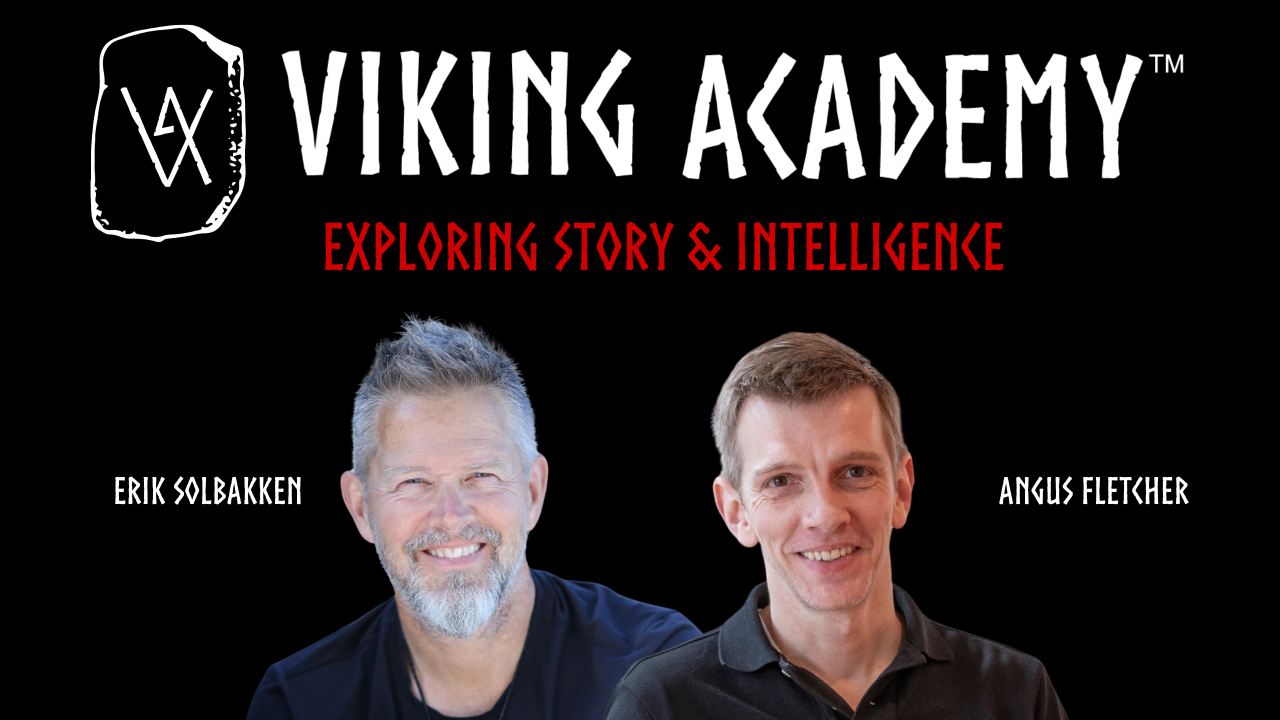
#54: Exploring Story & Intelligence with Angus Fletcher
What if intelligence is about more than logic, data, and knowing the right answer?
In this episode, we sit down with Angus Fletcher, author of Primal Intelligence, to explore how humans think through story and why intuition, imagination, emotion, and common sense may be just as important as logic. Angus shares how his research led him to rethink what intelligence actually means and why our brains are built to imagine possibilities rather than simply predict what has happened before.
The conversation moves into purpose, leadership, identity, and the stories we tell ourselves about our lives. Angus explains why purpose gives us direction, how leadership begins with taking the first step into the unknown, and how technology can distract us from the bigger story we're trying to create.
We also explore what it means to reconnect with the parts of ourselves that modern life can teach us to suppress, and why embracing our own story may be essential to finding purpose and creating a future that is uniquely ours.
Topics We Explore:
- Why intelligence is more than logic and data
- The four parts of Primal Intelligence: intuition, imagination, emotion, and common sense
- Why humans naturally think in stories
- The difference between meaning and purpose
- How story shapes leadership and the future we imagine
- How technology can distract us from purpose and identity
- Why the story we tell ourselves about ourselves may be one of the most important stories we ever create
Connect with Angus Fletcher: https://www.angusfletcher.co/
Learn More about The Viking Academy: https://www.vikingacademy.com
Episode Transcript:
Erik Solbakken: Hi, everyone. Welcome back to the Viking Academy podcast. This week we have Angus Fletcher on the podcast. Angus wrote the book Primal Intelligence. He is a professor of story science at Ohio State University's Project Narrative. He's worked with special operations down in the United States., people Malcolm Gladwell has called his book mind-blowing, and I gotta tell you, it is a mind-blowing book. It's an incredible honor to have him on the podcast. Him and- He and I... Him and I. He and I had a great conversation around the book, and the preface behind it is that we've identified intelligence the wrong way. That's his theory in the book, and that the way humans should be looking at intelligence is through these four different lenses of intuition, imagination, emotion, and common sense. The book, if you can see it here if, if you're watching the video, is earmarked. It's highlighted. I have, I've studied this book so much. I was looking forward to this conversation with Angus you wouldn't believe, and I ended up coming up with a new philosophy for the Viking Academy and a new ethos as a result of our conversation. I truly believe that the greatest gift that we've all received is being ourselves, and finding ourselves is finding our story, and Angus is an absolute brilliant, brilliant researcher and thinker when it comes to this. And, and him and I have a great conversation., we've got some Viking heritage that we share and the, some fun stories. There's some laughs. But overall, an incredible, incredible podcast. I'm gonna shut up now so you can go and listen to it and enjoy it. So without further ado, let's go explore.
Erik Solbakken: Angus, welcome to the podcast.
Angus Fletcher: I'm totally thrilled to be here.
Erik Solbakken: Dude, I'm, I'm so glad that you reached out about the changing the time for the World Cup because I was very nervous that Norway was gonna be in the World Cup, and then I was gonna be a little bit screwed because I was gonna go, "How do I email Angus and say, 'I don't wanna do the World Cup,' or 'I don't wanna do the recording right away?'" And then you reached out to us and said, "Hey, can we move it for the World Cup?" I'm, "Yes."
Angus Fletcher: That's right, yeah. So for my sins, I'm an England fan, even though my family's Scottish. Yeah. And so there's clearly a lot of self-hate in me rooting for England. And I was kinda pulling a lot for Norway, 'cause as you and I have discussed,, my,, my father once,, took me to the English coast and pointed out across the North Sea to Norway and said,, "That is where your ultimate grandfather came from., he sailed forth from those shores." came forth to England and assaulted your,, your,, your, your, your, your, your mothers. And,, so I,, I to joke that I'm,,, English on the outside, but obviously Viking to the core.
Erik Solbakken: Well, you see, that's why I knew that we resonated so well with each other, 'cause I, I don't know if I shared this with you, but my father-in-law is Scottish. Yeah. He's from Glasgow.
Angus Fletcher: Oh.
Erik Solbakken: He's a s- he's a Rangers fan, just putting it out there, okay?
Angus Fletcher: That's fine. I'm a Rangers fan,
Erik Solbakken: too. Yeah. There we go.
Angus Fletcher: Different- Any, any Celtic fans out there, don't send me hate mail. I'm
Erik Solbakken: sorry. Yeah, exactly. I apologize. Exactly. And I, I have a Celtic,, jersey, 'cause we went to Scotland. We went to Glasgow to go see a game, and the only game we could go see was Celtic. Well, my father-in-law was devastated. He goes, "Well, we can't do that." I'm, "Of course we can." And so I bought a jersey just to piss him off., but I always give him a hard time. Whenever he gives me a, a grief, I just look at him and I go, "Just remember where your blue eyes come from, Colin." And he goes, "You're such a prick. You're such a prick."
Angus Fletcher: That's right. Yeah, well,, I think a lot of our accent as well comes from the north,?, a lot of this is essentially, Gaelic is essentially coming to us from the, from over the seas as well, yeah
Erik Solbakken: That's... I love, I love that when... So where we met was at the,, strategic coach,, the CoachCon, and you were a guest speaker. And Dan got up and asked you that question about your, your accent, and I was, "Yes!" And then you just laid it o-, here's the full, here's the true accent right here. That's right. But you had trained yourself out of that accent.
Angus Fletcher: That's right, yeah, yeah. So, I,, I, I didn't used to speak this when I was, when I was a child. This is my imitation of my grandfather. But I did have an English accent when I was a child. I talked more this. Yeah. And,, and then up until about, I think, I guess I was 17, and,, I talked with this English accent my entire childhood growing up, even though I'd lived most of the time in the United States. And I eventually got to the point where I was, "Why am I talking an English person,"? And it was because,,, truth, I had been,, bullied a little bit when I was four, five, six years old, that a thing., just normal bullying, not anything particularly intense. And I'd been bullied a little bit for being English, and so,, just I had a little bit of national pride in me and I was, " what? I'm gonna stick hard to my Englishness." And so I had this English accent, which I carried around with me for years, then I finally was, "This is so weird." And so I lost it right before I went to college, which was, of course, a bad move, because if I had an English college... if I'd had an English accent in college, I would've been much su- more successful on the dating scene., and then I, of course, freaked out all my friends,, when I came home,,, for the summer. And they were, "What happened to you in college? Did you just learn to speak American? Is that the one thing you picked up in college?, what's wrong with you, man?" But yeah. So I now have a fake American accent after previously having a fake English accent, and,, it's the story of my
Erik Solbakken: life. So what's the true accent? What's the true accent then?
Angus Fletcher: I think, honestly, I was probably born just to be silent. what?
Erik Solbakken: Ah.
Angus Fletcher: I'm a very head spacey guy. So when I talk to myself in my own brain, I don't have any accent at all.
Erik Solbakken: Well, that's where, this is, this is where this all comes down to. So,, I, I got a copy of your book. I'm pretty sure Dan recommended it to us,, Dan Sullivan,, in, in Strategic Coach. He recommended your book, Primal Intelligence. And I, of course, when I heard that you were gonna be speaking there, I was, "I gotta, I gotta see Angus." I had reached out to you previously to try and get you on the podcast, 'cause I was so excited about your book. This is, you wanna talk about geeking out, dude. You gotta see... For those of you that aren't watching the video part,, the book is highlighted, it's marked up,, and I've gone through it multiple times, and now I've even put tabs on the sides of it of these key, key thoughts and ideas in here. And when I was, when I was thinking about all the questions and things that we were gonna talk about, I almost got overwhelmed Do what?, almost had, I was deer in the headlights kinda going, "There's so many things I wanna talk to you about." Because it's... The, the, the one thing I found with your book, it's it's, it's applicable to business, to the, to the Army, to, to the Navy,, or sorry, to the Special Forces that you worked with. But the psychologist in me loves the psychology of it, and it's... And it also comes back to the Viking Academy ethos, which is I believe that every human was put on the planet for a reason, but we're the only species that doesn't seem to know why we're here Right? - Yes... we're running around with- That's,
Angus Fletcher: that's a good way to say it, yeah.
Erik Solbakken: Yeah. Running around with,, inferiority complex. It's the bird doesn't go, "Geez, I really wish I was a fish."? And, and so this, this really, your, your book just... And, and it hit on so many topics. I wasn't even... I said, I w- I got to the point where I'm, "Okay, where are we gonna start with this?", where do we start with this? And I think the, the, the starting point would be just the fact that you're breaking the theory of intelligence.
Angus Fletcher: Yeah,
Erik Solbakken: yeah., can you help the listeners understand what we mean by that? 'Cause you said, "I think we've got..." That's the theories that we've defined intelligence the wrong way for humans.
Angus Fletcher: Yeah. In the modern world, we've in- we've defined intelligence wrong, and we define intelligence in the modern world as some form of logic. And logic is a term that people use casually in conversation to refer to anything that kinda makes sense to them., that kinda makes sense. But that's not what logic is. Logic is a highly technical form of reasoning. It was devised by this guy, Aristotle, about 350 BCE. He laid down the rules of what's called syllogistic reasoning, and it was a series of and, or, not operations. And those things are literally what power computers. So these and, or, not things were rediscovered essentially in the late 19th, early 20th century. They were automated,, by people Claude Shannon, who's the, the father of,, of,,,, IT, I guess you could say, in the early 20th century., they were built into computer chips. They're the computer chips that took,,,, the Apollo lander to the moon,, that used these NAND/NOR gates, which are literally based on Aristotle's syllogistic reasoning. And what they drive is what we essentially understand as IQ, standardized tests, math, statistics, critical thinking, all these kinds of things. And for the last 50, 60 years, people have become obsessed with this to the point that they think that, well, the key to being a smart person they'll tell you, is to always make rational choices, to have the right data, right? People are obsessed with data, and they're obsessed with getting r-, rid of bias. So,, we gotta get rid of bias,? And,, Daniel Kahneman, all these ideas, these are all coming down to this single idea of what intelligence is, and there's a real problem with it. And the real problem with it is, is that logic requires huge amounts of data. Huge amounts of data. And in life, there's almost no data. There's almost no information. And that immediately tells you that the human brain had to evolve to be smart without tons of data. It's got something different going on under the hood, and that's what I explore in the book, and I talk about how the brain works and my own background in neuroscience and neurophysiology. And then those, these theories are pretty controversial., I would be lying if I said that most scientists agree with me. I think, most scientists think- Oh, you're a bit of a
Erik Solbakken: shit disturber, aren't you?
Angus Fletcher: Yes. Yes. I'm a little bit a troublemaker. But,, the US Army, as I talk about in the book, was, " what? This explains a lot of the stuff that we see in combat." And so we got to test the theory that, of this alternate theory about how your brain works in all these special ops situations. And,, not only did it pan out, the Army told me, "Hey, we knew this already."? Maybe these theories are new to scientists, but we knew this already. This is boring.,. So anyway, so yeah, the big story is I think the human brain runs on this other form of intelligence, which I call narrative cognition or thinking in story, and I think that's what kids use. It drives imagination, it drives intuition. It's connected to our emotions. Powers things common sense. And to your earlier point about Vikings, it's just rooted in our natural biology, and it's something that computers can't do. And when you start to access this part of your brain, you just feel more connected to life
Erik Solbakken: And that for me has been my... The driver for me in life has been,, purpose., what is my purpose?, who am I? Why am I here? What am I here to do?
Angus Fletcher: Yeah.
Erik Solbakken: That would be the Viking Academy ethos. It's, it's ab- all about discovery and explor-, go explore yourself. I, I'm thinking the Viking Academy is more of,, a philosophy of self-discovery. Yes, yes. It's it, it's wrapped in a Viking blanket, and I see our, our heri-, our heritage of Vikings. It... They were, they, they were so connected to their body, mind, and spirit that they were just living with passion and purpose. But they were living with primal intelligence. I remember, 'cause I was going back through the book and I was thinking, "The Vikings lived with primal intelligence."
Angus Fletcher: Of course, yeah.
Erik Solbakken: ,
Angus Fletcher: who- Yeah, anybody who lived, anybody who lived before a computer had primal intelligence. We've become obsessed with worshiping this device. And to your point about purpose-
Erik Solbakken: Yeah...
Angus Fletcher: so what purpose is is the story you tell yourself about your life. That's how you... what your purpose is. Because a purpose is where am I going, and that's what a story is about. It's,, where am I going and where have I come from? And where you have come from gives you your why. All these kinds of things. Mm-hmm. But in the modern world, we confuse purpose, 'cause what we do is we call it meaning. And meaning- Mm-hmm is what a algorithm does or what a math equation does. So, two plus two means four. And so we've confused purpose with meaning, and the reason that's a problem is the world is full of meaning. It's full of things that mean things. Any sign or signifier means something. But we as humans need more than meaning. We need direction. Direction is what comes from story. I need to know when I get up in the morning where I'm going and what I'm doing and where I came from. I need to know my ancestry. I need to know my history. I need to know, need to know what I'm building and my future,? And these are the things that,, as a Viking, you would immediately understand when you woke up in the morning. You wouldn't wake up in the morning and be, "I've gotta worship math." You'd be, "Where am I going?"? "I'm gonna go raid something,"? Yeah. Or, "I'm gonna go get some cattle," or whatever,? And you, you had that purpose that was directed.
Erik Solbakken: Yeah. The... It's,, I was th- I always envisioned that just they weren't afraid to die. If anything, they wanted to die, but they wanted to die gloriously., let's get the bl- let's just go battle, and because when I die, I'm going to Valhalla, and I will- Yes... feast with Odin, and I will have- Yes... everlasting battles and, and- Yes... food and, and just... It, it'll be the purpose. When you were saying the difference between meaning and purpose, what... When I hear meaning, there's no, there's no energy behind meaning or no emotion. But with purpose, it's an emotional driver. Yes. It - That's exactly
Angus Fletcher: right...
Erik Solbakken: it, it's this, this, this energy- Yes... that comes from it.
Angus Fletcher: Yes. Okay, so here's a real quick thing, right? Yeah. Meaning is truth, and so people in the modern world are obsessed with truth. But what we know about the human brain- Is it if you think you should do something? In other words, if you think something is true, you almost never do it. So think about all the things in your life., "Oh, I should do..., I think I should do that, I think I should do that." Yeah. But if you feel you should do something, you almost always do it. And what that's telling you is that emotion is the driver of human behavior, not beliefs and thinking. And so what those Vikings had, you're talking about, was this real passion. And that way of life, it seems irrational, but it makes more sense. And I'll give you an example based on your thing. So if you said to a modern person, "Hey,, these Vikings were, were,, were willing to die, ready to die," a modern person would be, "Oh, that's so irrational. Why would you wanna do that? You wanna,, optimize your life expectancy,?" "So you can optimize your dopamine release and all this stuff,?" And what the Viking would say is, "Hey, man- Everybody dies. Everybody dies. You're not gonna live forever. So, what matters in life is the death you choose. The reason that we're alive is to choose our death. That's the purpose of life. And when you choose your death, you say, "What am I dying for? What am I sacrificing for? What's the bigger thing that I'm giving my energy, my purpose, my direction to?" And there's a million good ways to answer that question but,, for many of us it might be our communities, our families, things we cherish,. And we find out the next chapter of our story when we get there. We don't know what it is,, but we know there is another chapter.
Erik Solbakken: That's that,, what, what's the cross you wanna die on?
Angus Fletcher: Yeah.
Erik Solbakken: , what, what is the, what is the pur-, what is the purpose behind your life?, what is it, what is it that makes me... It's interesting because I, I remember as a kid being told, "Don't be so emotional and don't be so irrational." And it's we've trained, we've unpacked our natural primal intelligence. Again, title of the book is killer, dude., it's,, I just looked at that, I was, "That is a great title." Well, I, I- And it's because it, it encompasses it but it, it's not,, it's not fully primal but it brings, draws the listener in, the reader in. And then when you get into it, it's, holy crap. Yeah. This is great.
Angus Fletcher: I have to, I have to give credit for... I, I didn't g- most of the best things in the book, I'm not responsible for them. That, that title is something that the Army came to me. Because originally I was,, I was, "This power in our brain. I call it human intelligence." Yes. They're, "That's lame, human intelligence." And I was, "Well, what about narrative intelligence?" They're, "That's even lamer. Narrative intelligence? What are you talking about?" And then I was,, kinda,, rambling on and the word primal, it came out of my mouth at one point., "That's pretty cool." And then I mentioned that to the, the, the, the book editor and she was, "Primal Intelligence is pretty cool." So a- as with most of the stuff in the book that's good, I have to give the credit to somebody else.
Erik Solbakken: Well, it is, it's interesting because I, I find it so,, curious that you're such a cerebral guy and a thinker and processing, and you've uncovered the feeling part of this. Yeah,
Angus Fletcher: yeah. Because- Well, because that's because I realized how dumb I am.? And, and I think that a lot of scientists and a lot of academics would do better if they just had more humility because,, the, the bizarre paradox of the way that universities work is they're filled with professors who don't know how to function in the real world. Oh. And yet they're supposed to be educating all these students how to live. It's totally bonkers. And I feel the number one thing you can do if you're, if you wanna be a wise person or a person who has wisdom, is just acknowledge in all humility that nothing. Mm-hmm. And then start from that basis. And in my own case, I'm, "I'm a very logical guy. I'm someone who you c- who does math really well., I'm great at math. I'm great at standardized tests., I think a computer." And what? It's totally useless. It's completely useless. I better figure out how to do all this other stuff that other people are better at,, emotion, imagination, all these kinds of things. And so that was kinda my journey. That was my quest, was to kinda go beyond myself and,, figure out how it is that folks you,, or,, Vikings and other folks,, are, are able to, to, to, to, to conquer, to strive, to, to have their own personal victories,, tell their own stories.
Erik Solbakken: Th- well, just so, I'm, don't tell anybody. We'll be real quiet. No one will hear this, right? I'm a CPA. I'm a chartered accountant. f- Oh... chartered accountant. We're talking full old school British chartered accountant, okay? Yes. That's where I was the braini- so but I had this dichotomy, so I've got this brainiac, odd, logical thinking, but I also play heavy metal music, and I'm in a band. Oh. And so I'm an artist from that point of view. So, I understand the cerebral think- the, the, the processing part of it, but I also have this emotional Viking, "Rar." Yeah., and, and it was weird because I've always felt it's been in-, there's been a battle between the two. And, and reading the book, I realized there's, there's a, there's a leveling point. It's m- straight and narrow is the way, right? It's that, it's, it's a balancing act of- Yes... both.
Angus Fletcher: Yes. And,, they're different tools. And this is the amazing thing about the human brain, is it can handle lots of different kinds of situations,? 'Cause it's a Swiss Army knife of smart. And in your- Yeah... case, right, there are times,, in, in, in, in business, we don't wanna go in there full heavy metal No.... cable. We wanna go in there with the numbers, and people are, "Ah, he's got the numbers." But then there are other moments when you wanna be able to kinda,, break out, I don't know, you the Megadeth or, or whatever. I'm not good at heavy metal, I should tell you. I don't have a, a, a deep bench. I know,, Black Sabbath and a couple things that. But when I was in my youth, I was in a very bad punk band, of which I was-
Erik Solbakken: Mm...
Angus Fletcher: clearly, clearly the worst member. I was by far the worst member. And, and I don't think there was a lot of talent in the other members of the group, with maybe one exception. But I was terrible. So all I really know growing up is punk and rap music. I'm bad on the metal. But presumably, right, metal brain helps you in some circumstances where accountant brain doesn't.
Erik Solbakken: That, well,, isn't that the... well, we used to jokingly say about that, well punk, you're not supposed to be very good at your, your, your instrument. You're supposed to just go play it and be noisy. Right? Just the more dis- the more disheveled and, and disorganized it is, the better, the better the punk music is, right?
Angus Fletcher: That's very kind. They wouldn't even let me play an instrument. They made me the lead singer, and I can't sing at all., literally. I would stand up at the front and just s-, scream occasionally and then fall into the crowd. It was, it was pretty bad.
Erik Solbakken: Do you remember a band called The Descendants?
Angus Fletcher: Yeah, of course.
Erik Solbakken: Yeah. Yeah. Okay. We opened for them at,, at a show here in Victoria called Rifflandia. And then we, so we played between them and Public Enemy. And so we... What?
Angus Fletcher: Yeah. Public Enemy, I'm not kidding you, I was listening to Public Enemy this morning. Public Enemy are my fa-, growing up I idolized- Yeah Chuck D., Black Steel- Yes... in the Hour of Chaos? Oh. I used to- craziest, this is a true story I don't think I've ever told anyone, since I was an adult, but when I was a kid I used to go around, there's that line, "I'm a Black man and so I could never be a veteran." And I used to say that all the time 'cause I loved the music so much. My parents kept pulling me aside, they're, "Please don't say that out of the house 'cause you're, you're not a Black man. You're a very, very white boy, and I don't think you understand at all what that music is saying." I was, "No, I understand the music." And I think in a way,, I did understand the music,, in that way that you do when you're a young person. Yeah. Even though I didn't, of course, understand all the music because- Yeah... I was a very white boy.
Erik Solbakken: Well, this, I, I think that gives an example of what you're talking about with the logic and the story think. As a kid, you're thinking in a story, and the story is, and you get the music and you're, you're- Right in the story of the music, so you're saying the line. But then you have the logical people going, "No, you're not a Black kid., what are you doing?" That's right. That's right. And it's, "No, this is it, man. This is awesome." That's right. Yeah., you're in the story of it.
Angus Fletcher: Yeah, you have that story. And in the same way- Yeah, so just again, being totally honest,, when I was a young kid, so I was an immigrant, I came to this country, I felt very much an outsider. And I was very much inspired by a lot of Black culture in, in America because I felt here's another group of outsiders who are being heroic, who are being brave, who are,, great scientists, great artists,, great engineers. And that, and that really was really empowering to me., even though,, it led to a number of hilarious incidents, when I was 13 and I would go... I, I literally would go to all these rap concerts in, in, in,, Philadelphia places as this,, very scrawny white guy, -... and being,, looked at askew. But no, I, I loved, loved Chuck D. What an incredible lyricist. And I, and I feel honored by association. If you look in the back of Primal Intelligence, it thanks Chuck D for, - Oh. Oh, that's hilarious... his awesome songs. Yeah, even though I've never met him. Oh. I just wanted to put that out there in the world to, to signal how,, how influential his music was on me.
Erik Solbakken: That, that is amazing. So I, we ended up, so I knew the owner of Rifflandia. So there's 8,000 people at this. It's four-day music festival. Right. And what they did is they put us up on a scaffolding beside the stage, so we ended up going between, and we were a surprise guest. So we popped up and we did a bunch of Ozzy and Iron Maiden. No, Ozzy, we did a tribute to Ozzy first, and then we disappeared, and we showed up, and there's cryo explosions. And then poof, we disappear, and everybody's, "Who the hell was that?" And then all of a sudden the next band shows up on stage. And then boom, we popped up again and then did a Metallica medley and, and then,, we finished with,, Fight For Your Right with Beastie Boys, just to get,, get the crowd pumped up for- For the,, for, for for,, Public Enemy. But the funniest part was we had backstage passes, we were set up and all the rest of that, but I felt Wayne's World walking in the back, hanging,, p- putting the,, c- "Well, yeah, we're b- we're b- we're backstage,"? That's right. My kids got to come back there, and my family. So we were all backstage, and we had our own tent and a... our, yeah, the whole nine yards. It was, it was wild, right?
Angus Fletcher: It is. So you said your kids came. It is the weirdest, coolest thing when,, you, you're in that,, zone. I'm too old for it now, 'cause,. But,, when your kids are just young enough that you can,, get them into these events. Yeah. And you,, feel you're somewhere between being a dad and a rock star. Yeah.? You got that,, that little vibe going. They must have, they must have had their minds blown when they saw you- Oh..., emerge from the fire.
Erik Solbakken: Oh, totally. Totally., so my one, one, Jake, he's,, 24 now, and my daughter Isla, she's,, 14. And so they were both there at this, and they watched this thing. They were, "This is the coolest thing ever." And just, just to wrap the whole story, 'cause here's the story,, now this year we're playing at the Saanich Fair. So that's normally where all bands go to play at the end of their career. So I had this pinnacle at this big festival, and now we're playing the Saanich Fair. So I figure, "Okay, we're washed up now., now we're really truly the, we're the dad band, right? So we're gonna play-
Angus Fletcher: Okay. You're gonna come back in 20 years and, -... sell out stadiums. what? 'Cause that's how it works., you gotta have- Yeah..., that fallow period. Yeah. And everyone's, "Wait a minute. Where's that band? We need that band back in our lives." That's all. Yeah.
Erik Solbakken: No, cool., okay, now where, where, where was I? Okay. So let's get... L- I wanna get,, the listener, I want them to understand, 'cause,, I've deeply..., this book has changed my life. I kid you not, Angus., I'm serious., this really has clarified so much for me the way I think, the way humans behave. It's applicable to not j- I said, to all this huge spectrum, right? Because it's, it's a, it's a exploration into who we are,, how we behave and, and the, the fact that,, that intelligence has been misunderstood. If we could start talking about this more often,, are you looking to get this into the school systems and, - Yes, get it in- Yes... because this, this book, my kids are all getting a copy of this. They're getting it. I'm gonna make sure that they understand or at least I'm gonna be teaching them it., and because they'll be, some of them don't wanna read. W- That's just kids, right? "I don't wanna read. I don't..." I'm, "Okay. It's a really good story." Okay., but where... Okay, where am I going with this? Is I'd the listener, because I've got a deep dive in this, what are... So we talked about your theory that we, we've identified- We've, we've defined intelligence the wrong way. Yeah. And then the real- there's a different way of looking at it. And then there was four aspects of intelligence that, that the logical side doesn't have. That's right. Can we walk through those four- Yeah... and, and, and, and have a little conversation about that because again... A- and I felt also, just coming back to strategic coaching. We were at Coach Con, and everybody, these people were, you were coming up and you did your speech, and everybody's, "Oh my God, this is amazing." And I'm going, "I know, I told you it's gonna be...", and I've got all the other ex-, I've got the rest of the story frame, right?, the, because I've- Yeah... deep dived into the book. Yeah. I just wanna make sure I don't miss anything for our listeners so they clearly understand what we're talking about. Yeah. So let's go through.
Angus Fletcher: Well, I'll do my best. Okay, cool. But, I'm a professor, so I make everything- Yeah... more complicated than it needs to be. But as simply, as simply as I can state it, what happened is, is, is,, I, I run this little kinda zany research lab, and we made this discovery a while back that essentially the parts of your brain that light up when you're leading- Yeah when you're a leader, are the same parts of your brain that light up when you're telling a story.
Erik Solbakken: Okay.
Angus Fletcher: And that in itself is a mind-blowing thing,, because why would telling a story in your own brain, why would thinking in story be the quality of leadership? And initially, when people found out about this, they're, "Oh, is this 'cause leaders are all great communicators?" Well,, it turns out most leaders are pretty bad communicators. 'Cause,, leaders are out there in the future getting frustrated with everybody not seeing what it is that the leader sees. So why is it that leaders are thinking in story?, why is it the same part of your brain that goes active,, if you're Abraham Lincoln, is going active if you're a screenwriter?, what's that about? And it turns out that what leadership is is it's seeing a story of the future and then making it happen.
Erik Solbakken: Mm-hmm.
Angus Fletcher: And every great change in the world has be- been because somebody saw the story- Of what could happen.
Erik Solbakken: Mm.
Angus Fletcher: And they made the future faster essentially. And so I became obsessed with this. I was, "Oh my goodness."? So it's narrative intelligence, it's story thinking and story, story thinking. And leadership to me isn't just about,, being the big boss CEO. Anyone can be a leader 'cause you're the leader of your own life., you're the one who... Leadership is taking the first step into the unknown, would be a way of thinking about it.
Erik Solbakken: Mm.
Angus Fletcher: And so any time that you're there creating that purpose for yourself, creating that drive, creating that destiny for yourself, you're thinking about a story for your future. And so what we've seen in the modern world is people are getting worse and worse at this. To your point about people not having a sense of purpose, we're being distracted all the time by algorithms, by technology. These are fragmenting our stories. So instead of thinking in these kinds of long-term arcs, we're just thinking these little dopamine bursts. We're just surrounded in this associational world,? That's right. That's right. That's exactly right. Yeah, looking
Erik Solbakken: at the cellphone. Brah, brah, brah. And
Angus Fletcher: so it's - Yeah..., how do you, how do you get back to thinking these stories? How do you find your story? And how do you make your story real? And then how do you make larger stories of, of your community real? And so I became obsessed with this and did all the theoretical work in it. And that was when the US Army contacted me. And the Army said, ", Angus, would you a chance to, to, to test your theories? Would you a chance to break them down?" And that was when I started to realize that another word for story is a plot, and another word for plot is a plan. And so a big part of what's happening when our brain is thinking in stories is it's making plans for the future. And the reason the US Army was so interested in this research is because that's essentially what you gotta do when you're a special operator. You get handed a plan., "This is what you're gonna do. You're gonna take out Osama Bin Laden," or, "You're gonna rescue these hostages," whatever,., and then you get in the helicopter, and then you jump out of the helicopter. And the moment you jump out of the helicopter, chaos, and your plan shatters. And you've gotta spin up a new plan. Then you gotta spin up a new plan. And you've gotta spin up your plans as fast as your environment is changing. You've gotta match the rate of situational change with your ability to come up with new stories. And so they were, "We wanna understand this better, Angus. We wanna understand how to train it because we're seeing in young folks they're having a much harder time with this than older generations. We feel all this technology is, is, is, is getting in the way of them becoming great operators and great leaders., can we start to break it down?" And so what we did with the Army is we started out with the first process,, which is your intuition. And your intuition is essentially your ability to spark a new plan by seeing an opportunity. Okay. And then after you've got your intuition and you've sparked that new plan, you've sparked that new story, you've got your imagination. And your imagination helps grow and multiply that initial spark. And you'll have experienced this in your life when you start seeing a branching future, and you start seeing all these possibilities, all these things you could do. This is your child brain. This is your imagination going wild, and you're multiplying all of these plans. And then of course, once you've got all these plans going, if you don't want to lose your mind, the question is, is which plan do I choose? And that's where you've got these other two components of your brain. And one of those components are your emotions, and your emotions help you hone in on the, the plans that are right for you. And then you've got this other thing, which is your common sense, and your common sense helps you hone in on the plans that are right for your environment. And so if you've got all four of these qualities working, what you're doing is you're spotting opportunities in your environment. You're multiplying the plans or the stories, the narratives, the future narratives that you could take based on those opportunities. And then you're selecting from those based on what feels right for you and what fits your environment. So you're not just finding a story that works, you're finding your story that works. And those are the four components of Primal Intelligence. And you see children do this almost naturally until we train them out of them in school. And on your best days, you'll be doing this automatically too. You'll be entering an environment. You'll see something you hadn't noticed before. It'll spark your imagination, and then you'll start to reject things that don't feel right for you. Then you'll settle on something that does feel right for you, and you'll figure out how to adapt it to your environment using common sense, and you'll get your win
Erik Solbakken: So the four again
Angus Fletcher: Are intuition- Intuition imagination- Imagination... emotion- Emotion... common sense
Erik Solbakken: And it's interesting when you, when you lay those four out, I think about those all four seem to get stamped out as a kid.
Angus Fletcher: Yes. Well,
Erik Solbakken: yeah, of course. They get stamped out.
Angus Fletcher: Yes. Yeah, so let's talk about it. 'Cause,, first of all, intuition has been totally misunderstood in the modern world. So if you ask anybody what an intuition is, they'll go to Daniel Kahneman, and Daniel Kahneman says an intuition is a pattern match. And it turns out a pattern match is something that a computer does better than a human, which would then lead you to think that computers, AI, must have great intuition, when in fact they have dreadful intuition. And really what an intuition is is your ability to spot an exception to a rule. It's your ability to spot what the army calls exceptional information. And this is what kids are amazing at. Kids are amazing at spotting things that don't fit, which is why kids are so annoying when you're trying to do anything with them, right? 'Cause they're constantly seeing all the exceptions to your rules, they're figuring out all the ways to kinda get around it. Yeah.?, I have this memory of just taking my,, my son to the supermarket for the first time, and he would literally stop and stare at every cereal box it was the most interesting thing in the entire world. I was, "It's cereal, man. It's just cereal." And he's, "No, this cereal box is amazing." And 'cause they're able to see what's special about things, whereas you as an adult have productivity brain and efficiency brain, and so you're not looking for the exceptions. You're looking for the patterns. And when you see an exception, you think that's weird or useless or a waste of my time. So that gets drilled out of you in school. Your intuition gets killed in school. Your imagination obviously gets killed in school because what do we know? What does school teach you? It teaches you that there's an answer, and the system has it. That's what school teaches you. Mm-hmm. And we also know that the moment that you believe that there's a right answer, you're less likely to come up with a new answer. So school kills imagination. Emotion, does anyone ever talk about emotion in school? No, of course not. No. They
Erik Solbakken: tell you not to have them.
Angus Fletcher: That's right. Exactly.
Erik Solbakken: Yeah.
Angus Fletcher: Yeah. And then that manifests in you getting angry all the time 'cause you gotta get out your emotion somehow, and then they yell at you for being angry, right?, and so,,, good on them. And then common sense, does anybody in the modern world have any common sense anymore? - 'Cause,, we spend so much time with technology that nobody has any common sense, and we just do all s- stuff that's zany.
Erik Solbakken: It's, it's, it's... So from m- my,, the, the another book that I'm reading, it's,,, Behave. Is it behavior? I can't remember what. It's, in getting in the microbiology of the brain. It's, there's another reason,, m- my understanding also is that the reason why we also don't see exceptions and we just see patterns, is it the brain's trying to conserve the energy as well? Is that part of it as well?, because the brain's trying to conserve energy so it's just looking for... But no- Well-... it should be looking for exceptions. The brain should naturally- It, yeah... No, that's the other way around, isn't it?
Angus Fletcher: That book... So that book is based on the reigning theory of, of biology and science. Yeah. And it's true that there are some efficiency things in the brain. Yeah, yeah. But the problem is, the problem is we in the modern world have become obsessed with efficiency and optimization- Yes... and therefore we've tried to force those values back onto the brain. The brain is not obsessed with efficiency or optimization. what the brain is obsessed with? It's obsessed with winning. And optimization does not lead to winning. Optimization leads to incredible brittleness, because you get over specialized in a very narrow way. Yeah. Yeah. And what leads to winning is the ability to surprise your adversary. How do you surprise your adversary? By seeing the one thing that your adversary doesn't see. That's not about efficiency,? That's not about logic. Logic loses on the battlefield, because if everyone's acting logically, they're predictable. And you win in life by being unpredictable. So all these theories that,, you get in books nowadays about the brain are just based on this computational optimization idea of, of intelligence, which is totally wrong, goes fundamentally against biology and leads you to be brittle and unhappy in your real life.
Erik Solbakken: Is it... It... Because they've taken the story of that and they've applied it to- Yes... They, they've created, they've created their own story and then- That's right... projecting your story on it. It is interesting. I, I'm curious about your, your thoughts on this. As I've had conversat- I, I have all sorts of people on this podcast, right? So I'm spiritual, psychics, intuition, 'cause we're doing body, mind, and spirit. That's is the, the exploration, right? And nothing's off the table for me, Angus., I'll go into, I'll g- I'll go, I'll go into every- anywhere, right? Because I'm, if I'm not, then I'm blocking out a possibility of discovering something new, right? Yeah. And so-
Angus Fletcher: So-
Erik Solbakken: Yeah...
Angus Fletcher: possibility was, the words you just used. That's the key word. Yeah. Because possibility is the difference between a human brain and a computer. Yeah. A computer can only think in probability. It can never think in possibility. And the difference between a probability and a possibility is a probability is based on stuff that's already happened before. That's how you calculate a probability. You get a,, a thing. A possibility is something that has never happened before, but could happen. And so what you're looking for on your podcast is something that you've never seen before. And when you see something you've never seen before, it surprises you, 'cause your brain has the ability to register surprises, 'cause surprises are the basis of stories. When you watch a story, you watch it to be surprising, not to be predictable. A story is the opposite of a computer algorithm. A computer algorithm is supposed to be predictable. A story is supposed to have twists in it. And so your narrative brain is out there looking for possibilities. And sure,, maybe some of the folks you have on here, after a while you think about it, you're, "That possibility did not pan out. It was possible, but it didn't pan out." But then you only need one possibility to work to change everything.
Erik Solbakken: Yes.
Angus Fletcher: It breaks all the probabilities. It produces a revolution. And that's why our brains evolved not to be efficient, but to be open. Not to be probabilistic machines, but to be possibility seekers.
Erik Solbakken: It, it's I've been building... I, I've been building... Oh, I'm building a story. Building a philosophy of self-discovery, which is just go and explore. Keep exploring. And it's very much in alignment with what you're talking about. It's exploring, seeing that thing. 'Cause when I, well, when I have these conversations and all of a sudden I go, "Oh, that's something I never saw before." And then instantly when I tie it back to my past of something that's there, and it, it helps solidify the past. And this is why the other thinking and the d- and the diagram that you put in the book was so brilliant. It's an integrated past with a, with a branching future is so exciting for me because I'm, you'll say something, it'll remind me of something I did in my past. It will then reconcile it with- Yeah... the purpose of my life, and then goes boom, and now here's a possibility I can have in the future.
Angus Fletcher: That's right. Yeah. Yeah. So the great thing for you is that you're living your fully self-actualized life. But the reason that we found out that kinda narrative structure that you're talking about, which is your integrated past and branching future, is we were working with operators who were struggling with post-traumatic stress.
Erik Solbakken: Mm-hmm.
Angus Fletcher: And when we were looking at those operators, we found that instead of having an integrated past and a branching future, they had a single future and a fractured past. So it was the opposite. And that fractured past meant that when they looked back through their history, they couldn't figure out how all the pieces fit. They felt they'd been different people in different situations. They felt they, they'd lived different lives,, that didn't all add up to a single life. And what that meant is they didn't have the same momentum that someone you has because instead of having that push from their past that's giving them the sense of purpose and direction, 'cause your purpose comes from your past, comes from your history, right? They were splintering their energy everywhere. And then meanwhile, in the future, right, if someone you, you have this branching future, that allows you to be flexible in the short term. So you're kinda this river rolling down a mountain. You've got that momentum from your past- Mm-hmm... but you've got that little flexible future, so when you hit a boulder, you can roll around it, you can flex around it, and again right back on course. But these operators who had PTS, because they had only that one future, they couldn't change or adapt or shift in the short term, and they could just get angry. And so what we saw with them is that they were confused. They didn't know where they were going, but they still felt that there was only one right way to go, and they would get angry if they couldn't get there, and that's post-traumatic stress. And I think a lot of people in our modern world suffer from some version of that. Mm-hmm. Where they look back at their past, they can't fit it all together, so they feel confused. They don't have a sense of direction. But then they're also really stressed when they look forward 'cause they feel it has to go a particular way or it's not gonna work out.
Erik Solbakken: Okay, I just, okay, I just made a bunch of connections there. 'Cause I was gonna ask you a question that got, got throttled or got,, put a, a clutch on it, and then we ended up c- talking about this. So what I was gonna say is I think the multiverse is real i- in a, in a literal sense, because everybody sees the world differently through the story of the lens of their story. Oh. So every person's in a, their own multiverse, 'cause they see and experience life different. So there is... The multiverse is real because everyone's experiencing it differently.
Angus Fletcher: That's beautiful. Wait, has anyone ever said that before? 'Cause I feel you should go out there and patent that, 'cause that's a much more satisfying explanation for the multiverse than the,, the, the stuff that you see in these, in these superhero v-, movies. what
Erik Solbakken: ? Yeah, no, no, that's something that I discovered on my own. I have never heard anybody say that before. Yeah. But guys, I was thinking about it because of the, because of this... And again, it's this- integrated past that I've had and going all my different experiences has brought me to the point of going, "Wait a second, everybody experiences life differently.", two people go to a hockey game, okay? Or l- okay, let's go World Cup, okay? So we got World Cup. Last game was Norway, England, right? And we're watching the game, and one person watches and they go, "Oh my God, what an incredible game. England won. It was amazing." And then there's a bunch of people who are Norwegian watching, "That was total crap. The referee was not doing this. The guys were talking under their mouth, and there was all these unfair things, and it was a horrible blah, blah, blah." And then you have someone in the middle who just watches the game and loves it and goes, "That was amazing." And then you got another person who goes, "I fucking hate soccer."
Angus Fletcher: Yes.
Erik Solbakken: Right? And so each person watched the event, experienced it totally differently. What is the actual truth of the event? And it does- there is no truth in the event. The event happens, and how we interpret it is our own universe. And that's... So the multiverse is, is real because everyone's experiencing a different reality than one another.
Angus Fletcher: Totally. I, look, I, I love this. I think it's incredible. You should b- write a much better book than I wrote about that. And just speaking about our shared cultural heritage-
Erik Solbakken: Yeah...
Angus Fletcher: , the beginning of Macbeth, the, the Shakespeare play that's set- Yeah... in Scotland, that play starts with this line, "Fair is foul, and foul is fair." And,,, "We'll meet again when the battle is lost and won." And I remember the first time I read that I was, "Foul is fair and fair is foul," but that doesn't make any sense, right? And then what battle is, is lost and won,? That's incomprehensible. That's a paradox. But as you've just said, no, every battle is lost and won, right? Either Norway wins- Yes... and, and England loses or vice versa, right? So that's, so every battle is also foul and fair de- depending on your perspective- Yeah... whether you're the winner or you're the loser. And that's something that obviously,, Shakespeare got from Scottish history,, back in the,,,,, grim Dark Ages, and that was something that our ancestors knew. Our ancestors knew that, the way you've said it, we're living in a multiverse where our different stories are all interacting with this larger narrative. So,, we're all at the soccer game, we're all at the battle, but our individual stories,,, are, are, are inhabiting their own paths and their own actions. Yeah. And,, in the same way that a forest is just branching and exploding in all these different directions, that's what life is. Not coming together to a single unified agreement, but, but, but growing, exploring, going all over the map,? Yeah. little Viking ships,? Yes. And each of us on our own journey to who knows where exactly till we get there.
Erik Solbakken: And, and this is where when I... Going through your book, and I'm using it as a study guide, because inside, at the back, the, the th- third section of the book was talking about forging your own path and doing your own, your own thing. And, and you- And experiencing your own life, if you have a good enough story, you can change the future., if you have a... If the story is right. And so for me, the story is around exploring yourself and ex- and the fact that... And I'll just add something else. I, I'm curious on your thoughts on this. I think the greatest gift that you received from the creator was you.
Angus Fletcher: Yeah.
Erik Solbakken: Because no one will ever experience Angus- No one will ever have Angus's e- experience, your emotions, your highs, your lows. They will never know who Angus is. Even you can be... You're married and your spouse will never really know you, you'll never know your spouse, you'll never know your kid. They don't- you can't experience the other person. It's the greatest gift you've ever received- Yeah... yet we look at it and go, "It's horrible." 'Cause we get mentally bound in our brains. If we change the story to the greatest gift you've received is you-
Angus Fletcher: Yes...
Erik Solbakken: it changes- That's really- It changes it. Yeah. It changes your future.
Angus Fletcher: That's also beautiful., I, I have to sign up for the Viking Academy if that's one of the core teachings, 100%,? Yeah. But, what you're saying is people turn-, people have this negative idea of I'm so alone.
Erik Solbakken: Yes. You
Angus Fletcher: know? I'm so alone,? I'm isolated. Nobody understands me. And what you're saying is, no, no, no, the gift is that your story is unique. There's never gonna be another you. Mm-hmm. And you understand you. Mm-hmm. Just in the same way, right? That the other person understands themselves, and each of us is carrying our own piece of the story. And going back to what I was saying about Shakespeare, that's how it is on a, in a play. When you look at, when you look at a, a play on stage, each actor is carrying their part of the story. Yeah. But none of them can see the whole of the story, but we in the audience can. And that's how you think about the divine eye. Mm-hmm. The divine eye is able to see the entire story. Mm-hmm.? Able to see how all the different parts go together. But each of us has to live our story to the fullest, just every actor has to commit totally., Hamlet can't be in there,, thinking, "What's going on in Ophelia's head?"? No, Hamlet just has to be Hamlet, and Hamlet has to be selfish,, and cause terrible things to happen to Ophelia, and that breaks our heart in the audience, but Hamlet has to be Hamlet. And,, that's the wonderful thing about life, and it, it just strikes me that just in talking to you that you probably have a similar thing that I have when,, I'll often meet people in life and other people will say, "Oh, that person is so rude,, or so terrible." Yeah. And I'll be, "But that's wonderful 'cause they're being themselves,"? And, I don't wanna change them and make them less themselves. I get it that they're obnoxious and kinda weird, but that's also amazing in the same way that that it's amazing that I've got this crazy raccoon in my backyard that keeps trying to steal stuff from my trash cans or whatever. I think that's beautiful. Or the... I have these chipmunks that are literally, they have these tiny teeth and they've somehow managed to dig through my driveway, my asphalt driveway- Oh.... to break into the basement. And my wife is, "What's with those chipmunks?" I'm, "It's incredible," right? These chipmunks,. And so whenever I meet somebody who's different or, or a part of nature that I don't understand,, there's so much of nature that when you look at it closely- Yeah..., that's so weird,? Yeah. I love that 'cause it's living its own life, and it's not trying to be understood by me. Yeah. It's just doing its own thing. And I think to your point, somehow humans don't understand that and we feel somehow we're alone. But no- We're together with everyone on the stage with us.
Erik Solbakken: Exactly, and that's the, that... It's a big painting, and all the painting, the colors and the shades and all that, if you don't... Or a big puzzle piece. If you think of it a big puzzle. Yes. If you take one of the pieces away, the picture's not complete. That's right. Well, that one puzzle piece is the most obnoxious prick you've ever met. And so you go, he was supposed to be a prick, 'cause if he wasn't a prick, the picture wouldn't be complete. It
Angus Fletcher: wouldn't work. It wouldn't
Erik Solbakken: work.
Angus Fletcher: Right? Yeah, yeah.
Erik Solbakken: And so there's this, there's a, it's, it's a new, it's a story on what our story is.
Angus Fletcher: Yes.
Erik Solbakken: Right? It's a, it's a, it's a reframing of it, and I just see it., and, and I can't say that I, I, I'm in that, that mindset all the time because I do me- meet some of these pricks and I get caught. It's almost I get caught into that story of that person. I get caught up, and then I get angry and pissed off, and then eventually I sit back and I go, "No, no, no, no, it's, it's all part of the picture. It's the puzzle."
Angus Fletcher: Yeah. Right? 'Cause it's, it's more than a reframing. It's you're going back and forth between being your character-
Erik Solbakken: Yes
Angus Fletcher: and being the audience,? Yeah. 'Cause the audience is ultimately the divine eye, right? The person who sees the thing. Mm-hmm, mm-hmm. And you wouldn't be playing your part right if you didn't get irritated at the irritating person. what? Yes., you, you... 'Cause you, you would then be the director on stage as opposed to off stage,? Yes. So you gotta, you gotta... And, and that's, again, the wonderful thing is in a way our own brain is a a multiverse in that we're able to go back and forth between different parts of our story,? Yeah. And you have that amazing experience- Yeah... of being in your story and then outside your story,? Yes. And then back in your story, and then outside it. Yeah. And you can never be in somebody else's story, but you can start to see the bigger story that you're a part of. Mm-hmm.? You get those glimpses of it, and that wonderful interplay between what it is,, the role that you're playing and, and the larger narrative and, and the, that glimpse you have of Valhalla or whatever the, - Yeah final piece is.
Erik Solbakken: Yeah. And it's all completely yours.
Angus Fletcher: Yes.
Erik Solbakken: And, and there's, there's an energy and a power and a freedom in that. Dan says, the ultimate, the single greatest freedom in life, it comes from letting other people have their own experiences. He said... And I'm, that's their experience. That's what they're experiencing. So you get to, when you take agency of it, when y- what you say in your book, it's when you finally take ownership of it and realize it's yours, all of a sudden the energy and the power comes back. And it doesn't become..., here's a question for you. I always think of,, where did this tendency for us to always compare ourselves to other people and to have this external story impact our internal story? And I think of it in terms of because that's how we stayed alive. Because i- I look at the, the... I'm looking at the group and I'm, "If I stray from the group, I will then be the small chi- I will be the, the fallow deer in the Serengeti, and the f- the, the big lion's gonna come and eat me because I'm getting out of the tribe. I'm staying out of the circle." So I, i- is that where we've developed that, that external requirement- Yeah... as opposed to the, the reframing the new story that I'm talking about, which is we all live in our own multiverse and, and the greatest gift is ourselves. And being... And what you've said in the book is forging your own path is the, the, where the joy comes. But we're having to reprogram the brain or, or, or the way we've been thinking.
Angus Fletcher: Yeah. So when you're, when you're a young child, to your point- Yeah... you just live your story. And as a young child, you also love other people for their stories., young chil- young children are incredibly tolerant of other people being bizarre,?
Erik Solbakken: Yes.
Angus Fletcher: So, so where does this change? They
Erik Solbakken: love it.
Angus Fletcher: They love it. No, they do. Yeah. Yeah. 'Cause, they're, they're in that na- natural zone. And I think to your point, probably 99.9% of animals are in that same state that a young child is in., that's just how they inhabit the world,?, but then we as humans, to your point, when we start hitting adolescence, we start to develop this social consciousness. And that's why,, when people hit their teens, they start to become very self-conscious, awkward. Mm-hmm. Mm-hmm., what's my place in the social hierarchy? Oh, that person's dressing weird. Oh, that's not cool,? Yeah. And this is this na- it's a natural process in terms of a maturation of the brain. We start to become hyper conscious of our place in these kinds of social hierarchies and so on and so forth. The, the problem is that i- in the communities that we evolved in were tiny. So there might be 20, 30, maybe 50., there's some evidence that the human brain can't really remember more than about 100 people essentially. Mm-hmm. So we know that,,, our original communities were quite small, and what that means is that there's a limited amount of folks you can compare yourself to before you start to realize there's nobody in my group who's really me, and I'm the person in my group who does this, or I'm the person in my group that does that,?, I'm the weaver. I'm the leader. I'm the baker,? I'm the person who fixes,, hearts or, or mends battles or whatever, right?, there's a million roles you can take. But all of a sudden in the modern world, our community is not 100 people. It's not 1,000 people. It's not 10,000 people. It's not a million people. It's billions of people. And so all of a s- is overwhelmed. It can't figure out what's unique about itself because there's so many people out there. The moment that it thinks it does something new, it goes to the internet and knows that somebody else has done it better,? Yeah, yeah. And so we lose this sense of our individual purpose in a team because hum- the human race has become so large and, and frankly, so oppressive. And technology has amplified that by constantly bombarding us with other people's social signaling, and other people- Mm-hmm... telling us that they're better than us, and probably lying about themselves, and misrepresenting- Always... social media,?? And so I think what you're seeing there is it's a natural process to have some sense of social awareness, but it's been completely distorted by the modern world, and you gotta therefore fight in your brain to get it back, and start to really focus on your own local place and your own local community. Your tribe,,? And then once you've got your tribe and your place in your tribe, don't worry about the rest of the world, right?,, un- unless they naturally encounter your story.
Erik Solbakken: And then, it, it... I, I just had a visual of this. So bringing it... Instead of comparing out... 'Cause we can't handle it. Our brains are, are evolutionary. We can't, we can't fathom so many people. That's right. So we get into the smaller. But if you look at the tribe, and then you have tribal... I think, I've, I've been thinking a lot about tribalism, though. Yeah., this country versus that country, the tariffs and all that. Right., the fight that's turning into us versus them, right? Right. But if you start at the small point and going, "M- my experience is the gift that the Creator gave me..." I, I jokingly say it's Allah, Buddha, Brahma, baby Jesus. Doesn't matter what you call it. It bec-, it's whatever you call it, I think you got the wrong name because it's... If it's everything, it's everything. That's right. But let's call it the w- infinite intelligence, right? Yeah. We'll steal from Napoleon Hill. The infinite intelligence. Doesn't seem to offend too many people when you say that., and it's a play on your book, by the way. I just- Yes, I noticed. I, I just, I put that in there. Okay. So you've got this infinite intelligence. It's, it's- It's playing the role for you. That's the gift that the infinite intelligence gave you. You then figure out your unique ability, your unique value contribution, what p- part in the play you're doing for the story in the tribe. But then your tribe plays a story, plays a part in the other tribe's stories- That's
Angus Fletcher: right. That's
Erik Solbakken: right... which then the other tribes get bigger and bigger, and it turns into this bigger tribe. And then that bigger tribe connects with others and... Or you could just say tribes, all of them connect. If they- Sure... if we looked at it from that point of view-
Angus Fletcher: That's right...
Erik Solbakken: which is, I think, what we've had for a long time in terms of the supply chain, and,, we can get into economics here. But the supply chain was this country was really good at making this one item, and this country made this good item. So now the air- the, the, the,, the car that shows up at your house has been made in 100 different countries, right? 'Cause there's all these different parts. So the- we've had that cooperation to a certain degree. - And then we could go down a whole another conversation of what the fighting and tariffs do to it, but I don't wanna go down that road. But it's this cooperation, this unique ability- Yes... and it turns us into this beautiful picture where w- you're all working together. I just have this vision where,, if we could see the world that way-
Angus Fletcher: Yes. Yeah, no, that's exactly right... yes. 'Cause what you're talking about is an org- a organic process of growth and connection.
Erik Solbakken: Yes.
Angus Fletcher: But what's going wrong is,, I'm,, sitting at my house. I don't have my tribe, because I'm spending too much time inside my house on my computer, right?. Yeah. Then I'm on my computer searching for people who I'm trying to find as a community, right? Mm-hmm. With these people all over the world who are very similar to me, who I then start comparing myself to and judging myself against,? Then we get into this combative relationship where our cyber community hates this other cyber community. And we're all fighting, because we've created this entirely artificial and synthetic mode of connection that isn't rooted in place, isn't rooted in these organic experiences, isn't rooted in conversations, and rooted in real knowledge., the thing is, when you meet someone online, you have no idea who they are. When you hang out with someone in, in the flesh, you get a pretty good sense of both,, what's good about them and,, what's not totally perfect. Yeah. 'Cause we, we reveal ourselves pretty quickly,? And so I think what you're talking about is this way that nature..., in the same way the tree takes root and then it slowly grows and expands itself- Yes the communities take root, and they slowly grow and expand themselves. And if, if you look at,, the the Germanic tribes,, during the 3rd and 4th century,, they're always fighting with each other brothers. But when the Romans came in, they all got together and fought the Romans,? Yes. And, and that's what you're thinking about in terms of that larger thing, and we've totally lost that in the modern world, because we don't have those roots anymore that connect us on a deep, organic level. It's all through these digital connections.
Erik Solbakken: Yeah, and that's, that's where a lot of the, my thinking and exploration has been as well, is that I look at, look at the way the... look at the way everything works out here., as I'm looking out over the ocean, I'm seeing trees, birds. There's bald eagles flying around, okay?, there's whales going by., literally I've had whales go by. I've seen them eating seals right outsid- my... outside my door. Oh, anytime you wanna come by, man, it... you... there's, there's room- Yeah... here for you and your family. You wanna come visit.
Angus Fletcher: , you've, you've totally sold me on your house-
Erik Solbakken: Yeah...
Angus Fletcher: just in that description. It's,
Erik Solbakken: it's awesome. But I'm watching it all doing its part., everyone, they're all doing their parts. They're playing their parts in the grand play, which is- If, when, when we see that our individual piece is so critical to the whole part that... And then you, you are grateful for the part that you play. We'll go back to Marcus Aurelius's teachings. His, - Yeah... I think there's a, there's a, there's a fundamental connection through all of these different teachings that's pointing us in the direction of accepting who you are and what you're here to do and contribute.
Angus Fletcher: Yeah.
Erik Solbakken: There's a beautiful connection. If you just look to nature, it does it.
Angus Fletcher: Yeah.
Erik Solbakken: The tree doesn't sit there and go, "
Angus Fletcher: I really wish I was a bird."
Erik Solbakken: Right? No, it goes, "Here's the oxygen, everybody. Feed me some CO." Right. Right? Let's just exchange, and it's a, it's a, it's a perfect collaboration because everything knows what they're doing. Humans, we're the only ones that sit here and go, "Oh, what, I think I'm gonna be a furry today," or, "I'm gonna be this or that." what?, it's-
Angus Fletcher: I do...
Erik Solbakken: it, it-
Angus Fletcher: We overthink it...
Erik Solbakken: we overthink it. We
Angus Fletcher: overthink it. We've lost it. Yeah. And, and the reason we overthink it is because we're not connected enough into the stream of life.
Erik Solbakken: Yes.
Angus Fletcher: And so we feel removed from it. We feel that distance, and we try and solve the distance by thinking about the distance, and then we end up caught inside our own brain, and then you get this cycle. And by the way, the stoics are great because,,..., they're everyone. They're also nuts, but they're great.
Erik Solbakken: Oh, yeah.
Angus Fletcher: Because,, they had these, they had these wonderful theories, particularly if you read,,, after Marcus,,, if you read Cicero, right, leading to Marcus Aurelius,., he, he talks out essentially about how,, life is a play. We are all actors. We discover our roles by acting. And,, Cicero has this real idea that,, an actor doesn't get on stage and think about what to do. They do something and then see, does it work with the other actors? Does it work with the audience? And that's how discovery operates is through this very physical process. And the stoics have this similar focus, particularly the neo-stoics, on acting as the form of discovery,? Mm-hmm. The eye sees not itself but by reflection. Mm-hmm. In other words,, how do you understand yourself? Well, you understand yourself by seeing yourself back in a mirror or by doing something and then feeling the result of your action. And people in the modern world are so obsessed with getting things right in advance of doing anything.
Erik Solbakken: Mm-hmm.
Angus Fletcher: But they don't allow themselves to have these natural interactions that you're talking about. Because a chipmunk doesn't think before it does something. It just chipmunks. Yeah. And then the result of its chipmunking causes it to be, "Maybe I shouldn't chipmunk in that way. I'll chipmunk in this other way,"? And same thing with everything in life,? When a tree spreads out its roots, it's not thinking about them. But if a root goes in the wrong direction, the tree will pull the root back and go in another direction. And it's that process of,, interacting as opposed to analyzing that allows, I think, for these organic connections to take root.
Erik Solbakken: Which is the ultimate story that I'm talking about with the philosophy of self-discovery with the Viking Academy, is go explore.
Angus Fletcher: That's right.
Erik Solbakken: Go explore. That's it. Go explore the self. That's
Angus Fletcher: right. That's right.
Erik Solbakken: , in, in your book, you, you anchor the story, the, the theory., you start with the, the, th- that we've defined intelligence the wrong way. We've been looking at it the wrong way, and then you anchor it with story think. And, and very much with, with,, William Shakespeare and how he has been the actual ground root on that. When we talked about that before, about ev-, he,, the different plays you were referring to, I was, he was referring to the multiverse. Yeah. Back to what we were just, just talking about. Right. He was talking about the multiverse- Yes... back then.
Angus Fletcher: He was. He was. Yeah, but he, he didn't see it you saw it, so it's still your idea. But yeah,, so Shakespeare, Shakespeare, he's this remarkable- Yeah... inspiration I feel to all of us because he's this country boy. He doesn't get a lot of education,, and then he changes the entire world. And I became obsessed with Shakespeare because all these people who I respected,, legends, whether that's,, Steve Jobs or Abraham Lincoln or Vincent van Gogh or Marie Curie.,, millions of folks read Shakespeare and said, "He was the person who killed my imagination. He was the person who sparked my intuition. He was the person who, who taught me common sense and how to feel." And so I was, what's going on in Shakespeare that he's doing all these incredible things? And the double answer is that Shakespeare came at the end of the Middle Ages. And the Middle Ages was this time when logic reigned. And we don't often think of logic as being the dominant characteristic of the Middle Ages, but they rediscovered Aristotle's books, these logic books, and they said, "God thinks in logic." And so this is the reigning theory of medieval universities, was that God was all logical, all rational. If you just got enough data, if you got just enough information, you fed it into logic, and in their case, the data came usually from the Bible. So in the same way that our modern AI is taking all these texts and then trying to kinda analyze with logic and come up with truth, what they were doing in the Middle Ages was the same thing. They were trying to feed the Bible and these various holy texts into these logic processors and find out what God thought. And as a result of that, all these universities were doing nothing. They, they spent century after century doing nothing, and Shakespeare was lucky in that he didn't really go to school. And so as a result, he didn't ha- go through all this indoctrination and thinking in logic. Instead, he was raised mostly in the country, a fair amount of,, natural existence, wandering through the woods, so on and so forth. And then he got pulled into this theater community, and theater is about acting, and so he learned from nature and from action. And as a result of that, he created these incredible plays which do the same thing for us. They reconnect us to our nature. They reconnect us to the nature of life. They stimulate imagination. They spark intuition. And I became obsessed with understanding how this happened and, and how Shakespeare had inspired all these folks. And eventually, I discovered that there was a through line that led all the way from Shakespeare all the way up to, to Special Forces and Special Operations. But the main point is, is that Shakespeare discovered what the Vikings already knew. And then he passed it on, and Shakespeare lives on in the modern world. Anytime you see,, a, a particularly moving play or movie or TV show or read a powerful novel, the odds are pretty good that there's a lineage leading back there to Shakespeare, that if the author didn't read Shakespeare, they read another author who read Shakespeare. And so it's he's keeping alive this natural power in the modern world., it hasn't quite gone out yet, but he's, he's,, this best-kept secret in the sense that although everybody knows the name Shakespeare, very few people have read it.
Erik Solbakken: Yeah, it, and, and I'm one of those people., I know him, and I remember reading a couple of the stories back in high school or whatever, but I don't have the deep understanding. After re- again, after reading your book and going into this, I'm, "I really should start reading some more Shakespeare," because it really resonates with me. It's interesting. You just said something there where it seems we're repeating ourselves. If there's one thing in history, we continually repeat ourselves.
Angus Fletcher: Yes.
Erik Solbakken: How the, the, you said in the mid,, there was a- Middle Ages... pro- Middle Ages there was a propensity just that to get enough data we can understand God. That's right. Feels that's what we're doing with AI right now, because I've talked to some people that are, "Oh, eventually it's gonna discover the mysteries of the universe." And I go, "off. There's no way. There's no way." Yeah. But, but okay, think that way. Go ahead, right? But that seems to be where we're going.
Angus Fletcher: Yes. We're- Well, okay, so what you're right about history repeating itself is the Middle Ages, they were driven by symbolic logic, which is the same thing that runs AI. After the Middle Ages came the Renaissance, which is when all these cool, amazing, remarkable things happened, and then the Renaissance was shut down by the Enlightenment, which reinstitu- reinstituted,, logic. The Enlightenment's not a terrible period, but it produced a lot of pretty bad art because it's obsessed with numbers and rationalism. And so the Enlightenment had to be overturned by Romanticism. And so odds are if you a painter, particularly painters van Gogh, whomever, in the 19th century, they're inspired by the Romantics. And so you get these, these periods., you get the Renaissance, you get the Romantics, you get the coming back of imagination and emotion in the sense that there's more to life than logic. Not that logic doesn't exist or that it's bad, but it's just not everything. But now we're getting a pushback again, and the Enlightenment is coming back, and the Middle Ages are coming back, and logic is coming back, and it's all about get all the data and then synthesize it and find the one truth, as opposed to what you're saying, which is there is no one truth. There's an infinite number of stories, and the gift of life is in the branching and in the growth, and the chance to be an individual and to be unique, and be, to be the only person who has ever lived your life, and to raise children who are the only ones who are ever gonna live their lives. And not for us all to converge on some,, weird AI utopia where we all think the same thing,, because some probabilistic algorithm has kicked out the ideal pattern for us all to model ourselves after. But the chance to be new.
Erik Solbakken: That's beautiful. That's... I, I see that. I see that with politics too. It's... We f- it... And countries will do that. They'll switch all the way to the left. That goes for a long time, and then eventually we switch over to the right. And the pendulum seems to swing deeper and deeper on both ends. It's it's this human nature instead of... And it's interesting because if you listen to the, the spiritual teachers, they're, "Straight is, and narrow is the way." It's, it's, it's about balance. It's it's not taking all the left or all the right or all,, logic or all emotion. It's it's a blending of both.
Angus Fletcher: Yeah, yeah.
Erik Solbakken: , there's, there's- Or it's the
Angus Fletcher: yin and the yang,
Erik Solbakken: right? Yin and the yang. Yeah. It's exactly., it's the story as old as time that we're talking about, and I find it so curious that we just keep... It's we're hitting the record on repeat. As a human race,, it's just going..., we're just..., what is it that, what is it that causes us to just keep going in circles?
Angus Fletcher: Well,, to your earlier point,, and, and, and just in all honesty,, 'cause I, I've thought about this a lot because I do think in a way human life is harder in some ways than, than, than natural life- Mm-hmm 'cause we do have this big brain that keeps- Yeah... getting in the way of stuff. And I think the amazing opportunity of being human is to discover and appreciate things that other folks in the natural world can't. Mm-hmm., a chipmunk does not appreciate the fact that it's a chipmunk. It just is a chipmunk,? It's not having this metacognitive thing of, "Oh, it's amazing. I'm a chipmunk doing these chipmunk things." Where we as a human have the ability to walk through the world and,, it's, it's that sense of worship. It's that sense of gratitude. Mm-hmm. That sense of wow, of admiration., you just feel so lucky as a person. I'm sure when you look out on the ocean or whatever, the ocean's not aware of itself as an ocean, but you are aware of it as the ocean. Mm-hmm. And you're, "I'm so grateful." But that level of consciousness and awareness can get misdirected- And so,, one of the things I've thought about a lot,, recently is,, we have these inner things. So for example,, we have something in our brain which is our inner child. And our inner child's job is to find wonder in things, to find the wow. And it turns out that our inner child is most effective when it's looking backwards, when it's having its mind blown by things in our past. Because when it looks forward for wow, then what it's doing is it's creating expectations. Mm-hmm. And then it's creating hopes and anxieties. And then it's, "It better be as amazing as I expect it to be or else I'm gonna be disappointed." So instead of receiving wonder from the past, we're trying to force wonder on the future. And so there's all these ways in which the human brain can,, its amazing powers can get tilted in the wrong direction, and then they snowball. And I do think it is for wisdom teachers yourself to pull us aside and be, "That thing you're doing is amazing, but just do it in this other way," right?? Mm-hmm. get yourself back in alignment. So to me, that's what it is, is it's, as in anything in life, the upside is also the downside. And so the upside of our intelligence- Yeah... is it gives us all these powers, but the downside is, is it also creates this floor that we can fall into that nothing else hits.
Erik Solbakken: This is... This... And but I'm seeing very clearly that what the work that you're doing and the work that I'm doing is pointing at the same- the same future, shall we say. The f- the, the ability, but it's coming at it from different perspectives. Yeah. But it st- it's saying the same thing. I see it very clearly. It's, it... What you're uncovering and what you've explored and what you've discovered is in alignment with what I've explored and discovered, but I've done it in a different way. But it's, it has a... There is still a framework of a, a story of life. Do? Sure. we just talked about. It's the self expressing and, and getting to recognize itself. I had... The last podcast, I had a fella named Michael Monk on there, and he was saying, we keep talking about... Now here's, here's a great thought I'll add in for you. We've been taught that the higher the vibrations, the better it is. So this ineffable infinite intelligence is this highest form of vibration and it's the, it's the ultimate. And then the lower it goes down, the harder, the more solid it gets, and now we're at this three-dimensional space, and then that's the heavy 3D that we're in., that's the, the hard part, right? He said,, it's the other way around. This is the most amazing, creative, expressive knowing of one's self that the Creator has ever made is this three-dimensional space, is because you're able to experience yourself in three dimensions. And so as opposed to the, you said, the birds and the bees and stuff, they're not, they're not aware of it 'cause they're vibrating probably at a higher, a higher vibration than we are. We're more dense. So creation is denser in the human than it is in anything else because this is the opportunity of us to truly express and- experience ourselves. Yeah. It's the biggest... And it comes back, again, it comes back to the Viking Academy theories. It's the greatest gift is you, is to experience and to consciously experience yourself.
Angus Fletcher: Yes.
Erik Solbakken: Right?
Angus Fletcher: It's- To be aware of your own story. Yeah.
Erik Solbakken: Yeah. Aware, aware of your own story.
Angus Fletcher: Yeah, yeah. No,, and to put it in a neuroscience lens,? Yeah., essentially,, what's amazing about our brain is it has become so large that it's able to look in on itself.
Erik Solbakken: Yes.
Angus Fletcher: , the higher levels of your brain are not there to look out, they're there to look in. And, and that's, and that's the re- remarkable thing, is that we start to be able to appreciate ourselves as ourselves. And by appreciating ourselves as ourselves, that also allows us to appreciate others., that's the possibility. Yes. Now, to your point, a lot of times the opposite can happen and we, instead of appreciating ourselves, we can judge ourselves, and then we judge others. Then we get into this - Yeah... whole negative evaluative space. But I would say,, to your, to your creator thing, what I've always been fascinated by is,, stories of creation. So whether you take them literally or, or, or metaphorically-
Erik Solbakken: Mm-hmm...
Angus Fletcher: most people seem to think that a creator would create something that's less than it to worship it. But if you're the creator, you wanna create something better. That's what a creator does, right? And so presumably, if a creator created creation, then what creation is is better on some level than what was there before, right? And what was there before was the creator., something has been added. And so it's not that we're,, in this,,, trapped state where we're not as good as something else. It's no,, this is the chance. This is the thing,? This is the opportunity. This isn't,, some state where we're trying to,, get back to something else that was better. It's go for it now because the experience you have as a human,, the fact that you're both in your story and able to see these other stories, right? That's the ultimate gift of life.
Erik Solbakken: That, that, that's beautiful. That's... It makes... See, to me, that makes more sense. Everything,... And this is that wonder of going, "Wow, wow, wow, wow.", I... That's where my dopamine hit gets hit because I'm, "This is, this is fun now." Because the... it's the energy release., feeling is the way or, or feeling is the way as opposed to thinking is the way. It's once you feel it, you're, "Whoa, this is, this feels right." Yeah., this feels right. But that, that encompasses... The minute you would... Let, let's just expand this out. If individuals thought the way we're talking right now- We would have no need or reason to fight or kill one another. We'd have no reason to... We'd never... Why would we ever wanna hurt one another? We'd... There would be n-,, Coca-Cola, peace on Earth, right? It's a right? Everyone, everyone drinks a cola and we're all singing together, holding hands. But, that in a serious sense., once you, it truly embrace that story, and again, it's still that story, it changes, it changes the world. And that comes back to what you said in the book. It's i- if it's a good... I- if the story is right, it can change the future.
Angus Fletcher: Oh, yeah. Well,, every future has been created by a story in the past, right? Yes., that's- Yeah... the future we're living in now is other people's stories,? Yeah. And to your point about,, this, this end to violence and the end to war, what is it that ultimately leads to these kinds of real acts of violence is it's the feeling that we're threatened, so we have to destroy- Mm-hmm... or kill something else,? And if you have your story, you realize you already have the greatest possession that nobody can ever take from you, and so you are not threatened. And in fact, what you see it is, as your job, is to help other people come to the same place as you. This is what,, Abraham Maslow says in his theory of self-actualization, which is another great example of how you have an absolute genius in the academy who gets thrown out by his peers because- Yeah they can't figure out how to assess or test his theory. And so instead they abandon one of the greatest theories of- Yeah.... You got,, William James is another genius. You've got Maslow. You got all these geniuses that get,, abandoned by the academy because everyone else has too small a mind. But,, Maslow's whole point is is that when you become self-actualized, what that means is you become infinitely caring and loving- Yes... because you have yourself. And once you have yourself, once you have your story, nothing can take anything from you because you've already lived. You, you have life. And you're not inclined to be violent because you're not inclined to be scared or to be threatened. And so that's the power I think of, of, of what you're talking about at the Viking Academy- Yeah... is once individuals start to find that in themselves, then it is this collective gift because you stop trying to take from others and give them the space to develop themselves as well.
Erik Solbakken: Yes. I love Maslow's hierarchies of needs. I, I was... When I first saw that, I was, "This makes so much sense to me.", and I could feel it made more sense, and the deeper I get into it, the more it reveals to itself. And this is the other thing too, is that it's you, it... Something you mention in the book, it's what we're n- we're not seeking happiness. What we're seeking for is growth.
Angus Fletcher: Yes.
Erik Solbakken: We're, we're seeking for a growth and a creative expression. Yes. Which is, that's growth. That's right. It's creating something greater than us. And of course, the creator graded, created something greater. It was us, and he wants us to keep creating.
Angus Fletcher: That's right. That's beautiful. That's totally beautiful, right? The creator grew us. We, we're gonna continue to grow. And,, that in a practical sense is what drives exploration and discovery and so on and so forth. But inside your brain, growth is what drives joy and purpose. And joy and purpose are different from happiness. Mm-hmm. Happiness, we know, evolved in, in worms, essentially, for associational thinking., dopamine is essentially is, is, is... You can, you can see it in C. elegans and all these kinds of tiny little microscopic,, microscopic worms. And, and dopamine is, is a way of making short-term associations about,, this food tastes good, this food is poisonous, this food isn't poisonous. And so dopamine happiness is only meant to last for a short period of time. Whereas joy is an emotion. It's not a pleasure, it's an emotion. It's different. And as from your emotions, your emotions can last pretty much indefinitely. They're really strong. And so once you start to tap into growth, you're tapping into joy, and you can feel joy all day long, undiminished. Unlike happiness, which kinda goes up and down and up and down and up and down and up and down.
Erik Solbakken: Yes.
Angus Fletcher: And so once you start to tap into that, and, and growth comes from these two f- parts of your..., what I would call,, the part, your child part of your brain and the artist side of your brain. And the child side of your brain is constantly looking at the path,, the past to find these moments of wonder that it can, can, can hold onto. And then the, the artist side of your brain is constantly saying, "Well, how can I make that a little bit better? How can I be the creator? How can I do something new and exciting?" And that's feeding this cycle,, from,, wonder and joy to purpose and direction, which creates this state that we usually call the sublime. The sublime goes beyond happiness and is this just state of bliss, essentially. And you, you get that by engaging in the growth cycle, and you don't get, get that by,, optimization hacks and all these other kinds of things. So to your point, my assumption is, is that the creator or,, whatever force it is created the world, lives in a state of the sublime. And the gift forward is to say, "Let me give the sublime to everybody else.", that's why the world is better, is because the sublime isn't just in one story, it's in all these stories. And we act the creator ourselves when we do the same thing. We both achieve the sublime, that feeling that comes from our growth, and then give everyone else around us the chance to feel sublime too.
Erik Solbakken: And the more stories we c- create, the more growth is happening for the creator- Yeah... which is there of the joy and the sublime. It's- That's right... it's so, a- a- and, and, and you can see that each individual persons, as we create new stories- Yes... as we, each person gets a new experience, there's mult- multiverse expands.
Angus Fletcher: Yes.
Erik Solbakken: It's where the joy happens.
Angus Fletcher: That's right. That's where the joy happens. Yeah, it multiplies, it increases. It come out. And that's beautifully said. I think that's really brilliantly said. And, and I think we all have a small opportunity to experience this through either our children or other folks we help., if we're a teacher, if we help people, their joy becomes our joy.
Erik Solbakken: Yes.
Angus Fletcher: Their purpose becomes our purpose, and we feel that, and our sense of the sublime increases, and that must be the same thing that,, whatever created the universe is getting the same,, expansion as well.
Erik Solbakken: And, and that's, that was, that one for me was the, was also part of the feeling of why I was gonna create the Viking Academy, is being able to expand this to other pe-, I, so I'm a business coach. I do business coaching. I'm, through Strategic Coach, and I, and I mindset. When I see someone else grow and, and but I didn't have the words before, and now I have it. Now they've integrated their past. Yeah., they've integrated their past by going in and going the wonder of their past and go, "Oh, it's integrated." And they all of a sudden now have a branching future, which is what if., I loved how you go why- Yes... is your past is, is the why. Yeah. The purpose. And then the future is a what if- Right which means it's open to possibilities.
Angus Fletcher: That's right.
Erik Solbakken: And you have this joy. And that's where joy comes in. It's, "Oh, I have a purpose in life, but I can do what I want with it."
Angus Fletcher: That's exactly right. Yeah, no, and that's the gift. And, the opportunity that you have, which is really special in your, in your role running the Viking Academy, is to be able to give people back the gift that they didn't know that they had. Because it's we all have that. We all have that opportunity to have why and what if in our lives, but we don't f- we feel the opposite. We feel trapped in our futures, and we feel we don't know why. And it's 'cause you're living somebody else's story, man. Yeah. You're on the internet, and you're comparing your life to somebody else, and so you're trying to live somebody else's story. And by trying to live somebody else's story, you're alienated from your own. Go back to your own story. Find your own story. And then what? You don't need to tell anybody that story because you're gonna help them find their story. Because your story to you is enough
Erik Solbakken: It's,, the, I, I, I'm embarrassed to say it, but I finally, M- Man's Search for Meaning was a book that I had not read until just,, literally six months ago. And Viktor Frankl, at the end of the book, he's, he's talking and he's, his... What is, what is the meaning in life, right? What is your meaning in life? And his meaning in life is to help people find meaning in their lives. That's right. Yes. And I, I tie that- And that is Jesus.
Angus Fletcher: Yes, exactly, yeah. And that sense that,, ultimately,, story thinking, what I call story thinking, then leads into story giving, which is the opportunity- Yes... to give other people the chance to find their stories, and this opportunity to just keep it going. And I'm sure there's nothing more satisfying to you in, in your, in your role as a coach or whatever when somebody comes back to you and is, "Here's what I did,"? Yeah. And then oftentimes they'll give you credit for it. They're, "Ah, you helped me do all this stuff." You're, "I'll take credit for it, but it was totally on you, man. Yeah, totally on you."
Erik Solbakken: Yeah, yeah. The,, e- this, this brings back, I wanted to ask you a question about being at, at Coach Con. What surprised you about that event?
Angus Fletcher: , the whole thing just totally blew my mind. First of all, I had no idea that, that that community existed. They... It took them a long time to break through, 'cause I have,, this,, just,, almost,, force field around me.,, just deflectors. 'Cause I'm... 'cause, I'm,, I'm,,,, I, I, I have,, a small group of super fans maybe, sh- shall we say,? I'm one of them. And I only have so much time in my life. So,, when I kept getting contacted by Dan Sullivan, and Dan Sullivan kept being, "I've bought 100 of your books," or something, and I was, "What is going on?" I was, "I don't know what's happening." And then I ended up on a call with him and,, 25 other people, 'cause he brought,, 25 people to the first phone call. 'Cause he's got,, this huge,,, he's got his own super fans, many more than I do. And I was, "What's happening?" And then I felt I'd walked into this other world-
Erik Solbakken: Yeah
Angus Fletcher: of all these folks whose job it is is to help other folks find their potential.
Erik Solbakken: Mm-hmm.
Angus Fletcher: And it was really inspiring. It was really cool. I was very humbled,, to get up there on stage., I was pleased to see that I think Dan was, was just about as, as, as awkward on stage as I was, frankly. Because I feel you get up there and everyone's, "This guy is brilliant,"? And then you get up there and you're, "What am I supposed to say that's supposed to pay off on me being brilliant," right? I, I guess just do my best,? But yeah, no, it was, it was, it was totally phenomenal. It was a, it was a really,,, welcoming community. And, and I was just,, just inspired by the level of, of energy.
Erik Solbakken: Yeah.
Angus Fletcher: Just everybody's energy there., and Dan's opening keynote, which I guess maybe I'll ruin now,, his basic point of that, he was talking about this phenomenon that we've all had in our lives where something has gone wrong, and we felt terrible, and we've had all this,, what he called negative energy,, in our life. And he said, ", when you've got that negative energy,, what most people do is they try and get away from it, and they wanna,, they wanna get it out of their life." He's, "Don't do that, because that negative energy is incredibly powerful. And,, when you've got that negative energy, you can use it to do so many things." And he talked... he told this story, I think, about how he'd had his book stolen, and then somehow the negative energy from losing his book was so powerful that he wrote a new book in,, two days. I was losing my mind. I was, "I've never written a book in,, under five years. How did you write a new book in two days?" But anyway, the point there that I took away from that, which I loved, is,, in the modern world, we look out at nature, and when we don't understand something or it feels negative to us, we say, "Oh, it's bad. I wanna get rid of it." Whereas what nature says is that everything is good. Even the bad things are good.? Even death brings life,? And even,, fear and anger,, the strength of those emotions can turn into joy and understanding. And the whole thing about life is learning how to take these things that our modern mind misjudges as bad and find the good in them, find the strength in them, find the power in them. And so that was one of the things that was cool to me about CoachCom, was feeling I was part of a community that had,, my same kinda, kinda, kinda vibe on life and my, my same kinda commitment to getting all of life, as opposed to,, living in this,, artificial space where we pass judgments on others. Yeah. And, and, and segment things off into good and bad.
Erik Solbakken: Yeah, it's not, it's not really a rah-rah,, "Let's go do this," and rah, rah, rah. It's his is he gets you to think about your own thinking and- Yeah... and, and, and e- experience your own life. He- big thing with Dan is agency. He says, "Take ownership of your own experience."
Angus Fletcher: Yes. Yeah.
Erik Solbakken: , which is in alignment with what we're talking about, is that's when I'm g- when I'm coaching a strategic coach, I'm bringing the tools to them, back to your point from before, and they dig up from their past and their experience and who they are, they find the solutions inside themselves. I don't give them any solutions.
Angus Fletcher: Yeah.
Erik Solbakken: I'm not giving them anything. I'm just helping them lead, guide, and protect them to discover their own story. Now, which I'm gonna take from you, is that's what I'm really doing, is I'm helping them lead, guide, and protect them to discover their own story.
Angus Fletcher: That's right. That's right. No, because of course, no one other than you can find your own story.
Erik Solbakken: Exactly.
Angus Fletcher: And that's the incredibly empowering thing. Yeah, and,,, funnily enough, the person that I learned later introduced me,,, to Da- or, or, or gave my information to Dan Sullivan is, is someone called Chris Collins. So I don't know if him, but he was a part of the coaching community too.
Erik Solbakken: Yeah, yeah.
Angus Fletcher: And he's a brilliant guy, and he's, he's f- he's obsessed with this idea of locus of control, which is this mid-century psychology idea, which is,, you have to claim that even if something isn't my fault, it is my fault, and it's this psychological shift. Whereas in the modern world, we're always blame-shifting. Yeah. And we're always trying to be,, "Who made this problem? They better go solve it." The idea of locus of control is even if it's not my problem, I say that I caused it. Because by saying that, I give myself the power to fix it. I don't have the power to fix something unless I own it as something that I caused. And a huge part of taking control of your own life is even though most of your life is not in, in your control, obviously, right? 'Cause,, there's other forces out there. Instead saying to yourself, "No, it is in my control. I am the author of my story. When something goes bad in my story, I own that," right? "When there's a tragedy in my story, I own that." And then you're realizing the amount of power and agency that gives you because then no one else can ever drive your story. You become the creator of your own story. And that mindset shift is something I felt very powerfully at,, at CoachCon. Yeah. It is something that I'm a very big fan of.
Erik Solbakken: Yeah, I'm not a fan of being a victim.
Angus Fletcher: Yes.
Erik Solbakken: Right. Exactly. Victim mentality isn't there., and for me,, I had a vic- victim mentality before. So I'm, I'm a recovered alcoholic. So 18 years ago, I hit the crash and I, and, and I hit the bottom, and I was a victim up until that point. From that point forward, I took ownership of my life, and it's all the spiritual teachings point to the same thing, we are creating our own experience.
Angus Fletcher: Yes.
Erik Solbakken: We are creators. And, and so w- I love these conversations because I start to connect the dots between all the different- All the different,, shall we call it thinking. There's spirituality, there's scientific, there's biology, there's the economics. E- all the areas, and I can see they're all pointing to the same thing. So they... We'll, we'll say the same thing in a spiritual sense, but then we, you'll talk about it in a biological sense or a,, a physical sense and, and I'm, "It's the same thing."
Angus Fletcher: Yeah.
Erik Solbakken: It's - It's pretty much
Angus Fletcher: the multiverse.
Erik Solbakken: It's the... It's, I'm connecting the multiverse. I'm seeing it. But then the joy is that everybody gets to be part of it. So for me, that's what I really wanna bring. And, and this, this conversation, Angus, has been fantastic, dude., thank you so much for this because I, again, I, I go into them not sure what I'm going to find, and you have helped me... No, seriously, I... You've helped me define the purpose of the Viking Academy in, in ways that I never saw possible by integrating these, your thinking and what you've experienced with what I've experienced. That, that, that's the greatest gift you've given me, dude.
Angus Fletcher: Well, I appreciate that. And as I feel bound to say, of course, you made that discovery without me, right? That's your story that you found. But I've also had a couple light bulb moments during our conversation, and at some point we'll have to continue the conversation about,, alcoholism and AA, things that, 'cause that's my new project is working on addiction, working with folks on addiction and... 'Cause I think that in some ways that's the hardest community to help them find their story again, but when they find it again, it's totally transformative. And I think,, in addition to working in schools, that's my next area of, of, of focus.
Erik Solbakken: Oh,, I've got,, lots of experience in this area. Okay? So I you want... I'd be more than happy to work and- Yeah... and to, to help with this because,, for me, that's... So for the last 18 and a half years, I've been seeking mys- I, I've been seeking a higher power. It's that's the training or the- Yes... shall we call it the 12 steps, is seeking a higher power. 12 steps, yeah. But I realized that I've been seeking myself.
Angus Fletcher: Yes.
Erik Solbakken: So that's the agency you want
Angus Fletcher: So we do need to talk because I'm fa- Yeah 'Cause 12 steps is incredibly effective. Yeah. But it does not work for everybody because e- a lot of people buckle under this idea of a higher power, obviously.? Yeah. And it's a struggle,? And I'm very interested in how shifting 12 steps from a theological or doctrine-based approach- Yeah... into a more narrative approach can be more effective for people. Yeah. And we, we, we, we've seen that on, on, on, on some of our early studies. So yeah, I'd love to come back and talk about that in the future.
Erik Solbakken: Oh, yeah. We'll l- we'll definitely, we'll definitely circle back on that., but what? We need to get ourselves ready for the,, the World Cup.
Angus Fletcher: We do. Yeah.
Erik Solbakken: Get def- deflated. But this has been a great conversation. Definitely we'll follow up on the,, on that for sure after the end of the podcast, but,, any parting thoughts for our listeners before we go off?
Angus Fletcher: Just always remember, the most important story in life is the story you tell yourself about yourself. You have control over that story. Make it your best one.
Erik Solbakken: I love it. Thank you for being on the podcast, Angus.
Angus Fletcher: Thank you. Thanks for listening to the Viking Academy Podcast. Make sure to leave us your honest feedback by leaving a review on Apple or Spotify and hit.