#53: Exploring Perspective & Self-Awareness with Allison Brenner
What if the way you see yourself isn't always the way others experience you?
In this episode, we sit down with Allison Brenner to explore the fascinating gap between how we believe we show up in the world and how we're actually experienced by the people around us.
Together, we dive into self-awareness, relationships, personal blind spots, and why understanding our impact on others can be a powerful tool for growth. Allison also shares the inspiration behind InnerVue, a platform designed to help people gather meaningful feedback from those in their lives and better understand their own social impact.
This isn't just a conversation about personality assessments, it's an exploration of perspective, accountability, and becoming more intentional about how we show up in our relationships and the world around us.
Topics We Explore:
- The difference between how we see ourselves and how others experience us
- Uncovering hidden strengths and personal blind spots
- Why self-awareness requires more than self-reflection
- How feedback can help us grow in our relationships
- Understanding our social impact
- The role of perspective in communication and connection
- How InnerVue brings meaningful feedback beyond the workplace
Connect with Allison Brenner: www.yourinnervue.com
Special Offer for Viking Academy listeners and members: Use code VIKING20 for 20% off
Learn More about The Viking Academy: https://www.vikingacademy.com
Episode Transcript:
Erik Solbakken: Hi, everyone. Welcome back to the Viking Academy Podcast. This week on the podcast we have Allison Brenner. Now, Allison is an industrial organizational psychology consultant. Don't let the big, title fool you or scare you into thinking this is gonna be a big, boring conversation. We get into a great, deep dive into Innerview. Innerview is a self-awareness platform that helps people understand how they're experienced by other people. This is really cool when you think about it, 'cause a lot of the psychological profiling tools that are out there is understanding who you are and what makes you tick. This one is about who you are, what makes you tick, and how it impacts others. So how you are being perceived by the outside world. It started in the big corporate, now she's brought it out to everyone, with this platform. the conversation is a lot of fun. We both have psychology degrees, so we go deep into the psychology. I'm deep into the business application side of it as well. But we also talk a little bit of heavy metal and Dokken. We start the interview off with that, which of course sings to my heart because who doesn't wanna talk more about heavy metal than yourself, The Viking, Sol Bakken? Me. I love it so much. next to exploring the self. So anyways, in this podcast, I hope you have just as much fun listening to it as I did recording it. So without further ado, let's go explore
Erik Solbakken: Hello, welcome to the podcast.
Allison Brenner: Oh, thank you. Thank you, it's awesome to be here. Yeah. I appreciate you hosting.
Erik Solbakken: So you, you had a question for me just as we were about to start. What was the question?
Allison Brenner: Well, I was doing a little digging, and I read something about there being some heavy metal band play in your history, and I just was wondering what was the story there.
Erik Solbakken: Oh, yeah, no, I have a band. It's called Reign Down. so R-E-I-G-N, ReignDown.rocks. Hit Subscribe, anybody who's looking at. Anyways, just kidding. Not kidding, not kidding. yeah, I'm the drummer and lead singer in an '80s heavy metal band. So we play all the old, It's like, people said, "When is it-" Oh, wow. "Is it classic rock?" I'm like, "No, classic rock to me- No. still feels like Creedence Clearwater Revival and that sort of. That's classic rock. Yeah. This is like Ozzy, Iron Maiden, White Snake, Van Halen, Ratt, some Metallica, good, wholesome family music, right? Like, which is like your grandparents are listening to that now. They're like, "Wait a second. Is. How does this work?" Yeah, so that. Yeah. So I- A little
Allison Brenner: Dokken, a little- Oh Judas Priest, a little. Like, I get you.
Erik Solbakken: Dokken.
Allison Brenner: Yeah.
Erik Solbakken: Oh, okay. You're my new best friend. A little White Snake. Okay.
Allison Brenner: A little Dio, all of it. I get you. Yeah.
Erik Solbakken: Oh, yeah. Where the devil horns came from was Ronnie James Dio, right? Yeah. That was the original devil horns, yeah. yeah. So that's my, that's my other stage gig. So I'm. I love being on stage. Entertain, enlighten, and empower, that's my three E formula. so yeah. So last year we played a place called, a, a, a festival called Rifflandia, 8,000 people. We opened for- Fun. we opened for Public Enemy. Oh. So Public Enemy. It was a massive show. And then this summer we're playing the local county fair. So literally I think that's the end of the arc of the r- of the, of the profess- of your-. professional career as a musician. Once you're playing the county fair, you're pretty well old and washed up. Mm. I'm okay with that, 'cause it's a good arc, so we're gonna play the county fair. And it's still
Allison Brenner: fun.
Erik Solbakken: Yeah, and it'll still be fun, so it's great.
Allison Brenner: Yeah.
Erik Solbakken: So anyways, enough about me. This podcast is to have an exploration about yourself. Now- Mm. it's very curious. So your team reached out to me and said- Mm. "Hey, we think it could be a good fit for the podcast. Let's talk about interview." And I was like, "Ooh, this, this sounds fantastic, an exploration of body, mind, and spirit." So, -. I'm meeting you for the first time. Give me a little background here. Who is Allison, and does she play in a heavy metal band as well? She likes Dokken. I know that. So you, you're already on my good books, right, like to start with.
Allison Brenner: I would say probably most people that know me today don't even know that that is, that world is part of my past. But yes, as an '80s kid, the, that was my music. So I'm with you. I get it. It's still fun and, and that's awesome, but no, I haven't played in any band and I'm not musical, but,
Erik Solbakken: .
Allison Brenner: Oh,
Erik Solbakken: speaking of, have you ever seen Dokken play?
Allison Brenner: I have.
Erik Solbakken: okay. There is a sh- there's also this festival in Oklahoma City, it's called Rocklahoma.
Allison Brenner: .
Erik Solbakken: We went there, like, my wife and I went there 15, 16 years ago. Saw every, almost every glam metal band you could think of. There was- Wow. Dokken, Scorpions-. Michael Schenker Group. There was Twisted Sister, Cinderella. It, it was epic proportions. You were talking about big time hairspray hair, like- Oh,
Allison Brenner: yeah
Erik Solbakken: that was
Allison Brenner: great. I lived in New York in the '80s, and so y- Okay. you couldn't, you couldn't get enough stiff stuff in your hair to make it big enough. Okay. Yeah, I was all about it.
Erik Solbakken: Okay. So you loved, you, we, okay, so Alice and I, we're in alignment with music. Let, let's keep going.
Allison Brenner: All right. So courageous self-exploration, right? That's your deal. We're in alignment there too. And so that's led to the founding of Innerview. We can, we can get to that. Yeah. I can give you some background. I just was always interested in people. I was always interested in behavior. why do people do the things they do? How come they show up the way they do? Are they aware of their impact? since childhood, just always interested, always knew I'd study psychology, and I did. I studied psychology, and I went to grad school thinking I was going to be a psychotherapist, which I was for a few years. and I worked in domestic violence, and I worked with individuals and couples, and I worked in a inpatient psychiatric hospital for a while, where, on the specialist side, I worked with their sex addiction program. All kinds of interesting things in that past part of my psychotherapy life. And then I felt that while I love the study of behavior and the measurement of behavior, I wasn't called to stay in mental health, per se. And so I pivoted into industrial organizational psychology. And in that next long chapter, almost 30 year chapter of my life, I, worked with organizations that are looking at, leadership development. How do they select the right people into important roles? How do they promote the right people into important levels? and I worked with a lot of government agencies and private sector on creating tests that evaluate behavior to look at who has the knowledge, skills, and abilities that are s- ready to be successful at whatever that next role is. So I did that for a long time, and somewhere along the way, my clients started saying, "Well, you have this psychology background. Could you maybe do some coaching for us?" And I wasn't, I wasn't really clear on exactly what coaching was and how it was different, and so I went and got certified as a coach. And, started just kind of expanded my consulting practice to include coaching, and again, just working with people. And, and what I would find throughout all these different sort of avenues was this regular recurring theme around sometimes people not being aware that what they thought happened in a room wasn't necessarily received the same way by everybody else in the room. So, sometimes people weren't aware that how they intended to show up wasn't always how they were received. And this became like a kind of a theme that I saw time and again. Along with that, I sometimes m- in my work for organizations, I would debrief, with people. They would do a workplace 360 assessment, which allowed them to gather feedback from their direct reports, their peers, their supervisors, and they'd have all this data, and then we would debrief it together. And I would think to myself, this is really available for people that are like middle manager and above in big companies, and it's great information to s- have a way to get some feedback. How do I show up? But it's really only workplace context and often around your role or your job title. And I just kept thinking, "Wouldn't this be awesome for regular people?" Like, maybe you don't work at a big company, maybe you're early career, maybe you're a solopreneur. Like, there's so many ways. Maybe there's a way, wouldn't it be great if we could get this kind of feedback? And again, like I think about how there are customer satisfaction surveys to tap in. how was your experience with us? Or employee engagement surveys. How is your experience working here? Or you take a course. How was the course? How was your instructor? You see a doctor. Like, there's so many ways that we provide feedback on our experience, and the one way that I could not find evidence of was how to seek out what's it like to be on the other side of me? And wouldn't it be great to democratize that to allow anybody at any stage of their adulthood to be able to take a sur-, give out a survey to the people who experience them the most-
Erik Solbakken: .
Allison Brenner: to say, we all have blind spots, and I get it that I only know my intention, my desire, my perspective. But I'm really missing a critical piece if I don't find out what your impact is, how you receive me, what your experience of me is. And so I created Interview as sort of that, like, relational layer, that way of saying, I wanna. I care about how I show up in relationship with you, and I wanna, A, make sure it's aligned with how I want it to be, and B, I want to make sure that if I'm not coming across in certain ways, the way I would like to, that I know about it so that I can develop some skills or tweak some behaviors in order to be more aligned with what, h- how I wanna show up in the world
Erik Solbakken: So is this. When you were doing the, By the way, we have alignment in all of sorts of areas, because I also have a psychology degree, and then I was into business, and then the. It's a. I have my own route, but I, I. What you're saying resonates. I understand where you were going on a lot of it. When you were doing the, the, the how do I fit into the organizational structure, were you doing a bunch of personality profiling as well? Like, did you get into doing DiSC- Mm. or, Kolbe or PRINT and all those? Were. Was that part of the s- the deal as well? Some of it. Some of it?
Allison Brenner: , I'm certified in Hogan, in their, sort of trio of the big three for Hogan, and I'm certified in emotional intelligence, the EQi and the EQi 360. And so sometimes I use those tools. Yeah. but those are more, like, personality profiling or- Yes. EQ assessments. And what I would say that's so different, and I get this question a lot, of people ask me, "Oh, is an interview like a Myers-Briggs or like an Enneagram or.". And it really isn't. No. It's pure feedback.
Erik Solbakken: I, I know. That's what I'm picking up on. Like, that's- Yeah. 'cause it, like. I'm curious just if you were doing those other tests, like the Myers-Briggs and the, and the, and the Kolbe and the-. PRINT and the strength, CliftonStrengths. I love those. And then there's Working Genius. There's all those things, but those are all kind of inward focused, so to speak. It's like me. How did. H- why do I do what I do? How do I do what I do? And what do I do, right? Like, those kind of three layers. And- But then you're missing the. And then when you put all those three together, how does it impact the people that I'm doing it with or for, right? Like, it's like- Yes. so it's, it's that. It's the missing. It's, it's kind of taking it from just a in personal dimensional to bringing it to interactionally with other people.
Allison Brenner: 100%.
Erik Solbakken: Yeah.
Allison Brenner: And the thing, I, I agree there's a lot of value in all of the, assessments that you've named, and yet one thing that they all have in common is the only information they have is self-reported.
Erik Solbakken: Right. So you could, it could be, misconstrued because we're all see ourselves, we. Like, I. By the way, here's another one of my theories. The multiverse is real.
Allison Brenner: Mm.
Erik Solbakken: Everybody goes, "Oh, it's a great theory, that there's a multiverse with multiple." No, no, no, the multiverse is real. Okay? It just happens to be that everybody's living in their own universe, 'cause everybody experiences life differently. So what I'm thinking that I'm experiencing is totally different than what the next person experiences. Because is it, I see the world. Like, what color is the sky in your world? Remember that question? Someone will be like, "What's wrong with them? What's the color of the sky in their world?" I don't see, and I won't experience the world the same way you will. So when I'm having a conversation with someone, I think I'm coming across like a really nice guy. On the other side of it, they're going, ", you're quite a bit of a prick, Eric." Like, it's not coming over very well, right? Again, depending on where their perspective is at, everybody has their own universe they're living in. They're all living in their separate universes. But what I find so, fascinating about what you've created here is that you're, it sounds like you're compiling the, the experiences of multiple people-. a lot of people that you're interacting with, and then bringing it towards a, a global view of this is how you are seen in the world from an aggregate
Allison Brenner: perspective-
Erik Solbakken: . That's exactly right. as opposed to a- We look at patterns. multidimensional perspective because it depend. if you ask my ex-wife how, what I'm like, I'm an asshole, right? You ask my current wife right now, and I just made her coffee this morning, she thinks I'm lovely, right? So, what is he? Is he an asshole? Is he a nice person? It depends on-. the context of the person. But it sounds like you're aggregating across a, a large swath of people that, that matter to you. So do you, do you segregate it with here's the work people and here's my home life people? Or, like, how does that work?
Allison Brenner: So, you're absolutely right. any individual just has an opinion. Once you get a series of people that are seeing a similar s- trait or a skill set or lack thereof-. now it's data. And so we. So the person who's, who's asking for feedback, we call that person the speaker. Oh. And the speaker is able to choose what category they put their invitees in, and we call those invitees viewers, V-U-E-R-S. Now, traditionally, you might think, oh, it would be family and then friends and then colleagues, and what we have done instead, we have your inner circle, and you get to decide who's in your inner circle 'cause it might not be your family at all. It might be your roommate. It might be, your cousin who you spend every day with and your three best friends. Like, you get to decide who's in your inner circle. And then we have the, we have an area where it, it is work-related, people that are work-related. we have another category that is for, like, leaders, guides, mentors, people who sort of show up in that fashion in your life. And then we have a wider community, and your family might be in your wider community if you're not close. There are other people that, maybe you see them a few times a year. They're more peripheral. Maybe they are people that you work with, but they are, they experience you every day, but you don't have a lot of interface with them. But they still observe and, I think we all know, we could think of people in our lives and say, "Yeah, like I know why that guy doesn't get a lot of second dates," or, "I know why she's- struggling to get a promotion," right? Like, we know things about people that they don't see in themselves, and so when you're able to invite- 8, 15, 20, whatever, 12 people, 30 people, and get a data set of feedback, the system is able to look for patterns in what they say. And they're not asked things like, "Is Eric a good guy or is he an asshole?" They're asked things about behaviors, skills and behaviors across 14 different categories that we know are important for success personally and professionally. So they're answering questions that relate to those different themes, and it's things like anywhere from communication and conflict resolution to, like, humility and, and authenticity, and humor, positive outlook. Could be accountability, interpersonal effectiveness. All these different areas where they're answering questions that relate to those themes, and then the system will look at kind of what's the pattern that's going on here.
Erik Solbakken: Okay,
Allison Brenner: cool. And it looks at it opposite your own self-report as well. How- So it not only sees how they think, it sees how aligned is your view across these 14 skills with their view so that you can get a little bit of reality testing too.
Erik Solbakken: So it figures out whether. Yeah, it figures out whether you're in touch with social reality. Yes. So this is a social, it's a social s- I don't want social scorecard, but it's a measurement of the social scorecard, so to speak. Th- that if I was to compare it to, say, a Kolbe or a CliftonStrengths, so a Kolbe would be how what I take action on first, CliftonStrengths is what I take action on. So it'd be like your questions aren't like, "How's Eric for coming up with a vision of the company?" versus Eric doing the work, which is more in the realm of the other, the other profiles that I was talking about. This is like, how is Eric with compassion and understanding when he's interacting with you?
Allison Brenner: So it would be, it would be a more behaviorally orchestrated question, let's say, about compassion or understanding or encouragement or composure, whatever it is. It would be like a behaviorally defined question, and they would be answering, do they see that behavior, never, seldom, usually, always, that kind of a thing. For the bulk of it, it's a five-point Likert scale where they're answering those questions, and then there are four questions at the end that are narrative, which is common with traditional 360s. But these are more like, when you think about how Eric consistently shows up, like what patterns do you notice in how he affects the people around him, either negatively or positively? And they can write in whatever they want. And then it could be something like, w- what strengths does Eric demonstrate so consistently that he may not even realize he's exceptional? And so it's an opportunity, there's four of them, but there's opportunity to say, "Here's where, where the person might g- maybe introduce some friction into relationships. Here's where they shine and are, helpful and c-, a, a good contribution." And the difference with nterview is that once you, once anybody writes in their response, they can write whatever they want as much as they want, they have to hit the AI Refine button, and the system will then preserve the message and remove their voice, remove negativity, remove harsh, attacks, so that the message that is received by the seeker is constructive, so it's useful, and kind, so it's not blowing anybody away. And I can give you an example.
Erik Solbakken: Oh.
Allison Brenner: If somebody were to write in, "God, Allison never shuts up. You can't get a word in edgewise. It's so annoying," there's a theme in there that is useful to help me become more skillful, but I don't need to be, like, trashed in order to get the message. So what I as a seeker will receive in my report will say something more like, "Consider pausing in, during t- discussion topics to allow for more inclusive conversation." I got the message. I'm talking too much. I'm not allowing other people space to, to, to speak. And so it gives me the message I need to hear without feeling attacked by the people I invited.
Erik Solbakken: That's brilliant. That's absolutely brilliant 'cause a lot, with a lot of Shall we call it? Especially so. 'Cause we're asking, it's a social aggregate which could really trigger our, human, behavioral biology, like, right? Like our, our, Oh, what's the word that I'm always looking for? It's, it, it's what's built into our DNA. It's, it's, it. We're social creatures. Like, if you find out all of a sudden your, your, in your social group and you get attacked, the reason, I, I believe from a psychological perspective, and, we're two psychologists here, we can- analyze the crap out of this all we want. But it's, from a, from the, from the basic root of it is, like, we're, our. We've been pr- conditioned or shall we call it, programmed for those that aren't psychologists, we'll call it programmed over the, over a millennia to survive. Like, our bodies are just-. we're just trying. What, what's gonna eat me? What can I eat? Those are the two questions. And if you're not fitting in socially, the reason why it hurts so much is because that's your body's reaction to go, "I better fit in with the, with the tribe, 'cause if I don't fit in-" Mm. "with the tribe and I'm out here, I'm gonna get eaten," right? Yeah, it won't survive. And
Allison Brenner: that's where-
Erik Solbakken: Yeah. the ultimate survival. But you've. what you've done is you've taken away the, the hurt part of the feeling so that I can just look at the behavioral aspect and go, "Oh, it's telling me that I should consider having-". "a pause-
Allison Brenner: .
Erik Solbakken: and leaving more space for the other person to talk.". And it's like, that's. "Okay, I get that," as opposed to, "You don't shut up and you won't let me-" Right. take care of it." Because then it triggers all that, evolutionary biology response- Yes. in me, and then it, it blocks off all possibility that I can learn something from it, because now I'm emotionally fraught. Like, any. anybody- Yes. who's all emotionally charged up, they can't hear shit.
Allison Brenner: Yeah. No, you're absolutely right. It's like that, exactly what you're saying, n- not only is there the, fight or flight situation with, like, my actual literal physical survival, but there's also my emotional shell that I need to protect myself. If people are regularly telling me I'm an idiot or I'm worthless or whatever, like, I can't, I can't. I'm not gonna seek out taking that in.
Erik Solbakken: .
Allison Brenner: It's too painful. It's too much. And so this is a way to find out, oh, here are some things that are getting in my way that I don't know about, and then we take it a step further. So in the traditional 360, you get to the end of some 50-page report and it says, "Go make some SMART goals," and it tells you what SMART goals are, but it doesn't tell you what do you do. And if people knew what to do, they'd already be doing it, 'cause they want to be more connected, right? And so we have a whole knowledge base in the back of the system that once you generate a report, and let's say you learn that's one of your issues, you talk too much and you don't let other people in, you can now go and watch a 45-second video that gives you some skill directives on what to do to. Maybe it's stop interrupting that you didn't realize you were doing, or maybe you need to develop better listening skills, or maybe you don't know, you just learned that, your composure goes sideways when you're pressured or stressed or- tired and you're like, "Oh, so in those circumstances I'm not so fun to be around. Well, what do I do?" And we have interactive worksheets, we have videos, we have other resources that can help you develop the skills that are the very thing that you're coming at going, "Oh, well I don't want to be that way, but I don't know what to do about it." We go, "Great. Here, we're gonna help you. Here it is."
Erik Solbakken: I'm, I'm curious on the, all of a sudden I'm going to the applicability, like, so this is where my psychologist mind interacts with my entrepreneurial mind, and then my explorer mind, right? Like- I love the mind. I see all, tons of different opportunities for a- applicability here. just the one that popped up, not that it would be applicable today, well, I, you never really know, was relationships. Like, like husband, like marriage counseling. Like, this would seem like you'd be able-. to even apply this to a marriage counseling very well to a marriage counseling situation where you get this feedback, I guess, how would you hone that in though? Because it, how you behave with the one person is different than you pot- potentially behave on the aggregate. I'm curious on your findings on that. So if I'm looking and I'm going a social aggregate of how I behave, could be very much, and this is a question for you, is that in alignment or is it a representation of how I potentially act towards my spouse? Because I see a lot of people that like, they're so nice to everybody else, they turn and talk to their spouse and they're a total asshole. Do what? Like, they're-. super friendly and nice out here, but then to the spouse they're not. Is there any kind of a, have you seen any metrics where there's a relation at, where there's any insight you can pick up from the social aggregate that would, they'd be able to point and, and hone it in on the individual social interaction? Yeah, so that's- Yeah. like an aggregate social versus individual specific social.
Allison Brenner: Yeah. So, so I'll say a couple things. One, we're a very new company, so we are- Yeah. we are rolling in data in real time that is informing all kinds of things like this- Ah. because it's pretty new. I'll also say that, I find- Generally speaking, you're not one way with one person and completely different with everybody else. Mm. So it would be like your. You'd have, your workplace wife or your workplace close people, that when you're, i- impulsive and quick to anger at home, maybe everybody doesn't get to see that, but some of those close workplace people see it, right? There's other people that see it. and I think. So one thing I'll say is that the data belongs to the individual. It belongs to the seeker. So different from 360s that goes to HR or your boss and gets conflated, evaluation and development, and it all kind of messes together. This is really only for the seeker's knowledge. Now, what we talk about in terms of relationships is that it can be very, a great tool to develop greater intimacy, and I don't mean sex intimacy, I just mean intimacy in a relationship, to be able to say, "Here's something I learned in my report. Here's something that my, generally people see me as warm, compassionate, and accountable, and something I wanna work on is, managing my composure when somebody challenges my point of view." And being able to share that with your spouse, even just one piece at a time, allows you to do couple work to build together and support each other through positive direction growth through, developing personally. So that's one piece of it. the other thing that I was going to say, is that you're able to have k- different kinds of conversations where, maybe your spouse says, "You always X," or, "You never Y," right? That's like the stereotypical conversation that happens, and it's an opportunity to say, "Well, let's look at it because that's maybe contrary to the report I got. So now let me think about if that's your experience of me, let me think about why that would be showing up in this unique relationship when other people aren't seeing me that way. Clearly, I have the skill, 'cause that's acknowledged, I have the skill to show up better, and so why don't I do it here?" And that's an opportunity to grow in that perspective as well. for those who are growth mindset oriented and are willing, wanting to develop the relationship and not just be right, it's a good way to say, maybe your s- maybe your spouse is able to show you in real time, "Hey, this is an example of the way that you speak to me when you think I'm wrong or when you need me to do something and you bark it at me. Can we-- can you look? Like, is that a skill that others would say you have, and if so, how might you import it into this relationship?"
Erik Solbakken: This comes back to my concept of the m- multi-births being real, the multiverse, right? Is the fact that also I know for a fact with all my work in psychology and all that, depends on the person, where their frame of mind is, and what they're processing. So you. I can say one thing to two people-. at the same time, and one person will take it as an assault and an attack, and the other person- 100%. takes it as praise. And thank you so much that, Eric loves me and cares for me, and the other person think Eric hates them. And so this is, this is where the complexity. And I'm very fa- I'm, I'm quite fascinated to see what you're gonna be able to extract once you get to a critical mass of data points-. and using AI to, to analyze all these different layers. Because how do you, how do you discern the difference between my behavior is causing suffering in one hand-. joy in another.
Allison Brenner: Yeah.
Erik Solbakken: And so then is it a matter of going, okay, I need to discern when to do that behavior for person A versus person B, versus person A needs to go get their own psychological help. do what? As opp- I
Allison Brenner: do.
Erik Solbakken: as opposed to it's an aggregate of, yeah, I need, I wanna work on this certain trait on, that Erik's bringing out to the world because it's generally in a roundabout way asshole-ish.
Allison Brenner: Yes. what? So- So those areas that you find, oh, these are asshole-ish and I don't wanna come off that way, that's something I'm gonna work on. But I'm gonna say it starts even before that. Yeah. To address your question, what I found when I did my own interview is even just going through the self-assessment alone, even though I wrote it, even going through it, the self-assessment alone, for my, for myself, it started to, like, wake up receptors in my brain of like, ah, that's something I don't pay attention to very much. That's something I should think about more or scan for more or ask, "Did that land okay? Here's what I meant." But it, it kind of ignites, a new level of intention, intentionality-. in my relationships even before I ever invited people or got their feedback. and then of course I get their feedback and I'm able to see, okay, so these are some things for me to learn. and then to go review it every month or, couple of months to be like, oh yeah, how do I stay aligned with the me I want to present to the world so that I can be, h- I can have the most clarity and I can be the most aligned with how I'm gonna come across. Of course, I can't know the impact I'm gonna have on every single person around me, because some people bring their own shit and, that, that gets in the way. And that's part of the reason why the interview process is really looking at the patterns in the aggregate, is because any one, screwed up interaction, we don't know. Is it me? Is it something that person brought? If that person is, particularly insecure and they're gonna come along and be like, "You're so intimidating," is it me? Or is it that I'm, like, going on with my life and they're struggling and person- personalizing whatever they're experiencing? We can't get too in the weeds about every single one individual, but we can become more attuned to paying more attention. Like, am I coming across the way I want to? And seeking, being more in relation with people, rather than just- like I throw my thing out there and you throw your thing out there. It, it heightens the awareness of, like, let's recognize that there's the space between you and I. What's going on in this space? And being- ready and developing the skills to be attuned to that space in the relationships that matter to us so that we fix them, so that we help them turn out more of what we want.
Erik Solbakken: Y- when you were, you were saying it, "It's not you, it's me," I just instantly think of George Costanza off of Seinfeld. And it's like, "No, it's, it's me, not you. That's mine. You can't use that on me. That's. It is me." "It's not you." "No, it's me." "No, it's me." Right? Ah. That's all I c- I, I just hear that all the time. We're talking about that. The, the, the, the interesting thing, with all of this, and, and you, you said that, just when you go through your side of the assessment, so you get access to this, and you go, "Okay, so I go through my own set of questions," and by just looking at those set of questions it makes you reflect upon the self, right? Yes. And it's Viking Academy is. I'm more and more convinced that the, the reason why I created it is now it's a philosophy of self-discovery. So the Viking Academy is like a blanket kind of philosophy of self-discovery wrapped in a Viking blanket, right? So it's a philosophy of self-discovery. It's, it's about going and searching the self, which is, I think, is the greatest adventure that all of us have, and I think it's the greatest gift we received is being ourselves, being who you are. Mm. The act of going in and doing the first part of it makes you reflect upon the self, which is- how am I showing up? Is this the way I wanna show up? Is the expression of me that I really wanna bring to the table? And so that first part is that first exploratory phase where you're starting to look at yourself in a non-, non-confrontational way and a, and, and not, and not a vulnerable way. And even the rest of the process, if I'm hearing this correctly, is you've created it such that it is. it's a vulnerable thing for people to figure out and to be honest with themselves, and to have other- Mm. people be honest about them. But you've taken away the vulnerability and the s- and the pain that can come from some really pointed interactions with the social aggregate that the AI has f- filtered out so that you're looking at it with a non-emotional, non-emotional reaction.
Allison Brenner: As m-
Erik Solbakken: As much as one can, yeah. As much as one can, but you also. The whole process is exploratory. That's the- Yes. that's what's really cool is like it's figuring- It's just
Allison Brenner: about having curiosity.
Erik Solbakken: being curious and, and e- go explore. Like, that's what I keep saying. Like, let's go explore. This is-
Allison Brenner: Yeah.
Erik Solbakken: the whole thing we're doing today, is we're exploring e- having a conversation, exploring what each other is doing and each other's thinking, and- Yeah it, having that curiosity. But from the beget-go, even just going in and doing the questionnaire at the beginning part, that's the beginning phase. Yes. Then you can get the social aggregate phase, and then you go- Yes. and then I can have, now what can I do to change it? So it's like- Right. like three phases there. And
Allison Brenner: some people will dive in to self-exploration, and they'll use the knowledge base, and they'll work on building skills. Some people want a little bit more support. We have interview coaches that can meet with you for a 90-minute debrief and pore through your report with you, and just make sure that you're really, like, understanding the data and where you wanna go with it, maybe set some intentions or some goals. and then some people might choose to do six months of ongoing coaching on the report itself so that one by one they might dive into different areas that they want to build. But it starts with, something that I read about your guiding principles is that it starts with taking responsibility for your own life.
Erik Solbakken: Complete
Allison Brenner: ownership. And. Right? Complete ownership. And so that's- Yeah. you have to be ready for taking responsibility for your life. Yeah. There are no victims in interview. So you have to be ready. Yeah. I wanna take responsibility for my life. And, Tasha Eurich did some research on self-awareness, and what she found was that 95% of us claim to be self-aware, and 10 to 15% of us are.
Erik Solbakken: That sounds
Allison Brenner: about right So, right? Yeah, that's right. And so that means if you have awareness that your sense of like, "I know who I am," isn't 100% on target. Yes, your intentions, what you mean, what you want. Like, there's a lot that. But it, it, it's, incumbent upon people to realize you don't know it all. You can't know it all without knowing how you impact the people around you. And if you're not willing to seek that out, how can you fully take responsibility for your own life? How can you proactively improve for yourself and, to use your words, your tribe, right? How can you show up fully resonant with the you you want to present if you don't know some percentage of how you're landing?
Erik Solbakken: Yeah. It's, that's such a huge part of- Self-awareness is, how you wanna show up in the world, and then how you're showing up in the world can be two totally different things. The, I'm curious, when you first started, you started in corporate, and so it was behav- corporate organizational structuring, helping in that part. Sure. And then you got to this. Like, this is now you've brought this out. I could see why corporations really wanna have this, 'cause when in business, like, the. I, I jokingly say this, if it wasn't for people, business would be easy. Like, it would- It really would. It really would, right? And- People are
Allison Brenner: messy.
Erik Solbakken: y-, in there, th- this just we're human, right? We're humaning, right? And when we're humaning, it's messy. Yeah. It's messy. Yeah. And it doesn't, follow an algorithm and all the wonderful things.
Allison Brenner: Right.
Erik Solbakken: , where's my, where's my linear trajectory growth on a, on a. Well, you keep- You got people working here, so shit's gonna go sideways- Yeah right?
Allison Brenner: Yeah.
Erik Solbakken: , this is just what happens. so that, I can see why they would want that. And then now you've brought this out to the, the masses, so to speak, like, to anybody-. to look at, and it sounds like it's a. I love the fact that you've got coaching involved in more of it. Can-. can you explain a little bit more of how, what people can have access to? 'Cause I always like the listeners to be able to walk away with, "Go, hey, this is something I wanna go explore further," right? Yeah. And I'll, and I'll put it in the show notes, and I'm gonna make sure I put it into the Viking Academy in the, in the actual part of the Viking Academy as well as a link so that they know they can- Mm peop- the members that go in there can be like, "Oh, yeah, interview. Right. Here it is." Click and go find it. Mm. So it'll, it'll. You'll be forever immortal, memorialized in the Viking Academy, right? - I
Allison Brenner: love that.
Erik Solbakken: -
Allison Brenner: Who doesn't want a Viking?
Erik Solbakken: Yeah, there you go. I. That's what I think. so-. what. Tell me a little bit more about how people can access it and what they get for options, 'cause I love the fact that it wasn't just like- Mm "Here, take this assessment. You're done," and then you go, "Okay, great. Sounds good for about a, a couple days," and then it goes away. You've created-
Allison Brenner: Yeah.
Erik Solbakken: a support system beside it. So I'm curious on- Yeah. the whole platform.
Allison Brenner: Okay. so I will get into that. I just also wanted to say, just 'cause you were sort of mentioning how there would be value in organizations, and th-there is. There's value for organizations. I'll say there's a lot of, competing traditional 360s out there that we are not really trying to compete with. we do think that there's, some upgrades to Innerview in the increase in anon-a-anonymity and, and being able to, know what to do with your data when you get it. So we definitely think there's an advantage to organizations using Innerview. But where we've seen, the biggest growth and interest, and this is sort of full circle to what you said in the first place, was relationships. And, we've been talking to dating coaches and matchmakers and, -
Allison Brenner: matchmaker CRMs, and there's so much, energy here around, wow, there's so many people that are maybe unhappy with the process of dating or of the swiping or the, whatever it is that's going on in the world today of how people are finding love and relationships, and this seems to really be resonating, and so that's super exciting. In terms of the process, yeah, you, you log on and you take, you, you load in phone numbers for the people that you want to invite so that they can be invited by SMS, by text. You could do it by email too, but text seems to work best. and once you got those loaded, you have to have a minimum of eight, a maximum I think it's 30, and then you do your own self-assessment. And it takes 10 or 15 minutes. It's not a big ask. It's not a long time. 10, 15 minutes to 15 probably if you include loading in your, your viewers. and then the system does the rest. The system will send a text and say, "Hey, Eric is working on some personal development and really values." I'm, I'm paraphrasing. This isn't exactly what it says, but it's close. ". really values your perspective. Will you please take 10 minutes to give him feedback?" And there's a link. And then it says, "If you do it in the next 72 hours, we have a reward you can choose from," which we do. So people then click the link, they take 10 minutes, they fill it out. If it's within the 72 hours, they can choose from two weeks of a free class pass or some, I think it's $25 off a $50 meal through InKind, in their restaurant network that's throughout the country. And, that's the US. I'm not 100% sure where they are in Canada, but they're growing, like ridiculous growth. - So that's it, then they're done. Now, if the person got the text, if the viewer got the text and they didn't click on it right away, the system will send them a little friendly nudge every few days to try to encourage them to get it done, and we tell seekers, ideally wait till you have s- at least 70% respondents in before you generate your report. and sometimes that's done within a week, sometimes it might take a couple of weeks depending on how slow people are to participate. And then once you generate your report, you can review it. There's, it's super. Like, it's not, it's not clinical, so it's not dense where, like, you need a clinician to debrief it with you 'cause you can't understand it. It's written for th- the regular person. You could understand all of it. However, if you want some support, if you want a partner to sort of pore through it with you and help look at, like, what. ask, ask meaningful and powerful questions to help me realize, okay, what is most meaningful to me in this report? Where do I wanna go with it? You can choose to meet with a coach about that. If you wanna have ongoing coaching, you can select that. You can always add on later, so maybe in the first place you buy just a tier one regular individual interview assessment and then after you say, "Gosh, I would really like to do a debrief," you can just add one on. It's all in the system. Once you get to the knowledge base, it's broken out by, the different skills and behaviors. So if, for example, it showed, hey, you have a hidden strength, you didn't realize that, people come to you, they're the o- you're the one they choose for encouragement because you really come off as such a supportive person, and maybe you didn't even really think of yourself that way. Mm. Now you sort of stand a little taller, you have a little more confidence. maybe you found out your humor scores are so much higher than you thought, and you go, "Huh, I didn't know I was so funny. Maybe I'm not gonna be a wallflower at the next party I go to. I'm gonna go mingle more because I believe in my- in myself in a different way." At the same time, maybe you find some blind spots that arose, and you say, "Huh, I thought I was a much better communicator than what my feedback indicates." And they say, like I. to use earlier examples, like, "I interrupt a lot," or, "I'm not always listening. I'm, I seem to be thinking more about what I'm gonna say next." Now you can go into the knowledge base and click on communication, and there's different resources that are there for different aspects of communication, and you look for the one that speaks to you, that you want to develop some skill in, and you can start there.
Erik Solbakken: The, the couple things have kind of popped up into my head here. One of them is that, here's just from my own personal example. So I had, I did a speaking event, and I was, in Alberta. I did a couple speaking events. I was on stage, and I'm doing my thing, and then I've, I do an offer at the end, and people join my group coaching. This is for one of the other businesses that I have. Not the Viking Academy, this is the Accountant Success Formula. So I've got, I got four different businesses that I, that I'm involved in. So, and so I brought these people in, and then I had them in the group coaching, and then I was talking and sharing, and I was being open, and I was telling these people in, in the group coaching, it's like Fight Club. I said, "Whatever happens in Fight Club stays in Fight Club," right? So it's, it's an open and honest sharing. And but I was just, I was just talking about the fact that my two dogs, I had to put my two dogs down, right? It was back in November. And it was. And, and these, these are my two little buddies. I had them for 18 years, and- Oh, wow. I was sharing it all. And, and it was, like, heartbreaking. My wife and I had to take both of them in at the same time because they were both gone, and they were both s- 17 and 16 years old. That's how old they were. And then I remember one of the participants going, "Oh, my God, Eric, I had no idea that this is." She said, "I didn't think this is the type of person you were. When you were on stage, you were a different person than I expected-. than what, who you really are.". And she was like, all of a sudden it was like, I thought about that and I went, "Wow." And so I took that feedback and going, "Let's be more vulnerable in my- speaking world and when I'm talking and when I'm sharing." Now, in the Viking Academy, I've kind of taken all of those. There's the, all the shields are gone, like they're gone. If anybody's listened to the podcast enough, they start to hear Erik's vulnerability. I share about my alcoholism, my p- my past troubles, and all the things that I'm not quite feeling good about. So I've been more vulnerable about that. But I remember that was one thing that just caught me and I went, "Wow, but this is who I am," but she thought I was this-. oh, nothing bothered you, Grant Cardone, rah, rah, tenants, you're like, Jocko Willink or whatever, like just be-. total complete ownership and nothing hit me or, or, just this total man's man. And then I was talking about my little white, Maltese Shih Tzus that I had to take in and I was crying, right? Like, and they're like, "Where did this come from?" That was just one chance of it. Going in and using yours would be. Like, I could see how this is so powerful for an org- for business organizations and also just for, like for myself to go and say, how do I show up? Would I be able to apply it to my listeners and say, well, who do you think Erik is on the listener side? Like, have you thought about a, have you used it for that application? Because I just, I just thought about that, like as an actual Social personality-. right? How am I showing up in that? But it's not as much of an interaction on the social basis, 'cause they're just listening to me talk. I might be walking myself out of the idea or the question I had here. But it was where they finally, they, they saw me on the stage, and then when they met me in person, they're like, "Holy crap, you're not the same person." Mm.
Allison Brenner: .
Erik Solbakken: Right? And it was, it was cur- well, just that one aspect. Obviously, I, I was still the same person. Right.
Allison Brenner: Right.
Erik Solbakken: But I just see. I, my brain's exploding right now and just in terms of-. the amount of different options and the p- and the, and the applicability to this technology-
Allison Brenner: .
Erik Solbakken: to use it that way.
Allison Brenner: .
Erik Solbakken: So that was just one thing. I did, I, I did have a feedback like that just on my own that I can s-
Allison Brenner: Yeah it
Erik Solbakken: applied.
Allison Brenner: That's a great example. Yeah. And it's a great example of the value of creating the space to get that feedback.
Erik Solbakken: Mm.
Allison Brenner: And kudos to you for the takeaway, because all she did was say, "Oh, I didn't know you that way." What you did was say, "Huh, that's a really real part of me, and no one who sees me on stage gets to experience that. Why am I hiding it?" Mm. "Why isn't it, why isn't it coming out as part of who I am? I don't wanna be a sectioned off, siloed version of myself. I wanna be me." And so you took the clarity you got from her feedback to step more into the you you want to be, and that's all we wish for for inner view users.
Erik Solbakken: Yeah. And more of who I am.
Allison Brenner: Yes.
Erik Solbakken: Do what? That's the, that's- Yes. I think that's the funnest part is, if you can take that approach to philosophy of self-discovery.
Allison Brenner: .
Erik Solbakken: Discovering the self doesn't mean you're gonna find that you need to change who you are. Correct. All you're doing is uncovering who you are at your core, and that is the person that you truly want to express. Yes. That's the one, the inside that's trying to express itself to the world- But the expression that you're currently having, if it's out of alignment with who you're. If it's not being le- if it's not being received from the social aggregate, and I, I'm, I'm. I don't know why I've created that phraseology here, but I just like that- Okay 'cause it's a social aggregate. If it's not landing out there, that's not who I am person. So y- you're not making people change who they are, but I think that's where the emotional kickback and the pushback can come from it. It's like you're making me change who I am, and it's vulnerable, and I, I. it hurts my feelings, and, that sort of thing. This isn't that. This is leaning into, "No, this is gonna help you be more of who you are."
Allison Brenner: Yes. I. You, you get it exactly, and it really isn't about shaming anyone. It is not a verdict of, like, "This is who you are because this is what the interview report says." No, it's about holding up the mirror so you can go, "Huh, there are areas where I'm coming across incongruous, in- incongruous with- Hmm who I really feel. And so maybe I'm putting up armor or I'm, dodging, or I'm, I don't know, criticizing in places when it's, like, touching something vulnerable rather than just being h- it. in sync with how I'm experiencing myself. And it's okay. I can be more me. I have more clarity now so that I can be more intentional in line with the me I believe myself to be and want to be because I wanna align my intention with my impact.
Erik Solbakken: This is landing much more for me now, 'cause it's, it's. This is a matter of is who I am who I am being received as who I am? Yes. And if it's not, and so this interview gives me ve- gives me clarity into whether or not who I am is being communicated by those around me. And then when I see a disconnect between we're out of alignment, it's not that I'm being an asshole, it's that I'm not communicating who I am to the people that are gonna receive it. 'Cause-
Allison Brenner: Unless your intent is to be an asshole.
Erik Solbakken: Unless you're being- Then you'd be okay. Yeah, unless y- yeah, then, then of course then you can look at it and go, "No, no, no, I meant it to come across that way." That's right. "'Cause I wanna be that asshole."
Allison Brenner: And then you, then you're in alignment. But
Erik Solbakken: I would hazard a guess that anybody who's taking this on their own volition is not that person. Like, what? I, I agree. I, I really wanna make sure that I come across as a complete asshole, so I'm gonna do this social aggregate just to double check- Right. that is it really landing properly? Right. 'Cause I wanna make sure, make sure it lands in the fully asshole-ish way possible.
Allison Brenner: Right.
Erik Solbakken: Right?
Allison Brenner: Right. Yeah. - I don't see many of those.
Erik Solbakken: I don't see that happening, no. I don't, I don't see that happening.
Allison Brenner: Although I have a dream that at some point we get to a, a, a place, a state in society where it's like, "Wait, you haven't done an interview?" Like, almost like, why wouldn't you wanna find out? Why wouldn't you care about the impact you have on people around you? Like I, I hope that it, that the tides change and it flips over to rather than people being scared and like, "Oh, I don't need to know. I'm good," that it becomes more like, "Well, of course you should know. Who wouldn't wanna know how they impact people?"
Erik Solbakken: The, the-
Allison Brenner: . I-
Erik Solbakken: it's the, one of my One of my spirit councils that I meditate on every morning, so I have a council of nine that I talk to every morning, and I. They have two attributes, each one of these nine, so there's 18 attributes that I meditate on every morning. And the first one is Socrates. And Socrates is, the famous line is, "Know thyself and know the, know the universe," right? Know thyself. And I. That is the n- first one, right? He's the first one that I, I communicate with and I meditate with. That is, I think, the ultimate, is kn- knowing, know thyself. That, that's what you're doing, is you're helping people know themselves. Yeah. And that's what when I, when the inbound came in, I'm like, "Well, hell yeah. I wanna talk to Alison." Yeah. come on. Let's, let's do this, right? and I see the, I see the applicability to this and the, and also the. I think that it's, it's got infinite potential here to really interact and to help have a. democratize even the psychological counseling that you and I have talked about. I think AI has this- Mm. incredible opportunity to give more access to people to have access to- Maybe psychol- psychological counseling that they couldn't have access to in the past. This is where I wanted to talk about this. Is this an interactive AI that you're building? Like, when you get your report, or do you get the report and it's static? Mm. Because I see that if you can build it into an interactive AI, holy crap, now you've got, you've got scalability at mass. Because now you're not having the individual coaches walking through, but you're, you're interacting with it and saying, "Well, I tried this. Did this work? No. Well." what? So then it becomes almost- I do. your interactive coach.
Allison Brenner: Yeah. I, I don't know that I'm fully sold on that yet. I think there's still a lot of value in the human experience. and I think that, we're all evolving, in real time around AI and what it's- Yeah what, what it can do, what it can't do, what its limitations are, what's possible. And so who knows what the future could hold. For now, I still stand firmly in, like, the AI helps protect the anon- anonymity- Mm. which encourages greater candor, more honesty and truthfulness. People are, are less likely to sugarcoat their feedback to you when they know that they're protected, so relationships aren't damaged. People don't worry about retribution or reputation damage or any of those kinds of problems. And I think that there's value in being able to sit with a human and be like, "This is what the impact of receiving this has been like for me. Here's what I think about the fact that my lowest score was humility, and I never wanted to think of myself as an egotistical person," or whatever. I still think there's a lot of value in there. What I would say is we do, for people who, We, we have a feature called a pulse survey, and it goes out six months after your report, and it says something. It's two questions, really, really quick. Eric's been working on- Composure. How do you notice the difference? And it's just a way of, like, tapping back to be like, "Is anybody seeing the effort I'm trying?"
Erik Solbakken: .
Allison Brenner: And then we also encourage people, probably, every year or two is a good idea to redo an interview, because new people come in and out of your life. We all go through different seasons. We grow, we mature, we learn, we try on new skills and behaviors, and we wanna know how are they landing. Or we go into different periods. Now I'm a married person, now I'm a parent, now I'm newly divorced. Now how is my, how do I show up in the world? And so I think that there are opportunities for people to continue interfacing with their interview account where it, any worksheets that they do, any processes that they go through, the system holds it all. So you can go back when it's, 2029 and say, what, what was I reflecting on and what was I working on doing in my, building my accountability, and be able to say, "Oh, wow, I, what, I really see a difference in how I've changed and grown in that area.", so I s- I would say that there's currently an opportunity to stay connected and continue to grow and build with your, your interview database without that interactive AI that you're talking about, and maybe there's a, a room for that. I can see that coming at some point. Right now, I'm still really wanting to connect people, particularly I feel like it's such a. What I see is that it's such a time of tremendous depression and anxiety and loneliness and disconnected, and I think having a human coach available so that you can connect with a person, I think there's a lot of value in that in fighting this loneliness ec-, epidemic, and that if you're gonna do the work to find out who you are, being able to connect with a person over it I think still is the way to go.
Erik Solbakken: I, I couldn't agree with you more on that whatsoever. The, the, and it's, I flip-flop on AI or I, and I see people kind of go to extremes on it. I think AI is a great- To great tool to augment your thinking- Yes. but don't use AI to outsource your thinking. Yeah. The minute you use AI to outsource your thinking, then you're, you're falling back into a victim state as well. So I think AI as a augmenting is great. Yes. And that's all I just meant, like, getting the report. And I totally agree with the heart to heart as well. Like, so I do coaching-. for Strategic Coach. Mm. I don't know if about them. It, they're out of, Chicago and Toronto. They've got locations in, San Diego or no, Santa Monica and also Vancouver, British Columbia.
Allison Brenner: Mm.
Erik Solbakken: So I coach, I coach with that, and I'm doing in-person coaching sessions, and it's-. the difference between a Zoom coaching session and an in-person is totally different, and then having-. no person whatsoever is, is a totally different thing. So I'm a heart to heart guy, 100%. I was just more thinking in terms of once you get the report, just a quick little interactive like, oh, this based on this report- Yeah how can I do that? I could see taking the report and even just putting it into the chat and just having a conversation- You
Allison Brenner: could.
Erik Solbakken: just to interact with it slightly was what I was- Yeah. looking at. -
Allison Brenner: You can. You can download a PDF- Yeah, you could. of it- Yeah. and load it into whatever you like to use. Yeah. But that becomes like we're really about protecting the individual, protecting the seeker. The data is their own- Oh, yeah, I don't-. that they own, right? Yeah. So
Erik Solbakken: but that's what
Allison Brenner: I'm saying- It's up to them to throw it into AI. Yeah. Yeah.
Erik Solbakken: I, I was saying in terms of just, like, an interactive once you get it to have some que- Like even facts. Yeah. Like I found a lot of businesses are putting like, frequently asked questions. Works pretty good. Again, AI, as it's as worse as it'll ever be, like, going forth- Yes. because it, it,
Allison Brenner: it definitely- That's right. I've
Erik Solbakken: never heard it said that way, but that's right. it, it definitely, - It definitely hallucinates- That's right a lot, and I was, yeah, 'cause I had a little- Yes. I, I had to slap Perpe- Perplexity the other day 'cause it was telling me something, and it gave me the wrong answer. And I said, "That's not right." And then he said, "Oh, yeah. Well." And I said, "No, this is the right answer." And they went, "Oh, yeah. That's right." I said, "Okay. So tell me why you gave me the wrong answer." And it said- Yeah. "Well, I filled in the gaps." I said, "So you made an assumption." "Yeah, I did, and I should.". And I'm like, "Okay. So why did you do that?" "Well, if I'm missing gaps of information, we'll just fill in whatever we think logically is there." So it's trying to use human intuition, but it doesn't, it's not- But it's not it's not there- Yeah. right? -
Allison Brenner: I find the same thing
Erik Solbakken: regularly. Angus Fletcher wrote a book called Primal Intelligence. It's fantastic. It's the four, fourth pillars of human intelligence that AI hasn't been able to match up with yet.
Allison Brenner: Mm.
Erik Solbakken: Intuition is one of those. So I told AI, I said, "Well, now, from now on, you can't do that. If you fill in the gaps in between, you have to tell me you've assumed something 'cause otherwise-. you're telling me as if it's, it's gospel and it's not gospel."
Allison Brenner: Yep.
Erik Solbakken: Yep. It's not there. - I, I, this is really cool. And, and so, and again, I love the fact that you're in the exploration phase and you're just starting up. You're, you're starting to build it out. You're gaining the database. I think the applicability is huge, and I think that's where the, the opportunity and the risk is in any of these ventures is, like, because it- possibilities are so huge, it, like, kind of opens up the aperture and it's like, I love the fact that you've said, "No, we're gonna stick here and we're just gonna focus on this and stay there and build it and perfect that." And then I see there's layers you can add on top of it or-
Allison Brenner: , there's so much opportunity.
Erik Solbakken: tie it, tie it into- Yeah. the dating sites or the interaction-
Allison Brenner: Yeah.
Erik Solbakken: and all the rest of that. Like-
Allison Brenner: One of the things that I love about it is when, when you find one person who's like, "Yeah, I am interested in growing. I'm interested in taking responsibility for my own life. I'm gonna invite 15 people to give me feedback," that alone has the virality nature.
Erik Solbakken: Mm.
Allison Brenner: ? If, if, if I'm somebody who's interested in knowing how I show up in the world, I probably have at least a couple of people in my sphere that go, "Oh, I filled that out for her. Now I wonder, what would people say for me?" And so it has that opportunity to just continue to grow, even just through its own virality, which I love that aspect of it. And yes, w-, who knows what's to come? we spent the first year kind of, maneuvering through different industries and exploring in different ways, and when we hit, the dating and matchmaking, it went f- and we're like, "Oh, okay. Well, there's a big application here.", and, we get interests. We talk to people in business, whether it's for their whole company or for their executive team or for different segments. we, we find interest in a lot of places, but it's been a very interesting ride this last year of, like, where the geyser shoots the highest.
Erik Solbakken: Yeah. Which, where's, where's the lane that we're gonna stick into?
Allison Brenner: Yeah.
Erik Solbakken: , yeah. this is so cool. I'm. So what I'm really cur- what I'm looking forward to seeing is where this takes off from here. Mm. Like, where you're gonna end up going in this area 'cause, self. know thyself and know the universe, I think is. Again, that's the Viking Academy ethos is the philosophy of self-discovery. This is bang on. This, I think, is p- Filling a gap of a, of a, a, a gap that has been missing in it-. is the social aggregate. Yeah. Again, it's that how am I landing for other people-
Allison Brenner: Yeah.
Erik Solbakken: as opposed to that personality profile. I think it's absolutely brilliant, and I love it.
Allison Brenner: Thank you. I appreciate that. Can you tell me a little bit more about, when you're meeting with your Viking Academy participants, and the theme is know thyself-
Erik Solbakken: Yes.
Allison Brenner: how, how, how do you find these participants? How do they show up to that query or that quest? are they, are they drawn to you because they're already ready to be there, or do they come to you for other reasons and then have to, like, develop the courage to step there?
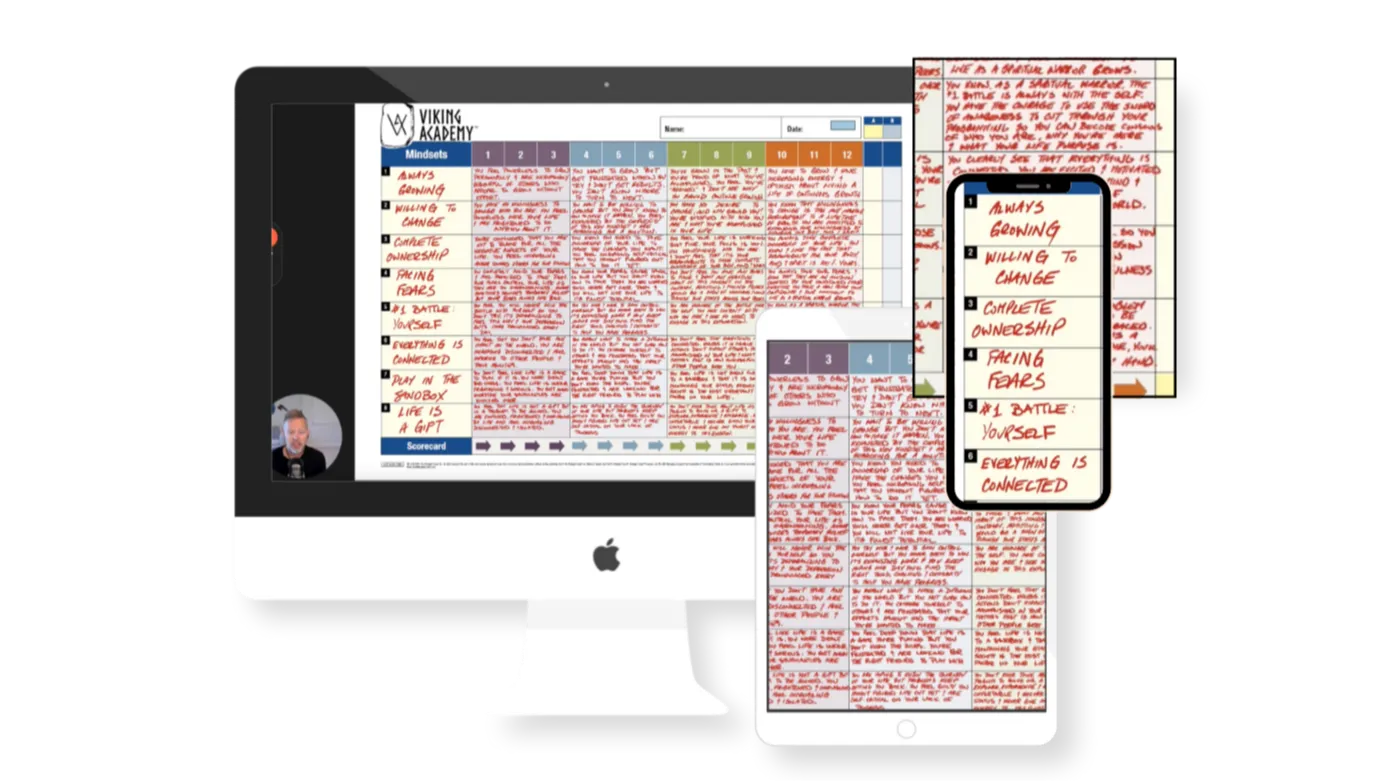
Erik Solbakken: Well, this is the interesting thing. So I, I, I've just written a Viking A-, the Viking Academy. I've drafted, I'm just putting it out there. It's gonna be on the podcast now, so I better make sure I publish this. Is the- It's called the Viking Mindset, okay? And it's the, unlocking the map to self-discovery. That's currently the title of what it's looked like. I have a scorecard. So this scorecard that you probably saw on the we-, yeah. this is a scorecard that I, I created up. It takes anybody from any of the different phases. So some people are just like- They're just curious and they're like, "Well, I wonder what this is." Yeah. Others are, like, already on their, on, on their way and they're hitting 12 out of 12 on the score, right? Mm. In terms of the mindset. So th- I'm hitting. I'm, I'm bringing people in from every phase. And so it's just having the interest in the mindset. If the people read the mindsets and they're like, "I don't wanna have anything to do with this," well then, pfft, they just go away.
Allison Brenner: Yeah.
Erik Solbakken: Right?
Allison Brenner: Right.
Erik Solbakken: So, - Right.
Allison Brenner: It's not for everybody at every stage of their lives.
Erik Solbakken: No. For sure. No. Yeah. No, no, not at all. But I think it. at any of them, if these are aspirational, like, mindsets, then they're like, "Yeah, I wanna grow." And the, and the coolest thing that I like about self-discovery is that I. it's a never-ending process. Yes. It's like once you have a layer, you go to another layer, and there's three-. parts of you. There's the mind, there's the body, there's the spirit. There's. And, and when those are not in congruency, that gets weird, and a whole nother layer of exploration-. is, okay, I'm, I'm solid in my spirit, I'm solid in my mind, I'm solid in my body, but they feel out of alignment, like, like separately compartmentalized. Yeah. Compartmentalized, till I have this experience of wholeness, which is what we're all seeking, I believe. Striving,
Allison Brenner: yeah.
Erik Solbakken: Is that wholeness. th- I think it's an infinite discovery. it's not, it's not like, hey, come and finish my course and now you, you, you have this stamp and now you're- You're done. Now you're a lawyer. Now you're an accountant. Right, right. Now you're a doctor. So you're completed. This is like-. this is like forever. It's life's work. This is forever- Yeah. ever. Like, it. There's a phra- I think it's in the New Testament or it might even have been a parable of Jesus, is that, "In my father's house there are many mansions."
Allison Brenner: .
Erik Solbakken: That means, like, every door or room you open up, it goes into-. multiple layer. Like, I just see this multiverse of just quantum- Yeah. realm of exploration, which can be overwhelming to very. a lot of people, and to some it's, it's exciting. -. I, to be honest and vulnerable, I oscillate between the two. I oscillate between the two. Sometimes I'm excited about exploring deeper, and other times I'm, like, overwhelmed by what's in front of me, so then I have to kind of just-
Allison Brenner: Yeah, I think
Erik Solbakken: that's super normal. find myself back in the center, right?
Allison Brenner: Yeah. I think, I'd be surprised if anybody was truly honest with themselves that didn't say that they shared that same experience. Like, even the most s- Even the most growth mindset individual-
Erik Solbakken: Yeah.
Allison Brenner: are going to face different things sometimes that create such strife and such suffering and such, such challenge that you have to go, "Okay, I gotta take a step back on the-" Yeah. diving in for, continued enlightenment. Like, sometimes you just need to go, "I gotta be with me here."
Erik Solbakken: Yeah. according to the creation story in the Christian, religion, even God rested on the seventh day. - Indeed. why do we s- think we need to keep going all the time, right?
Allison Brenner: That's right.
Erik Solbakken: Yeah.
Allison Brenner: And, and there's, it's. It would almost be like if all you ever did was keep going, that would raise a flag for me that you're not. Y- you don't have comfort in just being where you are and, like, knowing yourself today. If you're always onto what's next, next, next, you're never being.
Erik Solbakken: .
Allison Brenner: You're always searching, and I don't think that's healthy either, so.
Erik Solbakken: Yeah.
Allison Brenner: I think it's wise to be able to go, "And now I'm gonna sit in my plateau and see what's here."
Erik Solbakken: Unless you're an entrepreneur, that then that doesn't last very long because the entrepreneur-. gets to a certain plateau, and then they're like, "Wow, look at the view from m- what's next?" Right? Yep. They get. They maybe last for three seconds, and then they go, "What's next?" Right?
Allison Brenner: Yeah, I'm married to that.
Erik Solbakken: Yeah. There you go. Yeah. That's m- that's me. That's, that's the entrepreneur. And, and that's why when I'm hearing about what you got and I'm like, "Oh, well, what's next? What's next?" And I'm very much look, looking forward to seeing what it's gonna look like in a year from now, what this is gonna look like. Mm. So, let's make a point of staying connected- I'm curious too 'cause I would love to see where it
Allison Brenner: goes. I would love to. Thank you.
Erik Solbakken: , so there you go for. So and then the website, quote the website. Where, where can people go?
Allison Brenner: Yes. It's yourinnerview.com, and that's Y-O-U-R-I-N-N-E-R-V-U-E.com. I'll email you with all that.
Erik Solbakken: V-U-E. No, we got it. Yeah. We're gonna have it in the show notes.
Allison Brenner: Okay. But
Erik Solbakken: I always just like to have it in the ending part-
Allison Brenner: Yeah.
Erik Solbakken: of the podcast.
Allison Brenner: what? I'd, I'd love to offer you a coupon code for your audience so that they can get 20% off the published rate if they're interested in doing their own innerview. What's
Erik Solbakken: the, what's the, what's the code? Or are you gonna make it up in this moment in time?
Allison Brenner: I'm gonna make it just for you.
Erik Solbakken: Okay. Okay, perfect.
Allison Brenner: I'm gonna make it, how about Viking 20?
Erik Solbakken: Viking 20. We're go. We like that. It's- Viking 20. Yep, we're doing it. We're gonna put that in the notes. I'm gonna write it down so that I make sure I do it. Viking 20. There's the 20% off code right there. Viking 20, you got it. innerview.com. Yourinnerview.com. Your- Yourinnerview.com. yourinnerview.com. And it's- We'll have it in the show notes. Viking 20. I'm gonna memorialize this in the Viking Academy. I'm gonna put it in there as a permanent- Thank you. fixture as well. Allison, - I love
Allison Brenner: that you love it. Thank you so much for your time. th-
Erik Solbakken: this has been a fantastic exploration into the self. Indeed. And your social, your aggregate social impact-
Allison Brenner: Social aggregate I think is a good
Erik Solbakken: way to call it. your social aggregate. Yeah. I love that. I love that. Awesome. Thanks so much for being on the podcast.
Allison Brenner: You're welcome. Thank you for having Thanks for listening to the Viking Academy Podcast. Make sure to leave us your honest feedback by leaving a review on Apple or Spotify and hit.