
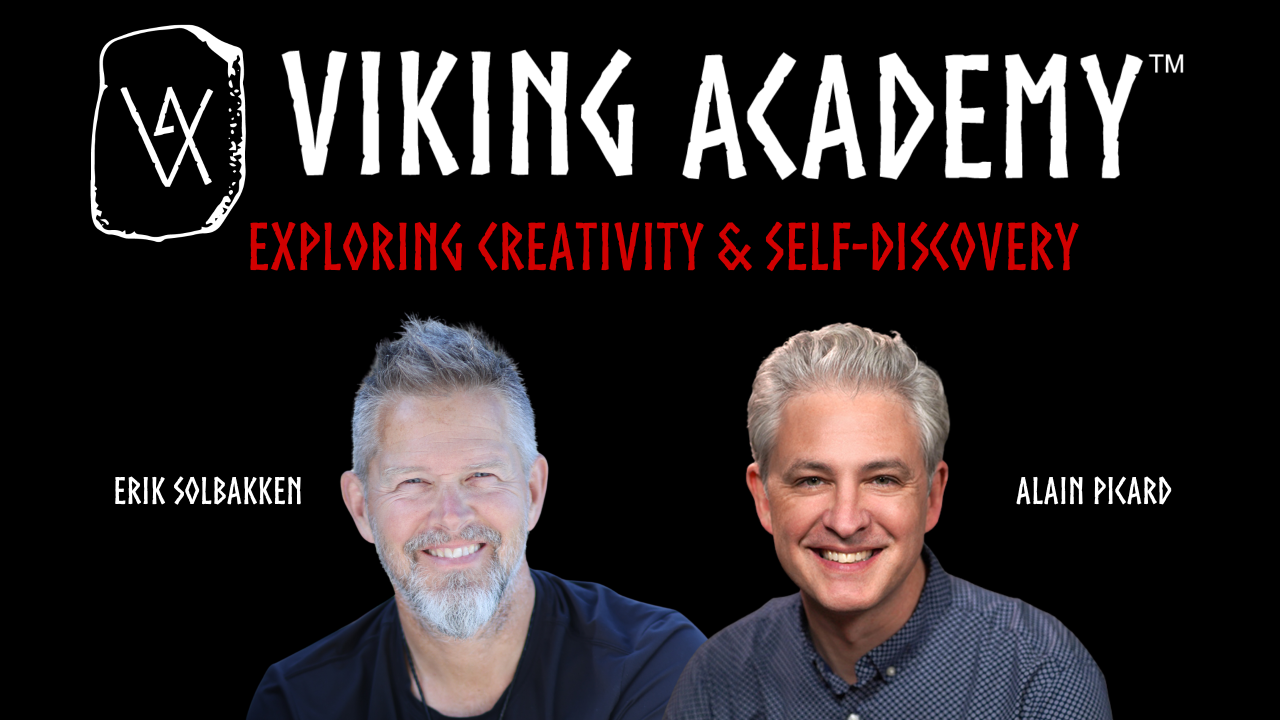
#51: Exploring Creativity & Self-Discovery with Alain Picard
What if creating something could help you discover more about yourself?
In this episode, we sit down with Alain Picard: artist, teacher, and creative mentor, to explore the connection between art, creativity, and self-discovery. Together, we dive into what happens when we let go of perfection, move through the fear of failure, and give ourselves permission to create.
From rediscovering passions that were pushed aside to finding confidence through the creative process, Alain shares how art can become a powerful way to reconnect with identity, purpose, and wonder. We also explore why simply showing up and creating can open the door to unexpected growth and transformation.
This isn't just a conversation about painting: it's about creativity as a path to self-discovery, and what becomes possible when we stop worrying about the perfect outcome and start exploring.
Topics We Explore:
- Finding yourself through creative expression
- Overcoming the fear of failure and perfectionism
- Rediscovering passions we may have pushed aside
- Creativity, confidence, and self-discovery
- Why showing up matters more than the perfect result
- Art as a way to reconnect with wonder and possibility
- The relationship between creativity, entrepreneurship, and personal growth
Connect with Alain Picard: https://www.picardstudio.com/
YouTube Channel: https://youtube.com/@AlainPicard
Instagram: https://www.instagram.com/alainpicard/
Learn with Alain Picard: https://www.picardstudio.com/learn-with-alain
Learn More about The Viking Academy: https://www.vikingacademy.com
Episode Transcript:
Hi everyone, welcome back to the Viking Academy podcast. This week we have Alain Picard on the show. Now Alain Picard is actually one of my clients in Strategic Coach.
So I coach at Strategic Coach in Toronto and he was one of my coaching clients. He still is actually and so he comes to his quarterly workshops and what he has is a art program online. And so he has a community he teaches and it's all in pastels.
So, it's pastel art and it's mainly for adults. It this is adult art. And what I really loved about the idea of having him on the podcast and what we ended up talking about is how finding yourself through art is self the actual act of self-discovery can be found through art which is what I believe the entire process of life is is self-expression.
It's creativity. There's a reason why we call the all father Odin alibab Buddha Brahma Jes baby Jesus whatever you want to call it is the infinite creator is that we are here to create and the act of creating and finding your self-expression of who you are is an actual creative act while doing artwork is a creative act and he's found that people are coming to him in adult life going I think I could have been an artist and he is facilitating that he's incredibly brilliant when it comes to mindset and how to approach it.
We have some deep conversations about how his work is very much in alignment with what I'm doing here at the Viking Academy, which is a philosophy of self-discovery because that is the process that he's doing. He's helping people find their self-discovery, helping them find their self-expression through artwork.
Um, great guy, great conversation, little conversation about uh little bit of World Cup talk because it's around that time that I'm recording these these podcasts. So, you're going to get a little bit of that as well. So anyways, without further ado, let's go explore.
Welcome to the podcast. Hey, Eric. Great to be here.
Um, so we were just talking before we came on air. I again I appreciate you moving uh the podcast off so that we could both watch uh the World Cup. A little thing called the World Cup.
Yeah, little thing called the World. I actually my podcast this morning got shifted off by an hour as well. I was actually interviewing Angus Fletcher from uh who wrote the book Primal Intelligence.
Awesome. And he actually reached out to me and said, "Hey, can we move it back an hour so we could actually watch the World Cup?" I'm like, "Yeah." And then my wife goes, "Let me reach out to Allen and see if he can move." And he was like, you're like, "Yeah, that's great." Okay. So, everybody's been shifting everything.
I was wondering what the world commerce was was like with the World Cup on, right? Like things, no one want nobody wants to work or or do anything but watch these games, right? I mean, that's this is what it's about.
Talk about like um living from purpose, right? I mean, we just you watch these games and you just have this singular sense of purpose. If you have a certain national affiliation or, you know, sense of identity around a team, it is powerful.
It is. It's And it's um I think there's a there's a metaphor in there for what we're actually doing here on the planet. Not to dive into the deep end of the pool, but I'm going to do it right away.
It's like watching a game, you get immersed in the game. You get immersed in it and you're watching it. It's like watching a movie, you get immersed in it, right?
and or which I'm looking forward to talking to you about what you're doing in your business and we I love the picture that you got in the background how people get immersed in the creative act of creating their own art. You get immersed in it. But when you're watching a game, it's like you get sucked up into it and it it's just a game though.
Like it's it's just a game, but the passion and the energy and everybody takes like they it's like it's real. Oh, this is life. Well, no, it's just a game.
I think life's the same thing. I think we're down here having our, you know, getting freaked out, getting angry, getting sad, getting happy, joyous, and all the rest of that. But really, really just it's like a sandbox.
We're just playing a game, but it's just, you know, that's more of a philosophical viewpoint than anything else. There's an I, you know, the the notion that it's just a game. I mean, like you said, I'm an artist and it's just a picture, right?
I'm just creating a picture or I my my first my boyhood dream was to be a a left-handed pitcher in the major leagues. Obviously didn't happen. Thank goodness because this wouldn't have happened but um it's just a game and yet it's so much more and and these are are environments where we have an opportunity to connect um humanity to humanity.
we have an opportunity to um kind of discover what we're made of in many respects, right? Find our character. I have a son who plays uh soccer and he just recently broke his wrist on the last it was a tournament on the weekend.
It was the last club game of the season and they were like in the semi-final of the tournament and a kid took him out and boom. And it's like these moments where you find out what you're made of where the disappointment of loss, the the excitement of victory. Yes, it is just a game, but it is so much more.
And it really whatever our our passion is, whatever that sandbox is, it provides this context where we can discover ourselves, connect with one another, and hopefully um impact one another, make each other better, right? I mean, I think that when I watched So, I I live in the US, right, Eric?
And and when I watched our US team this season, we've never really identified as a a soccer team or, you know, uh the international sport of football, right? But this was different. I watched us develop, start to develop an identity and that team certainly had an incredible identity, a sense of family, a sense of purpose, a deep sense of con connection and that was rubbing off all over the place.
Um, so you see how the ripple effect kind of moves out from there. Yeah, it's amazing that it's like the world's it's the biggest sport in the world. Like it's the largest sport like that.
So we go to a worldwide sport except for in the US like and the US is so big. you're so big on baseball and football and basketball and even hockey is like higher than soccer, right? But it's Yeah.
But but with soccer there, it hasn't had a soccer identity. It has a football identity, right? Um and and but this World Cup, you know, being shared in Canada, US and Mexico, it's really it's brought also the world to the world because I know like for example, like my home country of Norway.
Um Norway is on the map now. Everybody's talking about this big Viking giant called Holland who's this monstrosity and he's like there's a big they could been calling him the friendly giant because he's just smiling and he's having fun and he's playing the game and what an ambassador for Norway and the sport itself right so you see all these people now wanting to go to Norway and go see check that place out so it's actually it is a it is a world game that brings everybody together and what's really interesting someone pointed this out once it's a ball it's a it looks like the globe it's the world.
So, you're kicking this ball around which is the world and we're playing with the world. Well, there's nothing like it. I married a European.
My wife is German and she's my business partner. She's my soulmate and um I feel like in falling in love with a European, I got to have this wonderful and necessary broadening of perspective in terms of where my purpose was going to go in my life. and I'm so grateful for that.
So, yes, I've been in in Europe for World Cups and Euro Cups and it's always it is so exciting. I always laugh at my fellow Americans for how like, you know, crazy we are. We tend to, you know, have a certain vision of the world that isn't always um as expansive as it could be, but I think in places we're improving.
Yeah. Well, this well in give and take, give and take in this part. It's so I see the US embracing soccer even more now which is a great thing and it brings everybody together.
So so here's the thing. So we you know all the great places where I seem to meet all the great people to talk to strategic coach and I like end up meeting but the interesting part about this is where we met is I was coaching you. That's right.
In a in a coaching I am your coach and and I'm going to see you again in August. I see that you're on. So, like I'm actually your coach.
And so, when we met and we started talking at one of the breaks and you were and and we were I was getting to learn a little bit more about what you were doing. It um I get these little uh flashes of inspiration. I was like, "Whoa, that's like so cool what you're doing.
It's another expression of the self and people finding themselves again and going back to child." So, I was so excited, and I'm not framing exactly what you do yet because I'd like you to explain it, but I thought, "Wow, what a great conversation we could have around self-discovery through the art of art, which is what you're helping people do." And I that's what I at the core that's been my sense is that you're helping people discover them self-discovery through the expression of art which is a even a bigger ethos that I I I believe is true in terms of life but can you explain to the listener and to me as well what what you're doing and how you came upon it too. I'm really curious on that about that like how you came into this into this business and how we created how you created this entrepreneurial vision.
Uh, I'd love to, Eric. Yeah, I mean, so very simply, I help artists create loose, expressive paintings in the medium of pastel, which is actually kind of a niche medium within fine art. It's stick form.
It's not the oil stick version. It's like, think expensive uh chalks, but it's beautiful. This is a pastel behind me.
And I've worked in watercolor and oil, but it's the medium that really um I found my deepest connection with. And so, yes, I help artists paint. I was a portrait artist for years and years, turned gallery artist, worked on, you know, landscapes and figurative work and portraits and all kinds of different genres and then avoided teaching because I thought those who can't do teach.
I thought that very wrongly. It was a limiting belief of mine that I hid behind because there was probably some pride there. And I really, I'm sure, wanted as a young uprising artist to make my name as a, you know, gallery painter.
But what's amazing about my story when you say, you know, where where I came from, all of my successes have come on the other side of failure. So, I'm a big believer in um the redemption or the rediscovery of our purpose on the other side of failure. I wanted to be a left-handed pitcher in the major leagues.
That was my boyhood dream. very much shaped by the American dream, right? And how you get attention and applause as a young boy in a small town and um I came from a loving family and and that's what I thought would be a way of pursuing passion.
I didn't have the physical ability to do that. And so about halfway through college, I discovered it it wasn't going to happen for me. And I said, "Well, what else can I do?" And I was in a drawing class and my um teacher at the time, she said, "You could teach this class." She was frustrated.
She was ringing her hands at me and she said, "What are you doing? You could teach this class right now." Which shocked me cuz I was just having fun with it. It was a bit of a sandbag.
I was actually taking an elective drawing class so that I could get an easy A. And sure, having fun, but didn't see see past that. But once those scales fell from my eyes, that one passion wasn't going to happen.
I was able to open up to what would be possible and it was an interesting next couple of years of kind of rediscovering identity. I actually rediscovered some of my faith in that period of time. I I faith is a really important part of my life and um and so you know when you talk about belief and purpose I mean those are convictions that I live from and uh so I feel like I was always supposed to journey this path of creative artistry of becoming an artist but I was on my own version of a thing that really wasn't ultimately going to happen and when I got out of my own way some really wonderful discoveries started to happen.
So, yeah, now I get to help people reconnect with their passions. And I feel like everyone's carrying some kind of loss or some kind of um at some point in the journey, they had to sideline that thing or shelf it or put it in put it in the back burner or it was uh suppressed by others, their art, right?
or their passion for art or they were told they're not good enough or they're not good at all or um that's not a viable career path or do something more meaningful with your time. There's all these kinds of experiences. So, you're right like when I get to connect with people around creating it is like reconnecting them with a deep well inside of themselves of desire and passion.
but also there's a lot there that might be blocked up or suppressed and they need to believe again. So I like to say I traffic in dream fulfillment with with what I do even though I'm just we're pushing we're pushing pigment around a surface. We're we're using colored chalks, Eric.
I mean but it's so much deeper than that. And it wasn't for me until a market recession in 2008. Had one little guy, son, and my wife was pregnant with our second and I couldn't get a commission.
I couldn't make a sale that uh my wife got in my face, man. She said, "You're burying your gifts in the ground. You people have been asking you to teach workshops and you're saying no-c because your because of your pride." So, and you know she's German, so she said that very graciously.
Of course, I'm just kidding. She's lovely. She's lovely.
But she told me the truth and I sat with it and I was like, "You know what? She's right." And about a day later, I I came back and said, "You know what? You're right.
And I'm going to I'm going to take that workshop." And that's where teaching began for me right around that 2008 season. And I was young and inexperienced and I re I discovered a whole another passion truly. Like if you ask me now what lights me up, it's helping people grow at the at the most fundamental level.
It's helping people transform and grow through creativity. And uh so that's what I get to do. And and I do it by helping people paint landscapes like these or or portraits.
I have various courses and an online membership. At the moment, my primary business model is an online expression. I I for years and years and years traveled around the world teaching workshops, sold paintings and galleries, did commissions for all the different you know institutions and private clients and um just everything in between.
But it is such a blessing to be able to connect globally like you know I get to help people all over the world and it it's primarily adults. I I'm not a childhood educator and so I'm really deeply engaged in this process of encouragement of encouraging people on their own creative journey, seeing their own story unfold, reconnecting with passion, reconnecting with purpose and finding their identity and believing again because encountering beauty, you know, I believe in the power of beauty um as an artist it it it literally is a catalytic experience that creates hope.
So you can't look at something beautiful without having a swell of hope. It's a very powerful thing. So for me it's it's uh I'm I'm awake to it and it's very exciting.
I could go down 40 different paths on everything you just shared there. I I I want to go to I find it interesting that you were resistant to the thing that actually gives you so much joy and passion right now. Like you actually purposefully were like, "Nope, no don't want to do that.
Not doing it. Not doing it." But other people saw it. Your teacher in that class looked at you and went, "What the heck are you doing?" Like, "Why are you why are you not teaching this?
You could be teaching this. They saw in you what you didn't want to see in yourself. It's almost like you were per like it was like you were purposefully not wanting to look at that part of you.
And I find it very interesting that there was like a like a almost a dual person, not a dual personality, but you know what I mean? Like you just don't want to look at that part. And it's interesting why psychologically or spiritually why that would happen.
Like why you wouldn't have seen it. Yeah. I think it was really for me as simple as I've thought a lot about this actually, Eric.
I really and and done a fair am fair amount of work, you know, reflecting on my childhood and my journey. Like I said, I have two loving parents, but um there was no artist that I could look at in my personal life or extended family. No visual artist that I could look at and say, "Oh, there's a role model for what it could look like." And um I'm very achievementoriented and I'm and um I've learned that I'm an enagram three which is like an an achiever or uh even to some extent you'll perform for approval.
That that is a in in my unhealthy state that's what I would do. I would perform for approval. And so what does it take to succeed?
Who do I need to be for you in order for you to admire me, like me, celebrate me? Well, as a boy in my world growing up, athletes, they were they were celebrated. They were cool.
They were powerful. They were strong. They were masculine.
They were all these things that I thought was amazing. And I loved the sport of baseball. And but another thing that was overlaid there, Eric, was that my father, he and I bonded over baseball.
Probably that was probably our our strongest bond. Uh he didn't have a lot of opportunity to pursue his own passion for sports when he was a kid. So he got to live that through all my teams and beyond the coaching.
You know, he was another member of every team I ever was a part of. Right. So, if you think about the layers of um what was motivating me, there was a lot going on there.
I didn't have a lot of people as a young man going uh besides my art teacher, frankly, going, "Wow, you know, become an become an artist. That that should be your path, right?" Like, it just did it wasn't an obvious opportunity. So when I look back on it, I see all along the encouragement was there and that it was my great my greatest gifts were there.
Like I just had such an outsized ability to draw naturally from a young age and loved doing it and got a lot of like people loved it. They loved seeing the drawings I did, but I didn't believe that that was enough. And so yeah, I think it has to do with the stories we tell ourselves.
some of the narratives around what is uh desirable and and successful for our communities, right? If you're in a small community. So, thankfully I was able to cast that some of those limiting beliefs and and those wrong views aside and really kind of discover who I was.
I also just think I yeah I was operating from an artificial place for for a while and that was part of the power of you know there's something so liberating about failing in life. I I don't know about you but I'm sure you have somewhere along the way you must have had a tough run with something Eric.
So, oh, you have no idea, dude. I can't We could spend an entire podcast on my show. Nobody gets anywhere without having a few bumps along the way.
But I think that they we you should never waste a good crisis and they are these extraordinary opportunities to learn and grow and they're they're the greatest teachers. And so for me, they were uh the failures were really what allowed me to become freer and to kind of let go. Um and kind of be pulled by what I feel like who God wanted me to be, who I authentically really was becoming.
And uh so I'm not I don't today I don't paint to feel like I'm enough. I don't that's not the well I create from. I'm not trying to impress somebody.
It's a response. It's a it's a it's a a response to the wonder that I experience in life. that the beautiful scene, the the the gorgeous design, um the incredible sense of humanity.
It's always a response, that's where I'm coming from when I'm painting. It's a form of worship if you would you could say that, right? We all worship something.
We were just watching the World Cup or, you know, people are going bonkers over one team or the other team or a certain player, right? We're all doing it. We're all engaged in this great affair.
Well, when you create, you know, you're responding and going, "Wow, how beautiful is that sunset? How beautiful is that?" You know, fill in the blank. The um today's been a big day.
I've had a couple podcasts that I've recorded and the the the driving theme behind it is this. The creator is creating something. And when we create stuff, when we are in the act of creation, we're actually making something greater, right?
We're creating something that's greater. And the creator created us because it was something greater than the creator already had. So instead of thinking that we're lesser than, we're actually the higher than.
And the more that we create, the more we're expanding the creator's vision of creation. And so I I this this idea of unique ability or live working in your your your God-given gifts and what the creator made you for, right? And I I believe that every person was put on the planet for a reason.
We're the only species that doesn't know why we're here, though. And so our adventure, which is the joyful, is the dis is the exploration and discovery of the self, the true self that wants to express itself, right? The the capital S.
So going and and I when you're talking about when you're doing the art, it is just it's flowing through you. It's an expression of love of going this is me creating because that's the ultimate thing. I've got a I've got a piece of paper up here.
So our joint coach, our ultimate coach is Dan Sullivan. He he said creativity is intelligence having fun. And I always like seeing that creativity is intelligence having fun.
And I'm like, "Yeah, cuz it's it's an expression." And once you figure out who you are and you're expressing that which you were meant to be here for which you decided to come or whether you know however you want to think of it because everybody's got a different story on the creation story and the rest of it but my experience has been so far that when I'm actually expressing and I you're in that flow or that you know flow state that people talk about sports people artists entrepreneurs I don't think there's any difference because they're all creating right we're all creating You're now in here doing what you were meant to do, which is this expansive joyful expression. And what I love what you're doing is specifically working with adults is bringing them back to that childhood wonder.
Yes. And reconnecting with I believe who we were meant to be from the get-go. So I think we come into the world.
So far this has been my theory. And again, hey, I could be wrong. And that's the other thing I said I always just go like anytime I think I figured it out something else new comes in to change it.
So I've just come to a new conclusion. I'm like you know what from now on I'm just going to go this is what I figured out so far but hey I could be wrong. Right.
So this is my working theory that gets upgraded weekly. Exactly. Is that we actually came in as newborns where we come in with a sense of wonder looking around.
Wow. Look at this world. This is amazing.
Oh my gosh. And then as children, we're using our imagination, our creativity, and we're emotional, and we we're just having this wonderful play. And then all of a sudden, we start being told, "No, act this way.
This is the way you behave. This is what and you get conditioned over experiences over time." And you lose it. But then my experience is that I' I've found it again in later life or the tragedy that's happened.
For me, it was the alcoholism. I I I hit the bottom and I from there that was the wakeup call and then I've turned and I've started doing it. That's why I was so dri I was so attracted to what you were talking about in what you've created.
This platform is a is a platform for people to reconnect with their with their creative childhood self. Yeah. Which I believe is the original manifest of the blueprint of what who we are and what we're here to do is we're here to create.
If we're made in the image and likeness of God and God is the creator, therefore, we're creators as well, right? Ye are God, sons of the most high. All these acts that I do, you shall do and more.
like these all these phrases, it's it's saying that we're here to create. So revisiting and waking up to that creativity, that's self-discovery. Like that's beautiful, dude.
Absolutely. Well said. Yes.
Yes. And amen. I think that we um at our highest in in one of our highest experiences as um creative people when when we feel that profound connection that we're actually co-creating, right?
There's this kind of co-creation that's taking place where the creator and the created are are co-laboring to express something powerful. And uh I I think the only way to get there a lot of times is through play. It's, you know, when we when we ring our fists and we clench our teeth and we work so hard, we tend to squeeze out a lot of the wonder and we and we get into performance or we get into and I'm a work guy like I like I like doing the work and putting you know I think it's important but I but there's something so powerful about play and you started right out with it Eric and I think there's something there that's really really powerful and really important for us as creative people and to help people with.
I always find I feel like there's this part of the job that I get called to support people in the development of skills and and to set them up to succeed in a number of ways technically and you know use this stuff and information wise. The real work is in the mindset and it's at the heart level and it's in the excavation of of who they're created to be and just getting them moving in that and believing that and and allowing themselves giving them permission to say I am an artist because I'm creating right like that is so hard for so many people to say to to say I am an artist for so many reasons but if the great artist like you um has created us in his image, then who are we to say we're not, right?
And so that that acceptance is a really powerful process and and kind of saying, "Okay, what if and then moving from the presumption that what if I am and and allowing ourselves to be drawn into that beautiful story that uh we were made for more and that we can create. We I think just believing that we have permission to make art is in in and of itself very very powerful for people because I I mean I see people say I should be taking care of my grandkids.
I should be um you know cleaning my house right now. I should be. There's a million different things that are more important in their mind than, you know, cultivating their own artistry or cultivating their own creativity.
And those are those limiting beliefs that that that are, you know, that's someone's finger pointed at them saying, and often it's just that inner artist critic saying, "You're not enough. You're not enough." You know, and I love seeing that removed and and seeing people empowered.
My personal mission like there's what you know I help artists create loose expressive paintings and pastel. Yes, I do that. But my real mission between you and me is empowering artists to renew culture by revealing beauty, goodness, and wonder through their art.
That's my wake up in the morning uh drink the mission. That's what gets me up is is is to empower artists as agents of restoration in their communities, in their families. How?
by connecting with their art, by the simple act of creating beauty with with with embedded goodness and a sense of wonder that changes the world. That changes I've seen it a thousand times over. I say it with absolute confidence because it is incredible what sharing your unique expression does to others.
It is incredible, you know, over and over. I think we're doing the same work in a different brand. Like my the way I see it is that you're helping people.
It's self-discovery. It's self-discovery. And that's what the Viking Academy is.
It's an ethos. It's a philosophy of self-discovery. And so I'm encouraging and and being the the ring leader or whatever, just waving the flag, say, "Come on, let's go.
Let's go explore. Let's this is the path that like just go explore. Just keep exploring.
Keep exploring. Keep exploring." And and and I see that what you're doing is you're giving them an outlet to go come explore art. Come explore your creative expression through art and explore and see if what you find because you don't know what you're going to find once you take that you take that pastel and you're going to go to the you're going to the canvas.
You're like what am I going to uncover? What am I going to create? What's going to come through me?
What am I going to see? Maybe it's going to be a failure paint and I'm not going to be happy with the painting. Maybe that's what I'm going to find.
Or maybe I find that I'm not really as good an artist as I as I thought I was. Or maybe I'm going to be even better than I was. But you're never going to know unless you go do something.
Like it's this it's what you said about being in a collaboration with the creator. It's like there's a saying that we have in recovery movement. It's like you keep your head in the clouds with the creator, but you keep your feet on the ground, right, with your fellow man.
which is means you can you can be praying and meditating and connecting with the oneness of of the of all you know the infinite intelligence but if you're just sitting on a mountaintop not doing anything what's going to happen nothing right there isn't there is an active engagement in life that we can that we can take or unless of course that's your expression and you want to do it go for it like I mean really it's your life you can do whatever you want my experience has been the more I actively explore is when I bump into things and I find something new and and I and you know like I break I break Sometimes it's my own personality that I'm breaking because I'm shattering some of the the core beliefs that I have wrapped around myself. And that's actually there's a question.
What are some of the core beliefs that you've found when you've worked with people that after they've been working with you and you know as an adult and they're starting to test the waters on this and you've worked with them, what are some of the the beliefs that you end up seeing get shattered and then what emerges from that? Yeah, that's a great question.
I think um that boy so many people when they come to you know that sheet of paper or that blank canvas are afraid that you know the result of that is going to somehow define how good they are, who they are as as a creative person. And and that is often shaped by the words of someone early in life, whether it was a parent or an art teacher, you know, over and over.
We hear the stories about, you know, people who were told, you know, you're just you don't know how to do this or you shouldn't do this or you'll never be able to do this or you can't, you know, and those words just are stuck to them like these horrible bywords that that just haunt them. And so the most powerful experience I see is when they discover that they can when we help one another kind of set that inner artist critic aside.
Set that aside and just create. Just enjoy the process. You know, no worry about outcome, progress over perfection.
Really focus on the practice, not the production or the product. And and really get into play. these amazing emancipations occur and and that's where you see freedom that's where you see people discover actually I can and we know there are so many forms of expression even within like a narrow band like um representational art or impressionism or I teach a loose expressive style of sort of representational painting right you can tell it's a landscape or you can tell it's but it's loose well even within there there's so much room for expression so much room for what is good, what is beautiful.
And I love when people have an image shattered of what they're supposed to even be creating, what is defined as good, right? So that they can now get onto the real work of creating from an authentic place, right? From an authentic sense of awe and wonder without all this overlay of what it's supposed to look like.
And there was a lot of that. I and these are things for me that I that these where I've had to change my mind many many times about who I am and and what my role is. I thought for years, you know, I was supposed to create these beautiful pictures.
I honestly think now that my my job is is is to encourage people to keep showing up to engage with the practice internally and physically and move keep moving forward because if they show up, if they if they create the thumbnail sketch or the color study or the the larger work, if if they do it again tomorrow and then the next day or if if they only have time once a week for two hours, great. if they keep showing up, these miracles happen.
These creative miracles happen in their lives and it is extraordinary. So like yes, I create along along with them, but I don't any longer think that that's I think, you know, it's still something that I'm good at. I'm good at painting, but I have realized that it's I think ultimately I'm a I'm a big old cheerleader for other people helping them move forward, you know.
So, when I'm writing, I'm thinking about that. So, my creative work is so much more expansive than painting. Now, I think of myself as a leader, someone who, you know, when I'm if it's writing an email or a a PDF guide that go coincides with a topic or coming up with creative ideas, ways for artists to engage with the work, a new way of thinking about it, a new way of getting out of our own way or if I'm interviewing another artist, which I do that as well sometimes inside the community, helping them see other paths and opportunities.
All of this is unlocking for people to go on their own journey of discovery. We call it the artist journey inside of uh my community. My artist community is called cultivate.
And we're all cultivating our creative path. You know, it's like being in a creative garden together. Dude, you just expressed inside doing art on a canvas.
You just expressed the human condition across the entire globe. The fear of what shows up on the canvas being judged as good or bad. And then that's a direct reflection upon who you are in every spiritual teaching.
And I was like, it's do the work but leave the results up to the higher power. Right. Like yeah like or trust in Allah but tie up your camel, right?
you're doing like you're doing the work but don't worry about what the outcome is on other people's judgment of it doesn't become who you are but I think this is where ultimate fear comes from a lot of people I can sense it in myself too is a lot of fear of failure because if I fail at this thing that I'm doing which is a creative act like if you look at life as a creative act like your entire life is the blank is the is the canvas yes yes your entire life is the canvas as you're doing things. If you're afraid of other people's judgment of your picture of the art that is created which is the art of you and that it's a reflection on you.
It is actually isn't who we are at our core. Our core is an infinite being connection. We are express it's an expression which is a temporary expression which is like art.
It's a temporary expression. That's like you could write a spiritual awakening book just on that one comment you said about people that need to break that that that that that one idea and and those people are me right like that when I reflect on my journey that's why I was so hung up on being a left-handed pitcher in the major leagues right was I guess that's a vision of success and and grandeur and accomplishment that would be amazing Imagine if I can pull that off.
I was always a dreamer, but that that was the wrong dream, right? It was a it was something that was shaped by society and fun. Like I I loved playing the sport of baseball, but I think if I had a better sense of who I was, I would have seen it as something fun to do for a little while, but wow, I have all these creative abilities that that God has given me and and what could I do with those?
I didn't even think that until sophomore year of college when when the dream came crashing down and thank God it did. And I think these I love recovery uh like narrative as like the um the whole notion of surrender is so powerful, right? Surrender to a higher power and because we're not clenching tightly to things.
All the best things in my life have happened when I've surrendered. When I haven't tried to like force things to happen. Now that doesn't mean we sit on the sofa and do nothing.
I mean like when I surrendered to the the limiting belief that those who can't do teach and realized that it was my pride that was getting in my way. My wife said, "You're burying your gifts in the ground." I said, "You know what? I surrender.
You're right. I'm gonna I'm gonna be terrible at this and I was afraid of that and it might mean that I'm not getting all the sales in the world. So, I got to come over here and do this other thing called helping others and I'm going to surrender my pride and and give it a try.
And I was disastrous at it the first time, got a little better the next time and started being great at it over time. And oh, by the way, discovered a passion I'd never experienced before. Helping others grow creatively.
It was so much fun cuz I I I am a leader as a just that was always I used to sit in my studio alone painting beautiful pictures that would go in galleries wondering what's wrong with me? This is supposed to be the dream. Why don't I feel fully alive?
Well, because I wasn't leading. I wasn't rubbing up against other people, supporting them, encouraging them, guiding them, you know, exhorting them. That's I was made to do that and I wasn't doing it.
So, it's amazing how surrender is so powerful, Eric, in in in the daytoday. We have our battles uh both externally and internally and each day to be able to, you know, wake up and take that deep exhale and, you know, let go of whatever parts of ourselves that we need to let go of and receive.
Um, beauty for ashes. That's one of my in my life what I have a life verse that I hold on to. It's from the ancient text of Isaiah and it says, "I will give you beauty instead of ashes, joy instead of mourning, a garment of praise instead of despair." So, there's a divine exchange if you'll just relax and surrender.
actually here. I'm going to give you this amazing stuff in exchange for your pain, in exchange for your loss, in exchange for your mess, in exchange for fill in the blank, right? And so I see that that I get to bring beauty or or or be a part of helping people make that exchange.
Beauty for ashes. It could look so many different ways, right? Because we've all got ashes in our lives, right?
I mean, I don't have to look far to see it in my day, my week, my month, my year. So, that is so fulfilling to me. And to be able to do it creatively and to kind of get on that creative path, walk alongside one another, you know, and say, "Hey, maybe I've been a couple f steps further up the road.
Look at that horizon. Look what we can do together. Look what we can and look at what you're capable of.
Did you ever imagine you could do this? You could create this, you could share this. And when people start sharing the beauty they create and seeing its impact on others, wow, that is extraordinary because that reshapes their mindset because other people start telling them about what they're experiencing through the work and the process, which is very powerful.
The changing of a simple idea. I have a a book that I have sitting here. It's um Poor Charlie's Almanac.
If for whoever's uh watching the video portion portion of this, I'm holding up a book of Poor Charlie's Almanac. On the back of it, it says there's an old two-part rule that often works wonders in business, science, and elsewhere. Says, one, take a simple basic idea, and two, take it very seriously.
And I just I I'm I'm my experience has been so far is that an idea can change the entire trajectory of your life. Just an idea and and the conversation I had with Angus this morning was more about that we think we we actually see our lives in terms of story. We're not lo like we keep talking about intelligence is logic and memorizing numbers and that's true intelligence.
It's not and true primal intelligence our our our core basic not our basic but our our beautiful expressive creative selves comes through intuition imagination emotion and common sense. It's it's a it's a feeling that gets that gets brought up. It's we're we're not here to just just do everything automatically, right?
you actually get to be part of the expressive nature of of the creator. And I'm more and more convinced that actively exploring and being, as you said, a collaborator with the creator, be a collaboration with your life. If you're constantly exploring and you find one new idea, and I and this is why I love Strategic Coach so much is because every time I go, they give us tools to actually dig up within us a new idea.
They don't. They give us maybe they give us a new idea, but when you add that to your experience of your life, it pops up a new idea. That new idea can change your entire trajectory.
A really good story can change the entire future of the world, right? And you look at the world's greatest religions or that that have been around for centuries, they're stories. It's a story that now resonates.
And I think the ultimate story is the story of you. Like it's the greatest gift the universe gave us was us. Like the greatest gift the creator gave you was you and you got to experience you.
No one ever going to get to experience you ever in the entire history of life. You get to have that. And once you I think once you turn inward and you start really embracing that not in an egoic sense like not being oh I'm so great I'm so wonderful.
That's that's the lower s right? if we call it this lower self and the higher self. But when you attach to that higher self, that soul self or the what you're here to express God's purpose for you, you're actually realize that the greatest gift you've received is you.
And you get to go explore that every day. And I love the fact that you've given people a direct outlet in this particular area of creative expression through not only art, not only painting, but through pastels. Like you've actually niched like in a in a business sense, you've actually completely done with a super niche, right?
It's a super niche. Not only pastels, but it's for adults. Totally.
Yeah. I mean, I feel like that's niche. The niching is so important.
You know, if you're a generalist, you you don't appeal as well as I think if you're niching at at this point in in the business application of this creative pursuit because it really does help you identify more specifically with people. You know, in the one level, we're all doing the same thing.
those of us who are helping people create art. But yes, I'm using soft pastel. And I will say again, I tried to be a great oil painter.
Like, you know, everybody said, "Oh, you got the it's the medium of the masters. You know, the great artists in history are the oil painters." I was like, "I I better learn how to do that. I'm I'm doing the thing again, right?
How do I impress people?" Well, the first thing I ever did at college when when we signed up, I remember it was figure drawing class. I had this Dutch teacher and she's we had to buy this set of Rembrandt pastel sticks and bring them to figure drawing class. Well, I did and got to use those pastels to, you know, draw the figure from life, the live model right there.
It was just so immediate and visceral and intimate and tactile and it just connected for me immediately. And when I look at work by other pastel artists like Edgar Dega Ga and and Mary Cassat, artists like that that that tactile side was there. So it just I remember the eighth grade I did a deer in pastel in eighth grade art class and it you know I just remember how realistic I could end up creating it and and those moments they were always very they just were this beautiful sort of raw expression because I am a draftsman who likes color you know it's like a combination of drawing and painting in one that and pastel does that so yeah the niche is just my kind of selfish way of like saying, "Okay, this is this is a vocabulary I can communicate really well to you with and let's play together, you know, and and it's a great on-ramp." But, and I think it can help other artists like, you know, a number of the artists that are in my community use other mediums as well, but it's an on-ramp.
It's a wonderful on-ramp into the creative journey. The interesting thing is that you didn't you know when you I so I'm an entrepreneur. I started off in the accounting world.
Um I was an entrepreneur which is why I didn't get along with accountants because they're all having entrepreneur accountants are entrepreneur are technicians having an entrepreneurial seizure really and so I was not rubbing with them and I just I kept looking for that that expressive outlet and it and so then I started reading business books and how am I going to fix my business and I so and one of them it was always like find your niche and niche down niche niche niche niche niche. So there's one thing about forcing a niche as opposed to discovering your niche.
You discovered your niche by exploring and all of a sudden when it hit you just expla when you were explaining it, I could feel tingles on me because I'm like you hit the you hit the the the the right chord in the music. It was like like that this is it. This is what I'm here to do.
Totally. And I tried to make that note with other mediums and I couldn't get that resonance the same pitch like it just didn't it didn't feel totally authentic, you know? I did it.
I was competent in other mediums. But this one, it's just so pure. And um yeah, that's that's the side of it is is discovery.
Very much discovery. And the other side too, like Eric, I I spent years in these rooms with people. I I had in my own studio, I would have six or eight artists come on a weekly basis.
That's where I learned to teach every every week, bringing them into my studio. And then it was um going to travel workshops all over the world. I would, you know, do I would go to another zip code every single month and that's where I picked up the paycheck for the family.
And that was years of that. And um those rooms taught me how to connect with people, how to help people, how to understand what the needs were, what the obstacles are, what are the internal and external obstacles that everyone's facing. What am I really doing here?
Yeah, we're we're going to paint this together. And what what what inspires because it's a beautiful alchemy of I get to inspire people, motivate people, and activate people. like all that has to happen to really move them forward.
Like you don't just say here, do this stuff, go. They need to be inspired. There is something in creativity.
It's like when you go to a great concert, when you feel lifted up by the music and and really inspired, you get caught. You just get caught up in it and taken away, right? It's like it's an almost out-of- body experience, right?
where I think in those moments where we're creating together and I can demonstrate and communicate something visually and people get inspired, it's like this big old doorway gets thrown open to Narnia and they can run through and just start doing crazy things they never imagined. They go through the wardrobe, right?
It's it's amazing. And so I think the niche is just I can really get there quickly in pastel. I can, you know, I'm also uniquely I'm kind of I got a lot of trouble when I was young talking in class.
I didn't really understand the concept of whispering, have a low voice. I think it hit in seventh grade. So, I always got in trouble in school for talking, but like I can explain what I'm painting while I'm painting it very well.
So that ended up being another virtuous um quality that wasn't as useful when I was young, but now is very useful is helping people understand, you know, talking it through. Yeah. The It's interesting as you were explaining that I I've um again going through strategic coach and my own thinking about how I coach, I've come up with an ecubed formula like so when I when I'm coaching, I entertain, enlighten, and empower people because I'm there.
I'm I'm partially entertaining, keeping them engaged, right? I'm enlightening them, helping them shine a light into a corner into their world as opposed to me teaching them something, I'm enlightening it by shining a light into a corner for them so they can find it in their own in their own mind.
Right? So they're shining a light in their own mind to be enlightened and then from what they find they get empowered. And so to me, those three things are key as as a coach, as a facilitator is you're facilitating someone else's self-discovery.
Like ultimately, that's way I look at it. It's like I'm actually facilitating someone else's self-discovery. Well, what what do I need to do to help them with that?
Well, let's entertain them so they're engaged. Let's emp enlighten them so they can see something they haven't seen before. And let's empower them to go and and make the ch and and and find and discover themselves.
And then what do they want to do with that? That becomes an exciting thing. What do you want to do in your future now that you found this?
Like that's the other thing too. So when you're working with people and then all of a sudden you you you see someone who I'm not really sure. I'm really sure.
And all of a sudden they have that light bulb moment. You recognize it because you had it. Like you can't you can't transmit something you don't have.
So you see that person have that light up moment and they're like, "Oh my gosh, I can do this with it." like you went, "Oh my gosh, I can I can do this with it wi with with this thing that I found this this expression of me." Must be incredible to see someone go, "Oh my gosh, I can do this." And I not only can I do this in the moment, but I see how I can apply this in my life. Yeah.
I love the trajectory of seeing people grow in confidence and you'll see that in your entrepreneurial work and your coaching work. you know, when someone does something for the first time and they're timid and they're uncertain and they're fearful and they're doubting and all the different stuff, but if they can get through that and and create something, they go, "Wow, okay.
Not sure what just happened there, but I did it. Okay, let's do it again." And then you bring them through the process again, but now they're a little more excited. They're a little more trusting.
They're like, "Okay, yeah, but I don't like this and I don't like that. Well, let's do it again." And then by that fifth or sixth or seventh time, they're like, "This is awesome." And look what, you know, they've they've let go and they've begun to discover really what it's about.
And and so yeah, I mean, initially I'm helping people. I call it the apprentice stage where do as I do. I'll, you know, I'll give you the the reference photograph.
I'll show you the I'll demonstrate the painting. Do it together with me. Let's learn these skills together.
And then in the explorer stage, take what you learned and now apply it to your own discovery. What do you want to say with these skills? How can you set up based on an idea like this your own response to the subject matter?
That's amazing. Let's go. Okay.
And so we we go through these different stages where, you know, they're apprenticing, they're exploring, they're establishing, they're emerging and sharing their work with others. and and we can cheer one another on through those processes and it is so exciting to see that confidence build and then to see someone grow.
I like that you kind of distinguish that like lower self from you know the ego gets in the way but there is a sense in which we need to be kind of settle into a sense of confidence about who we are. It's a humble confidence right? Mhm.
Who am I to say I wasn't created for greatness if the creator has made me that way? Who am I to disagree with that? Am I to tell the great creator that he's not good at what he does?
Right? That's okay. So, I'll go along.
I'll believe that there's something incredible inside of me and I'll I'll begin to excavate and respond. I'll begin to make art. I'll begin to learn some principles of design and of color and of proportion and of scale and of texture and of surface quality and I'll learn a language visually and then I'll start putting together just like you would do with music, right?
And somewhere in that process it happens and someone creates and goes, "Wow, how did I do that? How did I do that?" Well, that beautiful sense of awe and wonder, that's where, you know, that's where you get the tingles and the goosebumps because they got out of their own way and just connected in in that in that powerful.
And when they when when they share that process with others and when they share the artifact or the result, the painting, people can feel it before they understand it. Right. You talked about intuition and those are all these like if we can if we can get into a place where we can actually align and and I say this not as someone who's mastered it because I get out I I step out of the present all the time and it frustrates me.
I tend to always be thinking in the future and strategizing and planning and all this stuff. But if we can if I can get out of my own way and just sense what what's going on and connect right and feel with my intuition, powerful things happen. I think that is that flow state and art can bring us there.
Um, if we'll kind of keep showing up, that's my thing. Just keep showing up. You know, you're not going to feel it all.
You you can't plan that feeling, but if you show up, it's going to come. You know what I mean? Here's an answer.
Here's a question that kind of popped into my head. I've been thinking a lot about fear lately. Like fear is something that um I've avoided like the plague.
I think everybody does. I think it's a natural thing to kind of avoid fear. Um but the one thing that I've found fear of failure, you've just alluded to it and you've you spoke directly to it, is that through those failures is where we get the greatest growth.
But that doesn't necessarily mean we're running out there to try and fail. But leaning into fear because when we're fearful, we and I've come up with a kind of an acronym. It's ape.
When you're fearful, you get you you come to attention really quick. Like when there's fear, boom, you're full attentive. You're present and there's energy.
Well, if there's if you're attentive and you're present and there's energy, what do you do with that fear next is determines what the fear does to you or does for you? Like, so if you you and I'm starting to have a new relationship with fear in terms of I think I've I'm starting to get rid of the fear of fear and saying I'm not afraid of fear anymore.
I'm not going to go find it. I'm not looking for it. But when it shows up, inevitably when it does, I want to engage it right away because this is the thing that we're talking about is going through and and every time I've done it, I've gone through fear, I'm always grateful.
But it's having the mindset before fear even hits me. Yeah. If I can have that light up so that I'm training my mind and my emotions to go, look, when fear comes, embrace it.
It's telling you something. It's an it's it's a giving you a signal that something your plan or something in your environment has shifted and changed and there's an opportunity for you to ape it, right? You can ape your fear, right?
What are you going to do with that ape once the fear shows up? And so, have you seen like do you see where I'm getting at here? Like when when people come in to do that, how do you help them through that fear stage so that they actually ape the fear instead of run away from it?
Yeah, I think having a conversation about where the fear is present, I think, is helpful in and of itself. Just understanding um man, I think I'm afraid to fill in the blank, right? I so when someone's paint when they're in the midst of when they're in the midst of there and you're working with them and you can see them frozen.
They're staring like say here I am. I'm staring at the canvas. I'm afraid to even put my pastel to the paper.
I I I I'm frozen. How do you help how do you walk someone through that? Yeah.
I there's a lot of little trip wires that we can do creatively to kind of get over a certain fear hurdle like the blank canvas for instance, right? I I and some of them are just very simple and technical, you know, like using an underpainting is a great way to break the fear of what to do next on the surface is just to put something down, wash it down, make a mess.
So just get So if we were to apply that to otherwise, just do something basic. Yeah. almost like you know when when someone wants to write an incredible piece of um you know book or something they sit there at the blank page afraid to write the first line because it has to be perfect and done already well what if you just write 500 words or what if you just write a 100 words like just start writing what's in your mind you know that whole so little exercises I'm a big fan of little exercises to get moving to get started I like to say it gets the tractor out of the barn there's a number of things we you know, like small thumbnail sketches to explore.
And and to be honest, all of them essentially focus on a a preparation or a creative practice that is helping you prepare for the art while you're making something. Right? So, if I'm doing a thumbnail sketch, I'm actually doing a problem-solving sketch.
I'm I'm I'm understanding shapes. I'm understanding values. I'm understanding some design concepts.
I'm I'm I'm moving things around with a pencil or a marker, something very simple. And and that's not the art. That's a big deal to to us in terms of getting out of our own way because I'm now moving visually.
I'm creating, but I don't think of what I'm creating as important or like beautiful or I'm going to frame it. And that in and of itself is quite powerful because I don't put all this pressure on that thumbnail sketch to be amazing, to be the next masterpiece. Right?
The reason people sit at the blank canvas and stare at it is because it's supposed to be a masterpiece and there's a vision in their mind of an end result that they can't live up to. So what how can I start? Right?
And that's the whole concept of procrastination. It's so good and it needs to be so good because of my There's so many creative people or aesthetic people. They see beauty.
They know what it looks like. They know what the result ought to be. And so they're like, "If I start and it doesn't live up to it, I'm going to get all upset.
I'm going to get frustrated. This whole thing's going to happen. What's that going to mean?" So they don't.
Right? So, yes, what I try to help people with is just starting. Do the thumbnail sketch, do a small color study.
Let's do a warm-up uh sketch. Let's create in a a sketchbook that that is for your eyes only. Like, there's so many different ways that that you can help someone because ultimately they're afraid to fail.
They're afraid that the result on that canvas or that paper is going to mean that they're not worthy, that they're not enough. And we know what that we know that that's not true. But if you know, we've got to find a way past that.
And uh and so yeah, that's where the fun of coming up with fun creative practices. And I've developed a painterly road map. I I my process my sort of loose expressive process I call the the painterly approach to pastel and and um I've got a painterly road map and that there are stages in it that if you would do you would you would just get started and it would it would really get you moving get you along the way and a lot of people what I I'll often notice is they want the end result first and they want what do you mean I got to do this preliminary sketch or a color study.
What? No, no, no. I want to start the finished painting and I want it to be good.
Help me do that. And they start getting mad at you. And then I just with a with a smile and we we've got to take a deep breath and and and learn about, you know, the journey we go on this.
You might show up to the easel one day and start slinging paint and come up with a masterpiece. You might. But more times than not, you're not going to.
And having a process that will help you discover um a really effective approach that's honest and authentic to you is going to be much more meaningful. So that's my kind of you know the process, but every step of the way it's mindset work every step of the way. And I think each one of us is unique.
Um, right now I'm I'm so often, you know, we do live Q&As's and group critiques and and we talk about what's working and where things can improve and um, we have a community where people are posting and sharing their work all the time. I've got mentors inside of the community that are providing feedback and I and I guard the culture of that community fiercely so that it stays hopeful, encouraging and supportive and it doesn't become a place for throwing stones.
You know, all of that matters because we're we are fragile initially. Um we just are. I think, you know, as when we come back to our creativity, we're fragile.
We're we're easily offended artists and creative people, we tend to be a little bit temperamental anyway. And so, we need encouragement. We need support.
I think that temperamental, that sounds like a negative word. It just comes from sensitivity, which is beautiful, right? Like if I'm aware, if I'm sensitive to like the way things look, the way things feel, um that could mean that I'm a little more touchy.
It could mean, but it also makes me uniquely advantaged to make something beautiful because I have that sensory awareness. So, I think that's one of the reasons why a lot of times artists get a bad rap because we just we have it's like we're highly sensitive to to a number of these things.
I I just made a connection there from the previous theory that I I shared with you is that we are super sensitive because we've gone back to the childhood state because that's where the creativity flows the most is when you're that creative child. Childhood state. So when you go back to the childhood state, that's why many artists are very insecure, especially in the beginnings with the people you're working with.
They're trying to they're reverting back to a childhood state. And so that's where the emotions and the feelings are the harest. And you don't know how to manage them.
You don't know how to accept them. Right? So every energy my experience in the energy healers that I've worked with is that every emotion we've experienced over a lifetime if we've allowed the experience to happen a pain suffering sorrow shock whatever it is you allow it to flow through you so you experience it 100% then it doesn't carry with you it doesn't create karmic residue but as a children you don't know how to handle these emotions so you're like block them.
So, you hold on to them and they get stuck in the body, right? And then you get and then you get all these other layers of conditioning and now you're an adult and then we're going back to where the initial experiences of these raw emotions and and and that's why it's so hard for us to process them because we're having to go back.
We're already already put it's like pulling the scab off and trying to re like look at the wound again. But it's actually the most healing thing you can do is actually to go back. I've done a ton of work for myself, going back into my past, working on what happened as a child.
Yeah. Pulling that scab off, rubbing it down, looking at it, cleaning the wound out, which is the hard work, which is painful, right? But then it then you get then you put proper medication on it.
You then you let it heal itself naturally, which the body can do. Then you then you're able to come back out and now you can engage the childlike wonder and creativity without the the the fear of of emotional uh pain coming from the outside world because you've learned how to work through it already.
So then you be able to be that that expressive painter that I'm going to create this new thing and whether the world loves it or not it doesn't matter because I'm totally secure in who I am because you've done the work. Yeah. Yeah.
And I think so you got that piece of go back to that childhood state, rediscover the childlike wonder, but along the way also kind of face those demons, those voices from the past that have one way or another, you know, shaped a view that has been unhelpful and maybe arrested development. On the other side, we developed these coping mechanisms, right?
That like inner artist critic. When we talk about that, um I I often will say Mr. perfect or Mrs.
Perfect that lives inside of us and they're always kind of sitting on the shoulder pointing the finger. This isn't good enough. You know, you didn't finish that enough.
That doesn't look realistic enough. That isn't colorful enough. That you should have done that.
That you oh now look now you overworked it. You know, so that inner artist critic is this mechanism that almost is like a coping mechanism that that manages this creative process and and kind of enslaves us to performance or approval. And when we get offended that there's that too, like our inner artist critic, if that thing is kind of driving the ship, we've somehow we've got to um we've got to pull the E bra on that one and and and graciously somehow acknowledge the presence of the inner artist critic and kind of um walk them off into the corner where they can not oversee the creative process for us and maybe bring them out for a purposeful review at the end of a painting where some uh where some review can be helpful.
But it that I I think that's the other side. So some of us actually without knowing it have this very strong inner artist critic that's just kind of driving the bus. And so you say something to me and and and that's that I respond from that place.
So we've got to kind of shed that as much as we have to shed the uh the childlike wounds, right? And they're they're connected, but one of is a mechanism for dealing with the other or protecting us from the other. Yeah.
That the inner artist critic. Um I I see that as a a developed uh programmed response based on our human uh condition to try and stay alive. Like the critic is there to protect you from the saber-tooth tiger.
Is to keep you within the tribe because in the tribe you're safe. If you venture out, you can die. If you're seen as different or if you're not accepted by the group, then you're ostracized.
And if you're left out in the group, it's like a big herd of antelope and the Serengeti. You don't want to be the dude that's over in the corner. You want to be in the big group, right?
And I think we've had that that that framing is there. Seeing it for what it is, I think also helps a lot just to look at it and go, that's what this voice is. It's telling me that I'm an antelope on the Serengeti trying to keep me alive when really this is not going to kill me, but it feels like it's going to kill me.
My experience is that this is going to end if someone sees my art and they laugh at it or they say it's garbage or whatever, but it's not. Right. And and it's interesting just to see the and logic never comes into play when you're experiencing it.
Like, and whenever I've experienced it, I very rarely can go back to this description that I'm sharing with you because, by the way, I'm human, too, right? Like, I haven't figured out how to walk on water yet, but but it's very curious to see how that the the psyche and the conditioning and the brain.
It's almost like, and I've said this on multiple podcasts, I'm convinced that the human the human being, our human species, needs an upgrade to our software system. It's like we're a lot of we're running on old software that's amigdula hijack which is once you have faced the fear you realize it's it's a it's a mindmade fear for example like what you're talking about here is just doing the work just do the expression as you express and you're creative the process of joy will naturally override this fear of death which you're you're going to die from doing art but the brain tells us we're going too.
Yeah. And allowing ourselves to explore means to go away from the pack enough to find my own expression, to find my own creative voice as it were, which I really think is just just get caught up in your own sense of curiosity and play and then somewhere along the way, you know, you're just going to be using your creative voice.
I think trying to force that is is unhelpful. But like in order to do that, we've got to go off on our own and we've got to have the belief that there's something there for us. There's something that we can say.
And you're right. It's like if the inner arts critic won't let us do that, right? So, we've got we've we've got to face that fear and be able to walk through it and summon the courage to um discover a new way.
And so yeah, that is that is the exciting part of helping all of us along. And I think that, you know, in my community, if people can linger too long in an apprentice stage, like they can say, you know, I'm just going to keep painting um along with Allen and and create what he creates and kind of do it his way.
So, you know, and some of us will need a little more time than others, but I my goal isn't to create a thousand Allen Peards. I don't I I'm the only one, right? My goal is to see a thousand unique expressions come forth.
So, what could that look like? And how can that unlock for people? And that's the really exciting game.
So, it's a interesting uh thought exercise that you're posing around just even some of the the reasons why the inner artist critic gets in the way. And I think you're right ultimately dealing with fear and having the courage and the permission to believe. We're entrepreneurs, right?
So, like I'm doing a certain expression of a life in art that for most artists is unfathomable. Like, and you know, I, you know, many of my peers, they don't even know what I'm doing. They're like that, they they can't even wrap their head around what I'm doing as a as a as a professional application of my artistry, right?
And that all came out of this entrepreneurial discovery and journey of of I'm going to go a different way. I'm going to believe that I can leave the pack and and and chart a different course. And it was discovering that I was an entrepreneur, Eric, that was a big freeing process for me.
And I I I didn't know that for a while. And and and I was so frustrated. Um, and when I when I saw that, oh, I'm a I'm an artist and an entrepreneur and a leader all wrapped in one like this mix of things.
I I've got to find my own way, you know, and I didn't find it myself. I followed I discovered it by listening to my wife um getting a lot of feedback, trial and error, banging my head, getting up, trying some more stuff and then you know discovering the possibilities and in this extraordinary moment in time that we live in that technology affords us through the internet and and you know having a studio where I can pipe out lessons all over the planet which is just unbelievable.
Yeah, thanks. I I think that that's really an interesting way to to think about the process of uh staying alive. There there's a lot of truth in that.
There really is. I've got to if I can stay in the pack, if if if I can be a if you if if and when when artists say things like, "Uh, oh, he's sold out. She's sold out." What are we even talking about?
Right. Like we're just saying, "Stay in the pack. Stay in the tra," you know?
Yeah. Exactly. Exactly.
You can't go out there and do that new and unique thing. So, we call them names. I'm I'm so grateful that you have found your creative expression and that your creative expression is helping others find their creative expression.
To me, I think that's the ultimate in in creativity is you're creating you're expressing who you are creatively. um activating other people's creative expression which I think has a ripple effect which is ultimately my my vision for the Viking Academy is this ripple effect of explorers and self-discovery and it ripples out and ripples out and it's a it's the greatest gift we've received from the universe is ourselves and why are we not just embracing it not in an egoic sense but in in a curiosity explores explor explorative sense and eventually we make it to that higher level of Maslo's hierarchy of needs where you have this enlightenment, this moment of enlightenment, realizing that this is the joyful part.
This is the fun. This is the exploration and the creative expression that you have. I love that you're doing that with people.
And um I want to make sure before we close this off, where can they find where can people find you and your and your and your course and your courses and your teachings and your community? You can you can head over to picardstudio.com. That's my website and everything can be found from there.
There's a learn with Allen tab on my website at Peicard Studio. And so it's spelled the same way as Captain Peicard from Star Trek. I'm glad you added that because I'm a big I'm a big I'm one of those I'm like a Catholic and a Protestant.
I love Star Wars and Star Trek. So like it's okay. You can you can do that.
Yeah, absolutely. Um yeah. So that's that would be great.
and and all my social handles are actually I do a lot of free content on YouTube. So my name Allan Pequard is my handle on YouTube as well. So and on Instagram Alain Picard.
Dude, awesome to have you on the podcast. Um I'm going to see you in a month in Toronto. Yes, pretty much.
Exactly in a month. That's pretty. I'll see you in a month.
Um in the meantime again, dude, thank you so much for being on the podcast. This has been awesome. Oh, it's been a real joy.
I appreciate it, Erik. Thanks for having me. Thanks for listening to the Viking Academy podcast.
Make sure to leave us your honest feedback by leaving a review on Apple or Spotify and hit subscribe so you never miss an episode.