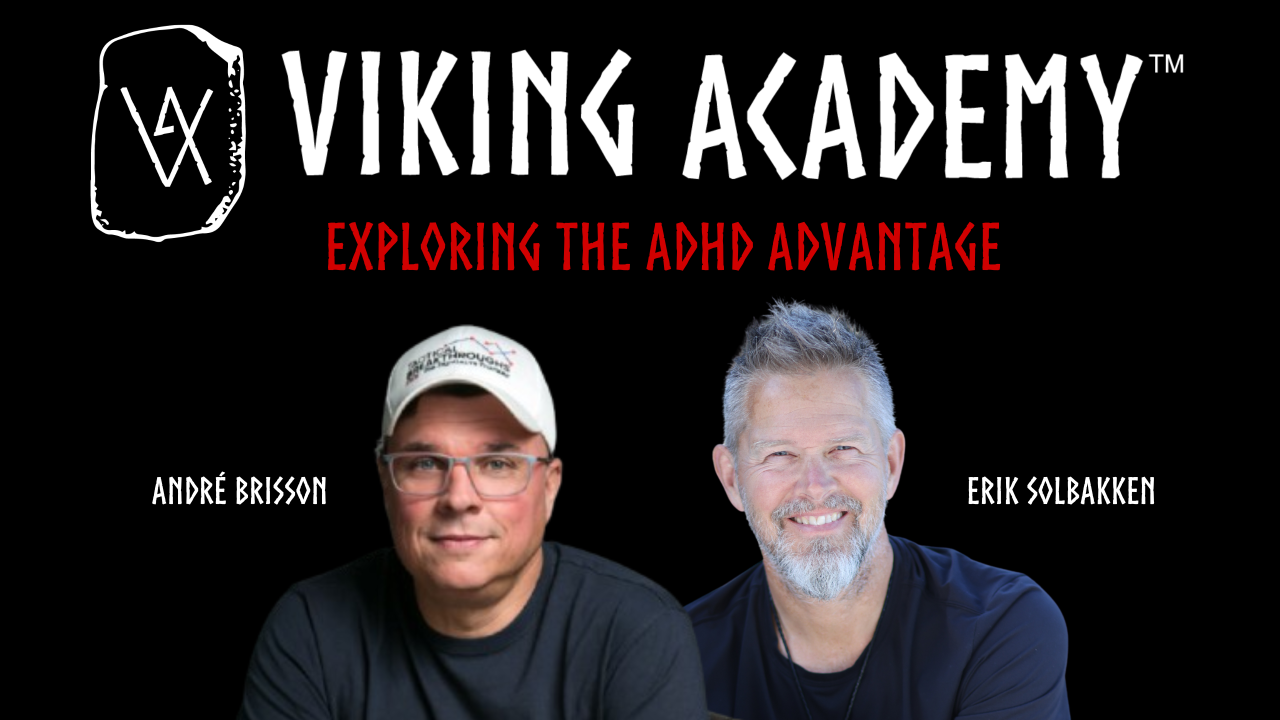
#23: Exploring the ADHD Advantage with André Brisson
Today, we explore how embracing neurodivergence can unlock hidden strengths and reshape the way we work, live, and lead.
I sat down with André Brisson, a successful entrepreneur, engineer, and the mind behind the Impulsive Thinker Podcast. Diagnosed with ADHD later in life, André had to rethink everything—from how he ran his businesses to how he understood himself.
What began as a journey to “fix” what felt broken evolved into a powerful mission to help others with neurodivergent brains harness their unique wiring. With raw honesty and hard-won insight, André shares how he learned to stop masking, start managing his energy, and build systems that work with his brain, not against it.
We talk about the costs of overfunctioning, the myth of being “too much,” and the liberation that comes from radical self-awareness.
Topics We Explore:
- Turning late-life ADHD diagnosis into a leadership superpower
- Breaking the cycle of burnout and emotional masking
- Building systems that support neurodivergent success
- Understanding the “cognitive hyperdrive” of ADHD
- Reclaiming energy, identity, and purpose in business and life
Connect with André Brisson: https://www.theimpulsivethinker.com/
Learn More about The Viking Academy: https://www.vikingacademy.com
Episode Transcript:
Hi everyone and welcome back to the Viking Academy podcast. This week on the podcast we have André Brisson. Now André is the host of the Impulsive Thinker and the Impulsive Thinker program for ADHD entrepreneurs.
Now, the reason why I wanted to have him back on the podcast, which I had him on before, I as reason why wanted to bring him back on is he has a really deep understanding and knowledge of personality profiles. And some of the personality profiles that we use uh in the strategic coach program that I'm involved in for the entrepreneurs is uh the Kolbe, the Clifton Strengths, the PRINT, and the Working Genius. Now, these profiles are for anybody.
This you just happen we happen to talk about it in terms of entrepreneurialism but in this podcast I wanted to share with you what these profiles do for you to understand who you are it's this is all about the exploration into you that's the purpose that's the reason why I made the Viking Academy podcast is so that you could pick up your sword and go and explore yourself and discover who you are and why you're here and what you're here to do the wonderful thing about these profiles is is they walk through the why you do things, what you like to do, and how you like to do them.
And when you take those three together and you interplay them on each other and have that understanding of how these profiles tell you more about who you are, you'll understand yourself that much greater. I had a bunch of aha moments during this podcast, as I normally do, and this one was no different than the other ones. Um, there's a couple fbombs, there's a couple jokes, there's a couple laughs as always.
Um, because, uh, that's just the way we roll here at the Viking Academy. So, if you're interested in personality profiles and figuring out a little bit more about yourself, which I'm sure you are, then this podcast is for you. So, there you go.
Let's go explore. André, welcome back to the podcast, man. Welcome to be here.
I'm happy to be here. Happy to be here. Welcome to Welcome to Happy to Be here.
Um, and this is like the probably the most awkward um intro. Intro that we've done. Uh, but I'm okay with it.
Well, that's good. I'm glad you're okay with it. Um, you know, it's what's really funny here.
Um, so we had our first inter we had our first podcast back uh the beginning of the 20 25 actually. Yeah, I think so. It wasn't it wasn't that long ago actually.
No, no, it wasn't that long ago. Um, but what happened was is that we talked about uh your ADHD the ADHD, the impulsive thinker. We were in that realm.
I really wanted on this podcast to dive into your understanding of personalities, okay? Because you've gone really deep as as always, like when you're going to do something, you when you really find something you're going to focus on, you go like all in. All in, balls deep.
You're full in, right? And so I'm curious just for to get kind of set the stage, what have you trained yourself on when it comes to personalities? Um, and then I want to dive into how you how you assess that when you're working with someone in terms of helping them understand who they are because I mean ultimately that's what I that's what we're after.
It's all about Yeah. It's all about understanding your uniqueness is what I like about it. And it's not really personality.
It's how you work and your natural talents and strengths. So it's not really your behavior. It affects your behavior or it's interpretation of how you work gets misinterpreted as behavior.
But yeah, I like I like this um because like one of my therapists told me like for 15 years I was working hard on myself reading a lot of stuff but at the time it was to figure out what was wrong with me to correct not actually understanding these were my talents and strengths and I should be utilizing them. Um, and then like Kathy Kolbe who's uh created the Kolbe A Index, she's like there's three parts in the mind. This is the model I really like from her.
Three parts of the mind. One is cognitive. That's what you learn and you know.
Um, and that's easily figured out by testing, you know, your exams and stuff like that. Then you have the affective part of your mind which is how you feel, what you love doing and what you like to do. And then what she has created is the conitative part of the mind which is how you do things the doing part of your mind.
And with those three parts you know we've had the cognitive for the testing we have the affective that's that's more the your personality and your behavior and MyersBriggs disc those are the personality test. Um they don't really identify what you do well and the conitive part understanding how you do it all the time every time and then it's your instinctive uh need to do this stuff is really cool so what I like is we have a few t a few assessments I call them tests but like the kbe index measures your cognitive part of the mind how you do things there's the clipton strength is basically your It's part of your affective because it's what you will spend your mental energy on.
So what you like doing and prefer to do. Then we have the PRINT the why of you which is identifies why you will spend your mental energy and that's more about your subconscious motivators. And then there's also another tool that I've been using is the Working Genius where it's about identifying which two geniuses that you have out of the six.
Um it works well. And the thing is all these things measure different things and they really work well together and they affect the nuances of that. So as you were explaining this I was just writing it down.
So there's cognitive which is our knowledge, a effective which is our feelings. Yes. And conitive co o n a t i v.
I believe it's how it's spelled. Conitive. Correct.
Y which is the how we do things. You're doing part of the mind. Yeah.
Yeah. How you do things, right? Yeah.
Um I I've you know I've got I've gone through those the the four that you just talked about the the Kolbe, the Clifton, the PRINT and the Working Genius. I haven't really dived I haven't gone deep into the Working Genius. And Kolbe has always been a harder one for me to kind of get my head wrapped around, but I'm getting better on it.
Um the the how part I liken it to here's my battery power. Like if I'm going to go do something, there's how much battery, how much juice I have to actually work on something. Um but let's so let's go into um so so you've gone super deep on this because I mean this is one of the things like when we're ever in one of these breakout sessions or when we're in uh strategic coach together because that's where you and I met and we go and we have breakout sessions.
We're talking with other entrepreneurs and someone brings up anything to do with any of these personality profiles. I'm going to call you just come in and go, "Oh, no. It's this, this, this, and this." And I've always been just like, "Holy crap, André." Like, you really understand this stuff like at a deep, deep level.
And that's why I wanted to kind of drill down on this for you. Um, maybe just Yeah, because the thing is I understand I can see the nuances work together, right? The how part of the brain working with the affective and the motivations are different.
So that's it's really interesting to me how to be able to explain our natural talents and strengths are being derived because it's all mental energy management is what I ee this. So if you can be in the right lane as much as you're as much as you can, you got infinite energy or at least you're burning that energy more efficiently. You know, I'm likening this where you just kind of framed that to following following the energy.
Like for me, it's like when what talking about unique ability and I truly believe that everybody was put on the planet for a reason, but we don't know what that reason is, and we're here to figure that out. I think that's part of I think that's the adventure of being human. We're the only species on the planet that doesn't know why we're here.
And and so you you're following the I call it the divining rod or the energy level and it's like oh what is what is actually making me excited. I think that's the universe giving me a GPS or something that's telling me where to go and where to find these things. And that's why I love these these personality tests or these profiles is it's it's honing in more and more on what's uniquely you.
And and I love how you also put down that you you've been working like you said you worked on yourself for 15 years to try and fix what you thought was wrong as opposed to taking who you are and using what you've been given, right, and what you've learned and what you like to learn and that's why you're here, right? That's that's what that's the purpose of it, right? And what I like about these, it validates the way you work, right?
A lot of times there's most people you don't work like the social norm or at the office or the company you're ha you're at or your family and this just kind of validates you're on the right track. This is the right way for you to do it. Um you know some people are very organized and structured.
They need that while like for me I don't like that it it res it it really grates a great grates me to be overly systematic. I'm more adaptable. I like to be able to be a little bit loose to be able to change paths when I can.
And my ability is very handy in certain sit circumstances while the other person's abilities are handy in other circumstances. So my way is not right for them but it's right for me and their way is right for them but not for me. So we got all these talents that instead of working on our like Dan Sullivan says, let's work by strengthening our strengths, not making stronger weaknesses because the weaknesses are determined by others.
So and then as entrepreneurs, even if you're working for someone, you should be having your weaknesses delegated out or someone else to help that because that's what they do best and enjoy. And this is what I really like about it um these these tools is that we you get that clarity and understanding of how you how you must work. It's not even you should work.
How you must work to be highly creative, effective and useful in life. And this is where having this knowledge of the self like exploring the self you being you the small s we'll call it the small s is leads to that deeper understanding and the one thing that I've been finding is that the more I the more I study the more I look the more I go into what I'm trying to figure out is my unique contribution to the world like why I've been basically I'm trying to figure out why the universe created me.
I mean that's my ultimate ethos is to just that's my biggest question. You know I was I I was listening to a podcast recently that I had just uh done with doc Dr. Jeffrey Gladden and um I I I actually love relisting to all the podcasts myself because I'm like holy crap there's a lot of stuff in here I didn't hear the first time when I was actually in doing the podcast.
So, I actually relisted to my own podcast because I'm like the guests have so much great information. He he had said um the it's the question. Don't be don't be attached to your answers, but be attached to your question.
Like the question is the most important one. And having that because then you're actually searching and looking for um you know, constantly learning as opposed to going, "Oh, this is the answer. I'm done." and I'm and I'm and I'm set in stone.
It's the question. And for me, the big question is is who the [ __ ] am I, right? Like really, that's the big question.
I I think that's a question that everybody really has deep down at their core. They're like, who the hell am I really? So, for you to get to a better understanding of who you are, I think this is what's really key with these tools is really cool because we can understand the what, the why, and the how.
Right? If you understand how you work, what you'll spend your money on uh your energy on and why you'll spend your energy on, I think it'll be it gives you a clearer sense of who you who you are. A lot of us are like mired.
You know, we we're supposed to show up to work 9 to5 do all this structured stuff in a certain way repetitive, right? And for a lot of us, it's that's not how we work. So, we get lost about who we are, right?
And the natural feeling or need to feel part of a community. And if you're in the wrong environment or the wrong community, you might say, "I'll try to blend in and fit in by being someone who I'm not." And this really helps us explain the differences, not use them as excuses. I hate it when people say, "Because I'm a a quick start, I I don't have to do anything, right?" or you know I got this strength from Clipton strengths and therefore I can't do it.
That's not true. It's just it's an explanation why you prefer things or how you do things um and then you make it work with everyone and it's self-awareness. You know that you do this and how I behave and how I do things does not work with other people.
Therefore I have to be cognizant of that. Either communicate effectively to them about the differences or you know find a middle ground because my way is not the perfect way for every situation and theirs may be. Yeah.
And it's kind of you and I had these conversations especially when it comes to attracting our perfect or ideal client to work with. It's like I'm not the right flavor for everybody nor and and I found that the more I become seated in the self, like in other words, I'm more comfortable in who I am, the more uh focused I get on who I am here to actually serve because the person I'm here to actually serve is the one that actually generates the most energy for me.
And so I'm finding that the bandwidth's getting more and more narrow, narrow, narrow, narrow, narrow. It's like like, oh, I'm out to change the world. No, not really.
I'm just out to change the people that are looking to be changed and have me help them with that change. Right. That's it.
Right. And so, so let's go. So, let's talk a little bit more just just for the readers and so or the listeners so they can, you know, listeners the readers.
There's nobody reading this. I hope there there's um the Are there someone else here? I don't see anyone.
So, there could be bunch of AIs and AIs in the room. It's always listening. André, they're always listening.
Bastards. Um, let's do let's talk about Kolbe as the as the So, we talked about, you know, the why, the what, the how, which, which equals the who, which, which I think is a great kind of um equation that you just brought out there. I like that.
But let's talk about the how. So the conitive this this colby let's talk about the four areas that gets measured and uh and then maybe I'll even give you my score and then you can maybe just explain to everybody how what it means. Yeah.
Okay. That's what I was kind of planning. Um so the Kolbe is how you do things and this is if by by knowing your four numbers I know how to manage you, communicate to you and and I'll know how you will solve problems or projects every time.
So the Kolbe has four action modes. The one is factf finder. That's how you share and gather information.
Then they have the follow through which is how you systematize and organize. You got the third one which is quick start. This is how you handle and risk and uncertainty.
So it's not like the risk of skydiving. It's just anything unknown. And then four is the implementer.
And this is how you handle tangible space. So every action mode has four or sorry three sections. So they have the counteracting energy strength, the accommodating strength or co-acting and then the initiating strength.
So every action mode has three zones of strengths. Yes, they're used on the number one to 10, but one doesn't mean you're better than a 10 and 10 is not better than one. It just identifies what strength areas that you have.
So like in Erik's case, his Kolbe A Index is 6473. So he has a six factfinder. So he is more about an executive summary person.
He is able to get the necessary details to move on to a project. Um, and while for me I'm an eight, I require a lot of specifics, a lot of details, and I have a longer energy, more energy, um, I need to spend more energy in that factf finder mode. While in Erik's case, his six requires less.
Yeah, my wife Erin is like the same way. Like she's she's a higher factf finder than I am. And I get, we can sometimes have a little bit of friction because I'm like, I got enough info.
Let's move. And she's like, "No, no, no. There's just more detail.
I need more detail." And understanding that has really helped us, you know. Correct. Yeah.
And that's why I say it's a great communication tool. So, like my accountant, he's a three factf finder. He just needs the the the the bottom lines.
Give me three things and off I go. I don't need to know everything. Um, and once I understand understood that, then I really tried to give them the main three things.
But it's also difficult as me because now I got to decide which is the most important detail to share. So um so Erik's four is for follow through and he is good at maintaining systems. Okay.
Um every time he initiates a project he will go look for a system that's already in place and he will sort of kind of follow it. Um, and if there's not one created or there's not one to follow, he'll kind of prepare one and create one to move forward. I'm a two followth through.
And I actually look for alternative paths all the time. And if I hit a wall, I will jump to another project. I'll jump to something something.
And in the engineering world, that's very frustrating because I don't it looks like I don't know where I'm going. But I'm able to go into um a project that's not well organized and still tackle it because I can adjust as I go. While people with an initiating follow through, they're very systematized and they need to have these SOPs.
Uh they like if they got a list of 10 things to do, they will do one 2 3 4 5 6 7 8 9 10 all in that order. Even if they know steps one and four are already taken care of, they must follow the system. Erik little less 1 2 4 5 6 I don't need 8 9 10's done.
Me I can go 1 10 7 3 2 1 like I'm adaptable that way and it looks like I'm chaotic. So So just to kind of bring this back to the listener so they understand. So the first one on the backfire, think about it for yourself.
It's like how much detail do you really need for like how you naturally collect and and and systematize and share data with people. The second one here I almost call it the it's almost the Rain Man, you know, the Dustin Hoffman um Tom Cruz movie with Rain Man where like he had to like I'm sure he would have been like a a 10 followth through probably because he has to have follow every little step every all the way, right? And so it's every little step in procedure.
Um, okay. And so then that's that would be like the second the second SC, you know, when I was thinking about the these three levels. It's like you're either a low, a medium, or a high in that uh the different strengths.
I want to say low, medium, high. Yeah. Yeah.
Yeah. Well, um, intensity. So, that was my eight factf finder coming out.
I apologize. Well, yeah. I'm just trying to sum I'm trying to simplify this down, but let's Okay.
So, we're talking factfinder and then how you follow through. Okay. Okay.
And then the third one. So just to like know that's a very valid question. So it means you have less energy or more energy in that action mode to spend.
So with my eight factf finder, I have more factf finding mental energy to use than I would in your case, Erik. With your six, you you're going to burn less less mental less um less mental energy on factf finding because you know let's let's go like this everyone has a 100 urgs of energy and with your your col gives a certain percentage so I got a higher percentage of fact you actually have a higher percentage of quick start so you have more energy quick start energy to burn than I do so that's the next one so quick start is how you risk you handle risk and uncertainty So you're a seven.
So you're really great at improvising. So when we first come to you with a project, the first thing you do is you come up with different ways to improvise or you're really good to be making a speech on the spot without preparation. Yeah, that's I'm very much very much like I can just and actually I here's one thing I wanted to also share with the listeners that once understanding who you are and how this or how you take action on things the the Kolbe uh results actually tells you what to do and what not to do.
Like I have this little summary and it's I'm if anybody's watching the video, they'll see my eyes peering up against the wall because I'm looking at these these all them. I've got the PRINT, the uh Clifton Strengths and the Kolbe up here on the Kolbe. This is what it actually tells me how I deal with uncertainty and how I take action.
It tells me race the clock and it tells me to do things at the last minute. Like it actually tells me that's the best way for me to do things is yeah you work effectively urgency yeah urgency it's more risk it's riskier and there's more uncertainty if you're working under pressure and but it just naturally seems to happen that doing things at the last minute that's when I get the best action but can you imagine if I'm with someone who is a like who's the opposite side of the spectrum where they stabilize their stabilizers but they're they're at the low level of quick start and they see me doing things at the last minute.
Can you imagine the anxiety it's going to give them? Correct. Because the ones that maintain, they they try to maintain and organize chaos, right?
On your end, you create the chaos with all the improvisation and and the urgency last minute, but they want the people who are on the opposite end of the spectrum, they're the ones that are the fddy duddies. They're the ones that all their, you know, they're sticking the buds. But in a company, you kind of need the people to make sure that they're going to reduce the risk.
They're going they're the ones that come up with plan A, plan B, plan C, plan D, 12, right to D. See, what I like what like for you, Erik, you're okay with failing. Your best working way is to actually try, fail, try, fail, try, fail, try, fail, try and be with ideas or different stuff.
And then all of a sudden at round 100, you win. You celebrate like that was the first time you did it. While the people who are maintainers and and stabilizers, they're going to say, "I was told a hundred times to go to hell on a on cold calls for one sale." That doesn't work because there's a lot of unknown and risk there.
So, they're the ones that come up with plan A, plan B. And what I like about this assessment tool is to be on a team, we need to have a balance of all these different strengths. So, you know, we need the stabilizers to make sure that the ideas that we're going to implement are well covered and that we're not going to keep running into problems, which stems chaotic.
Well, for you, you thrive on that. You like the difference opportunities to come up with new solutions. I like what you said there that I create the chaos and then someone at the other low end of the spectrum is trying to create some stability out to a certain degree.
You just explained the relationship between me and my wife because I just brought up Erin's Kolbe. So, she's an eight, which is the same as you as a factfinder. She's a six when it comes to um follow through.
But quick start, she's a two. So, you guys are polarized. Yes, very much.
They're polarized. Yeah. And the thing is that's the perception of you creating chaos from their point of view.
You're not creating chaos. You're creating new opportunities. No, I'm creating fun, man.
That's where the fun is is on the edge is on the on the cusp is like where are we at at the cutting edge? Where's the where's the newness? Where's the freshness?
Let's go. Let's go. Right.
That's where the energy is. I don't see it as chaos. I see it as Yeah.
I see it as fun. No, no, but for for the the stabilizer, it looks like chaos. Oh, what's he going to come in today?
What's he going to come up with now? Right. Because that means it's going to change their system.
It's going to change their stability. Oh yeah, Erin's gonna listen to this podcast. She's gonna be like, "Yep, André's got you nailed." Yeah.
And then the And then the last one is implementer is how you handle tangible space. So on the one end, the one, two, and threes, they're conceptual. You can talk to them about anything and they can conceptualize it in their head or they can conceptualize a solution.
While the initi implementers they need pro they need models and hard stuff they solve problems by using their hands. So I use this as the example is the mechanic. So the conceptual person can say hey we got a problem with the fuel filter because we're having these symptoms and they can see in their head that they're tracing a diagram and it goes here.
It makes sense here. If you talk to the implement mechanic, he's going to go or her say, "I have no idea what you're talking about." They will have to physically touch and follow and check. They will not be concrete physical connection for them to solve the problem.
And they're the ones that need it. Um, and you can't have a conceptual conversation with them. They won't see it.
And for them to see it, one way is to have more pictures or you got to give them more time to understand sketches than that. So it has to be more concrete and real versus So in this case, uh, Erik's a three, he's very conceptual, but he's touching the line of being able to repair and do things. Um, so that just means you have less.
In Erik's case, he has less mental energy to do hands-on work, physical work, uh, you know, maintaining the vehicle or whatnot, while someone else higher up on the implement. And they're very quality, uh, very so they're very detailed for quality on the physical side. And they and they will actually move things around.
They have to physically move things around, sit at a desk to see if they like it versus just look at dimensions from a diagram. It was interesting. We had this conversation at the last uh the last uh workshop I was at because I was taking the second u module uh in year one um to and we had a a presentation on the Kolbe and we went through this and that last column that you call it the implementer has always kind of confused me because it's it's about physical space and tangibles you know.
Well, implement she meant from the actual term implements tools. Yes, I know implements. But another is another is demonstrator is another best term to explain it.
They're good at demonstrating. Yeah. Um so, so here's the thing.
We take So, and this is just example for one of these these tests. So, we kind of did a deep dive into the Kolbe. Uh we found out that I carry chaos for my wife.
We understand that and she's trying to keep it stable. But this just this is the thing I wanted to share with everybody is that once you understand how you how you do things opens up your knowledge and understanding that other people how they do things is them. Yeah.
It's how they do it. If you can understand how somebody else does something, especially in an organization, in a business, if you can understand how they do things, it can remove not only a ton of friction between you all, but it can help you actually give tasks to one another that are best suited to you. And that's the thing for me is this this concept of a unique teamwork, unique ability teamwork, like having everybody doing what they're uniquely qualified to do.
And when everybody's giving doing their unique ability, you have you'll have more fun and energy and excitement because you're doing what you love to do, how you love to do it, why you love to do it, and then it everything fits together in a beautiful puzzle. Like if you had a unique ability frame, like a unique ability teamwork, that's the universe. Like that's the like if you look at nature, it's that's what it's doing all the time.
The bees are doing what they do. The birds are doing what they do. The trees are doing what they do.
And it all is working in in harmony. And it's all making this beautiful picture known as nature. Humans, humans on the other hand, oh, we get involved and we don't know what our unique ability is and how it fits into the big puzzle and the big picture.
And that's why I think humans create so much bloody con conflict and confusion and chaos. Is because we don't understand first of all who we are and second of all we don't understand how other people are and then thirdly we don't understand how we can put them all together to make a really cool picture known like like the like nature does. Yeah.
Yeah. And people think that my way is the only way or is the best way. Well, that's a given though.
Yeah. That's just human nature. Yeah.
Yeah. Yeah. Well, when someone does thing does something a different way, you're like, "Well, that's that's not right.
That's not the right way to do it." No, just happens to be not your way. Yeah. And I I think one of the big things that came out of me came out of this for me, especially when we did this with our accounting firm in Kelowna, is we started looking at everybody's we did the three, the Kolbe, the Clifton, and the PRINT.
We did all three tests and we started looking at it and I was like I realized this person doesn't there's a bigger ethos here. It's not personal. It's just their personality.
Do you know what I mean? Like so it's not it's not the person's not doing something to piss me off. It's not to piss me off because I think I take it personally when they do things in a way that I don't want them.
So it's I take it personally but it's not personal. It's their personality and once I understand that's how their personality I like that word personality for these tools because this is how why and what they do. The personality is like the disc like behavior.
So like th this is more about yeah me saying whoa let's slow down Erik let's make sure we got plan A plan B and C. Yeah, you'll misinterpret that as a personality or behavior issue, but it's actually my Kolbe saying, "Let's slow down and check everything, you know, stabilize things." I think we're probably getting hung up on definitions here, but yeah, that is how that's part of who you are, which is part of your personality. Do you follow where I'm going?
Like that's just part of your personality is the way you how you do things. It's just part of your personality. No, personality is not how you do things.
It's just how you behave and interact. But how someone's but isn't how someone behaves is part of who they are. It's part of who you are, right?
So how you do how you do something is how part of who the person is and who the person is is all of these things. It's like there's so many I guess what it is is there's personality is more about the thought patterns, feelings, and behaviors rather than what you'll do. But anyways, I I understand what you're saying.
I think we got we're getting caught up on semantics. We're getting caught up in semantics. I just wanted to be people think if you're a [ __ ] or an [ __ ] it's because of these.
That's no no. If you're a [ __ ] or an [ __ ] it's because you're a dick or an [ __ ] Yeah. Like that.
Yeah. But that's also if that's that's also part of your personality. It's part of the person to think what I mean.
Just I'm just saying it's it's a there's so many parts to a human being. Jo put it that way. It's so there's so many parts to a human being.
There's all these pieces and it's it seems to me to be almost an infinite playing field because as we go deeper into these understandings and we just talked about this one personality or this one uh assessment assessment. Yeah. Call it an assessment tool.
One aspect of the person, right? One aspect of them. As I go deeper into each one of them, I start understanding the nuances even more so for myself and for others.
Now, you're really good at seeing that nuance in others. I have because I haven't gone so deep down into this. I'm curious to see what what have you seen as patterns or common Yeah.
Patterns or common misconceptions of things that people could that the listener here could go, "Oh, yeah, man. I should really pay attention to this when I'm when I'm interacting with another person." About themselves or others? Well, others.
I think it's like both. I think it's both. It's It's always both because once you understand more something about yourself and then you go, "Well, I wonder how that I wonder how that here.
I figured out what color the sky is in my world. I wonder what color the sky is in that person's world. Oh, that and that's val and that's exactly true.
Like for me, I've always said I've been a a student of human behavior since I was a child. Okay? And what that was was I always asked why.
Instead of judging or criticizing their behavior or their reaction, I always asked why. Why did they react that way? Why do I react?
So if you're that curious side, if you say, "Okay, hey, they're trying to tell me I got to do steps one through 20 where I'm okay with 11,8 and 20." Why are they forcing that? Or why are they very passionate about that? Is it the way they work?
So if you start asking the why versus I don't like that, therefore I'm going to put some sort of label or judgment, that's where we I think that's where we lose it. I I think that's that's coming back to that that um comment that Dr. Gladden said was the question be more be more attached to your questions than your answers.
So the answer is already defined. Well well it's also like for example someone does something like that and I human nature is instantly go well they're a dick. Okay.
And instead of going, "Well, they're a dick." Going, "Why did they act dick dickish?" You know what I mean? You're So, I love your framing on that. It's like going, "Well, I wonder why they behaved that way." Which I think takes it I think what you're doing is also detaching yourself from the personal energy of the emotion that you're personally being attacked.
You, André, are being personally attacked. And you're not you're not going I'm not being personally attacked. This person is just behaving in their way.
I wonder why they behave that way. Yeah. But you need to have an open mind to be looking for those as well.
You have to be open that you might be misinterpreting people or you might be misinterpreting the situation. Yeah. Because like the other thing is I always ask without knowing.
Like I know a lot of people say, "Oh, because you're a factfinder, you do this, this, this." Well, that's not a why. You just told me why I behaved the way. So you've already predetermined uh the answer, I guess, in a lack of better way.
If that if this is making sense. Yeah. No, I Yeah, I'm picking up what you're saying.
So, it's like that person that asks you a question and when they ask you the question, you can tell by the way they ask the question, they've already formulated their answer in their head and they're just trying to check or trick you into a validating or validating their position before. Yeah. And I think this is where the complete openness and honesty I think it's openness and honesty um which is another concept that I had a conversation with Grace Gavin uh on the podcast about uh no honesty kn honesty.
She was talking about being open and honest and it's that combination of being open to what you're saying, open to let's see what it is, right? But the honesty I think comes into going being really truly honest with yourself and saying do you really know for certain what's going on? Because really when it comes right down to it, I get to these conversations with people and I go, you know, when it comes right down to it, none of us know what the [ __ ] going on here as Earth, like this entire existence of life, none of us do.
But but we keep trying to think we know what's going on. Or when we get a when someone gets a little bit of a inkling of figuring it out, they go, "Oh, this is the answer now that they've grabbed onto that." And then instantly now you have a fight with somebody else because you're all fighting over that one answer instead of everybody just agreeing going, "Yeah, we have no idea why we're here, but let's all try and figure it out together." And I think that's the consciousness, that awakening that needs to happen in human in the human species for us to survive to not go through another um extinction event is for us to finally agree with one another or to be open and honest to say we don't really know what's going on.
Let's just keep working together to figure out more of the pieces instead of saying this is the way. And I think that's what I really appreciate about you, what you just said there is that people are saying, "Oh, because you're a high factf finder, this is this." And you're like, "No, there's so many other facets to it." So, you're open to the fact that you don't know, but you're curious to find out why. Right.
That's that explorer curiosity that you have. Yeah. And the other thing I like about Kolbe is Kathy Kolbe came up with a creative process, the Kolbe creative process.
And it uses it requires all three parts of the mind. And the first one is motivation. So if you're motivated to do something, you will use your conitive strengths.
But if you're not motivated, you're not going to use your Kolbe strengths to solve a problem. It's just not going to work. So we got our motivation.
Do you know enough about it? Do you have the will to do it? What more do you know about it?
And then we instigate our conitive strengths to execute the project. And what I like about the motivation part is how do we get someone motivated to use their doing part of the brain effectively? And this is where I like to PRINT the why of you.
So this actually identifies two subconscious motivators out of nine. Okay? And if your subconscious motivators are tickled and you work within it, then you you you demonstrate your best self.
But if you're triggered in any way against these subconscious motivators, now you're in shadow self. And now what I like about this tool is this is the why part, why you do things. So I'm going to I'm going to list off the nine quickly and I'll talk about Erik's PRINT.
Um so PRINT one is for things to be correct, perfect and right. You know they strive for perfection. Two PRINT is to be needed and appreciated.
So they orchestrate success of and through others. Three is to succeed and achieve driving to specific goals. Four is to be special and find meaning in life.
So they recognize uniqueness and create distinction. PRINT five is to be knowledgeable and smart. So they synthesize ideas and knowledge.
A lot of people think that they're know-it-alls. Six is to be safe and secure. Anticipate, manage risk and rewards.
And the seven is to enjoy life and be happy. So they create and explore possibilities. Eight is to be strong and self-reliant.
So make things happen. And nine is to have peace and harmony. So they drive collective perspective and action.
And these subconscious motivators, it's for you, but you also want to do that for others. Okay? It's a two-way street.
It's really cool. So, in say that say, sorry, say that one again. So, the PRINT is not only about you being your best shadow self or or best self or shadow self.
You also want to help others be that as well. Okay, that was a that was a a part that I was unaware of with the PRINT that it's actually the way I want. It's the way I want others to be.
Actually, that makes a lot more sense now. Like for me, I'm a 18. So, my eight is to be strong and self-reliant.
I make things happen, but I also need if I'm triggered and people is not going to make let me be strong and self-reliant, then I'm going to become aggressive and I'm going to become dominating. That's my shadow self. But if I'm my best self, then I'm very supportive and I get stuff done.
But at the same time, that's how I coach. That's how I raise my kids actually is I want them to be strong and self-reliant. Yeah.
Even if their PRINT doesn't match that. So this this again, these these three personal or I know you don't like the personality. That's fine.
I'm over it now for now. Yeah. Okay, that's good.
Okay. Get that get that factf finder down. Okay.
So these three assessment tools is like the why you do things, the what you like to do, and how you like to do it. So we started with the how. This the the colby.
This is how you like to do things. Now we're shifting back up to why we want to do things under the PRINT. Yeah.
Um, and so but the thing that I was unaware of with the PRINT is I understood it was like my and that was the one I've been able to understand the most because it it was like oh now I understand why I act the way I why I feel so passionate about certain things or why I have negative reactions to certain things. It's because something inside me has been and this, you know, the trigger word trigger, which I I hate that triggered.
I I really can't stand that word triggered, but it's it's it is true. It triggering triggers. It's very triggering, man.
I hate the [ __ ] word. Anyways, um yeah, don't you don't trigger me with trigger. Yeah.
So, your one PRINT just went off. You're everything has to be correct. True.
Correct. Right. Yeah.
Which is so my understanding again with the with the numbers is like the number there's a first there's a one first number and then there's a second number the first number is your major the second one so for example I'm perfect correct and right and number three is to succeed and achieve you're one and three y a one three right um the interesting thing for my wife Erin is that she is actually a um she's a one as well so for things to be perfect correct right but her her second number is to be safe and secure.
And so the interesting thing is when you take her need to be safe and secure, perfect correct on safe and secure. The minute I go and do my quick my quick start and I'm okay with uncertainty and risk and I'm entrepreneurial and I go go. Well, yeah.
Your how your how is triggering her. My how is triggering her why. Yeah.
Right. Yeah. So, how I do things triggers her her safe and secure in there, you know.
But interestingly, when we went through and did this personality profile with our accounting practice, there was a ton of safe and secure in there. It makes sense if you're if they're taking care of their clients and they're good with it. Well, but but there need to be safe and secure.
I think it falls back into because they did math and 1 plus 1 equals two. I know that it'll be the same going forward. There's my safe and secure.
Like is there helps numbers piece? Yeah, that makes it Yeah. But I'm pretty sure they got a lot of follow through too as accountants.
So it's very systematic which supports the safe and secure because you can have some of your talents kind of uh support it, amplify it or counter it and put kind of keep things in tone. You just I just add another aha. So like like like your seven quick start if there's some injustice your PRINT will actually tone down your quick start if you're in your best self but your three PRINT to need to succeed and achieve your quickster can amplify that.
Okay. Try different things. Explain that again.
Like you said that if the if justice hasn't been served uh like like your one PRINT in a way I kind of summarize it as it's if there's a like for me I never really did anything in business unless there was some sort of injustice something that wasn't correct perfect or right engineering world they're just so arrogant and there's only one way to do it if not you're a loser so I've really created my own company to fight that right that's just like me with the accountant success formula I'm sick and tired of the model that they had and I And that that's what fired me, right?
So if you're in a scenario like that, you're not going to randomly improvise to deal with an injustice if you're staying in shadow self or sorry in best self. So it'll tamper down your you're probably going to start thinking more about your improvisation, your different ideas. But if you're in shadow self, you're one can now amplify your quick start to just go randomly do a bunch of different things and different ideas.
I'll rip the the Viking shield and the axe off the wall, then I'll just go to battle. Yeah. So, and that's where that's where the nuances are.
So, like if we want to now talk about the Clifton strengths, what you'll spend your energy on. Um, and I like this definition. A strength is a natural talent or pattern of thought, feeling, and behavior that can be productively applied.
A natural ability that comes effortlessly because and become stronger with practice and refinement and their termination their termination their definition of weakness is an over or underutilized strength I've always said that your strengths can become your stren uh your weaknesses or anything that gets in the way of your success that's a weakness so they've identified 34 different themes I'm not going to list them all all 34 I'll just talk about Erik's uh five. So what it does, it identifies your top five strengths in the four different domains.
How you execute, how you influence, how you build relationships, and how you do strategic thinking. So Erik, you are strategic. Uh so you create alternative ways to proceed and spot relevant patterns.
You're an achiever, so that will actually amplify your three PRINT, your need to succeed and achieve as well. So achiever is a hard worker. They possess great stamina and they like being busy and productive.
It's like an inner drive that doesn't make sense for to other people. Um, we just can't stop. Your third one is futuristic.
So, you're inspired by the future of what could be and your visualization of that future is always a bigger and better and inspires others in yourself. You're a maximizer. That's your fourth one.
So you focus on strengths and you figure out ways to stimulate personal and group excellence. So you want to transform something strong into something superb. You're not going to work on something that's weak to make it stronger.
You you're looking ways to make something stronger. And then you're a relator. I think we relate to ourselves because of the strength and our one PRINT and me and some other stuff.
But you as a relator, you got close relationships and you your deep satisfaction working with friends to achieve the goals and you're drawn to others that you already know are close and caring and trusting. So this is what you will spend your energy on. So you will using your other talents um you're very good strategic thinking, you're an achiever to go go, you see the future a bigger and better future and you're positive about it.
Then you find things that you know that's strong and make it stronger. And that's why you're very charismatic and you're very good with people because you can relate to them. You just don't get to know them.
You relate. You always find a way to relate to them somehow to connect. Yeah.
Very much so. I love how this this the simplified thinking around why you want to do what why the why the what the the how. Like why you're doing something, what you why you like certain things, what you what things you want to do or no, why you're doing something, why you're doing stuff, what you're doing, and how you do it, right?
This why what this how and it really what I did is I took it and I dropped it into chat GPT as well and I got it like started understanding it even better. And for the listeners out there, you know, you can once you get these kind of assessment tools, you can then play with your with AI to put them together to really like to cross analyze. Basically, you get André in a in a in a in a in an AI because André understands this so well.
He understands all the nuances, but you can take and throw it together. And the crisscrossing of all the different why, the what, the how painted such a bigger picture for me to understand who the hell this Erik guy is, right? And what I what I want to do.
What's really funny, too, is when I've gone through and done these ones, all of a sudden it's explaining things to me and I go, "Oh, well, that's why I did that. That makes total sense." Or that's why this gives me energy and this other thing doesn't. Well, that totally makes sense.
So, it's like this this you're discovering who you are, but when you discover it, you're like, "Well, of course that's how I am because I already know who I am." But you don't know the why the why you're acting that way or behaving that way. Um, and and that's the thing that the the PRINT is you don't understand the why unless you understand like you got the numbers because there's a lot of those behaviors appear the same but the why of the behavior is completely different.
So like I thought my daughter she was a um originally I thought she had she was a nine to have peace and harmony but she turned out to be a six to six uh a six to be safe and secure because I thought she wanted peace and harmony because she wants to save the oceans and she wants to go marrying biology to do all this but actually it was her why is actually to make the ocean and animals safe and secure.
That's her why. Even though the behavior is representative of a harmony person. Okay, I I'm gonna get this will throw you away.
My you know how kids they don't get along when they're teenagers, right? So, we had a scenario where we needed to ask my oldest to babysit the youngest because she was still having some separation anxiety about being alone because we wanted a date night. So, my daughter, my oldest is like, "No, she's going to be mean.
She's going to poke and prod and make it blah blah blah." And my wife was trying to explain to her, "No, you need that. She's going to be fine. And then also I said, this is after half an hour and I just stepped in and said, "Zenia, she requested you.
She feels safe with you." So I don't think she's going to cause issues because she needs to feel safe. And she actually stood up from her bed. She was about to yell at me and then all a sudden she's like, "Oh, okay." That is one of the biggest ahas I'm taking away from this is that PRINT that underlying why is actually what I want for other people.
Right? That's I want that for them. So now this is what I like about this.
This is how you can communicate and delegate and get people to do stuff. So for you, Erik, if I got a project that's going to take a day and is due in four weeks, I'm not going to tell you until the beginning of week four because I know you're going to do at the last minute because you're quick start. Right.
Right. Because you're going to lose track, whatever. You're going to put it off until you're going to get there to the urgency.
Okay. But now at the same time is if there's some sort of I need you. So I'll go, "Hey, Erik, I need you to correct this.
I need you to make sure this is right. Um, I need you to understand, identify patterns, and I need you to make sure that the customers can relate to this and make sense. All right?
But I need you to do these five things. And these are the goals for the project. Okay?
Now, here's some information. Just give me an executive summary. Figure out how you're going to do it.
And I just need a solution written down. That same project. I'm not going to communicate that to my team here.
It's going to be different because right now what I did is I tickled your motivator. Something's not right. I need you to fix it.
I set you a bunch of goals because that triggered off your sorry that activated your your three PRINT you need to succeed and your achiever strength. Me not giving it to you to the third week activates your colby. Me giving you some information or the information that you're going to disseminate on your own.
That's more like your calc uh your colby but asking you to make sure it relates properly to our customers just activated your what again. Yeah. Yeah.
And the relator on the clipton strikes that. Yeah. Yeah.
Yeah. Yeah. Yeah.
Yeah. Wild. And this is how and that's what I like about this.
So when I start seeing people have given me resistance, then I really look at these tools or I start to I start to make guesstimates. I've been at this for 15 years. Like you said, I've deep dove, worked with Kathy Kolbe and a lot of these other people around it is you just try to find how they're going to relate to the request.
Right? My assistant, it's all about harmony. Everything is has to be in peace and harmony.
So, she's making sure that she's helping my coaching clients feel safe. Actually, she is a 69, so safe and secure, but also there's harmony between everyone that they got the right information. Um, and and the thing is like, oh, the other thing we should talk about the Kolbe is me like it's all about energy management.
So, we go in cycles through your MO. That's what they call your modus uh modus operandi. Um and you cycle it.
So how you start the project, you'll do it a certain way, Erik. I'll do it a different way, but in the end, we're still going to get the same amount of information. It's just you're going to do do more cycles through your ammo than I would.
Right. Yeah. So you use up you're using up you use up the battery power and then you have to go recharge it and then you come back.
Correct. Battery power to recharge it. Yeah.
And this is where I start saying is energy doesn't dictate time or sorry time doesn't dictate energy. Energy dictates time. So if you want to look at as the part of mental energy you'll be more efficient.
Um if you can work within your why, how and what effectively then you're going to that energy burning is more efficient. So you're going to spend more time on it. You you can't say I have x amount of minutes with my factf finder or my clipton strengths because if you're not going to use that energy properly you're just a puking you know a smoke puking badly tuned diesel engine you're just burning a lot of fuel and getting nowhere fast they it would the thing that I I envision in my head is you know you're running a big business you got all these different people you've got all these different personalities if you could clearly understand and how each person operated on these three levels, the why, the what, and the how.
And to be able to not only put them in the right spot so that they're feeling energized of dealing with their That's what all this is. Yeah. And then and then when you go to give them any specific projects, you're able to articulate it in a way like you just did, which is customize it to that individual person's I'm going to say it.
I know you don't like it, but I'm going to say it. That person's personality. Okay, this is the personality and so that they can then perform at their top their optimal and then this is people perform their optimal.
The interesting thing for me though is when we I I can see it clearly. So I can see the the the application of it. It's fantastic.
I love it. But my energy levels to actually go and understand each person and try and understand all these different personality profiles or the assessments and then integrate it and understand it and do it. It it sucks the living daylights out of me.
Like I have this saying in our businesses and I say I do not manage people. I never manage people. I do I'm never a manager.
Like I'll be I'll be in charge but I'll never be in control. Right? Like I never want to be a manager of people like I just can't be a manager of that.
So is that like I need to find a who to manage and to help this sort of situation right yeah and making that statement is you can we can have an identical person with your mo Kolbe mo with your PRINT and your Clifton strengths but they'll be a great manager. Okay, that that I don't understand. Just because you're a certain uh MMO, a certain PRINT, and a certain Clipton's drink doesn't mean you're stuck in one role.
There's no perfect MMO for a certain role. There's more success in it. Um if you're allowed to be like just because society doesn't allow you to do things the way you want to and be free to be yourself, then we got to pigeon ho into certain things.
But in the end, all these talents are really good for a manager. It's just you don't want to or me and you like we got the entrepreneurial trait of go go go and wanting to go forward that we don't we're not good at managing people. And I think that could also fall under Working Genius.
So this this tool the Working Genius they got six different types of geniuses or talents and two of them are identified so that that's your working competencies two of them are your working frustrations. You can do it but it's very very frustrating and and then two and then two are your working geniuses. So your Working Genius the two you should be working on two of them are competencies and two are frustrations.
So there's six of them. Wonder I'm I'm looking at mine right now and I'm laughing. What are yours?
I don't know yours. No. Okay.
Well, so the working fr the frustration, the areas of working frustration are enablement and tenacity. And so it says under enablement, you aren't naturally gifted at or don't derive energy and joy from providing others with assistant for pro assistance for projects or tasks. Right.
So what are your what are your top two? Uh is invention and discernment. Yeah.
Because you're naturally gifted at and derive energy and joy from creating original and novel ideas and solutions. Right. And discernment assessing merit vocability this idea and solution.
And discernment for me I'm discernment wonder. Uhhuh. So the our discernment is misunderstood as well and it could be misunderstood as a counteracting quick start trying to keep chaos is just we really go through and think it through.
So discernment is about assessing the merit and workability of the idea solution and I'm a wonder. My second one's wonder. So identify the need for improvement or change.
So when I get someone says here's a challenge or a problem or whatever I go discernment first then I wonder. So I assess the merit and workability and identify the need for improvement or change. That's just my natural Working Genius.
And my bottom two is galvanizing and enablement. Galvanizing is generating enthusiasm and action around an idea or solution. You can tell by my tone that's really not one of my competencies.
And enablement is initiating support and assists in the implementation of the idea solution. I'm not that. I like to just get the solution discerning.
I wonder what the solution is. It's solved. I don't want to stick around and figure it out how it works.
I'm on to the next. Yeah. Yeah.
This working this Working Genius is is um Have you have you gone deep down into this one? Like not much. I've had a lot of conversations.
That's my next deep dive. But what I like about it, it's very great for teams. Yeah.
So that's why your Kolbe, your PRINT, your Clifton Strengths is great tools and talents for a manager. But your working gene is saying you're not really wired for that. Like me, I'm not an my galvanizing enablement is my my frustrations.
I can work in a team but I'm best alone but I'm not going to do a rah rah rah if you know if we're not doing our job. So that's why I'm not a manager. This has a lot to do with my Working Genius.
This this is funny. I'm actually I'm reading this working frustration again and this this makes way more sense now because I couldn't understand how those three other assessments someone else could have those same three assessments and actually be a great manager and I'm not. This makes sense now because there's even another layer to the why, what, and how.
Um, under working frustration for me, it says first of all, it was enabled. It says I'm not naturally gifted at or derive energy and joy from providing others with encouragement or assistance for projects and tasks. And then the the tenacity says I'm not gifted and don't derive energy and joy from pushing projects and tasks through to completion.
Right? So those are like the ultimate I do not manage. I do not manage projects.
I do not manage people. Leave me the [ __ ] alone. So what I like about the Working Genius is those terms.
You're not naturally gifted. You're naturally gifted. We can do it.
We can still do it. Yes. It's just not our right.
It's just like working competency. The one in the middle, it's neutral energy. You're good at it.
You're capable. But doesn't it doesn't burn energy. It doesn't give you energy.
That's a curious one for me, André, because like it says it says for me, I don't I'm capable and I don't mind rallying people and inspiring them to take action around ideas, projects, or tasks. I thought I I thought that because I've had a lot of people say that, well, Erik, you're like a motivational speaker and you get up and you you're getting people to change like for the accountant success formula, changing the business model. But I find that the energy I've had and you and I have shared a lot on this is when I'm trying if I feel like I'm constantly having to motivate others to into action, it draws a ton of energy from me.
So, I'm not interested in like if the person wants to change and I'm the right person for that change, man, we've got the energy. I've got the PRINT and let's go. Right.
That's your one PRINT that you that just spoke. Yeah. Yeah.
And so, but if I have to motivate them and inspire them and rally them, I I eventually I'm like, "Okay, that's enough." So, what did you say at the beginning? People say, "What about you?" They say that like I'm a motivational like I'm a coach. I do coach like I'm a business coach.
I have a sports coach like and a leader. That's your relator in your achiever strengths that they're seeing, right? You got build close relationships.
You connect. You relate to them so they feel inspired. And then your futuristic is your if you're I get you start thinking about this.
When are you most motivating to others when you're talking about future stuff? Always, always, always. So that's which is funny as because I I studied and became an accountant and accountants are all about the past and it was frustrating for me because they're always talking about the past and I'm like I've had enough of that like let's talk about the future.
So and what I just heard from you is actually your Clifton strengths that people are seeing versus the Working Genius in this case. Okay, dude. You know there there's so much.
So, I kind of want to I want to wrap this one up in a bow because literally we could spend hours and hours and hours going through all of these. You've got a very deep understanding of how all these work. And I really appreciate the fact that that just because you have these certain assessments doesn't mean that that's naturally the way you want to do things.
I think I see now why this Working Genius is good. These four these four assessments. So, we've talked about the Kolbe, the Chris Clifton strengths, the PRINT, and the Working Genius.
I see how all those really work together. But ultimately for the listener out there is like diving into you, figuring out you I think is the ultimate joy and adventure because I keep finding out more things about myself and go, "Holy crap." Right? And and you naturally, André, you can see that in other people.
And that's why I see that, you know, especially when you're in the impulsive thinker and you bringing and you're bringing these ADHD entrepreneurs through your program, how you you're going to be so powerful at helping them understand who they are so they can take their strengths and really maximize them on top of the depth of knowledge you have around the specific ADHD um strength that you have. Right. Right.
And my number two Clifton Strengths is uniqueness. So my drive is actually to find your uniqueness by using these tools. Yeah.
Yeah. I love that. Right.
Love that. Now I want to flip something at the end to think about. We have all these tools.
We know how we should work, why, what, and I'm thinking aware for Working Genius, but I'm working on that one right now. But this could all be screwed to [ __ ] by when you're triggered outside of the why. So, if you got some emotional dysregulation or past trauma that you're trying to deal with, like I see a lot of talented people all a sudden just shoot down a bunch of ideas and behave a certain way because of some past trauma and then that overshadows your talents and strengths because it's that protection mechanism your brain created many many moons ago.
So, it's forcing you to maybe be compliant when you prefer to be more strong and self-reliant just because of that programming from the past. And this is where I'm starting to see the nuances behind because me and you, we've talked a lot about our past. We've working ourselves a lot about like I'm doing a lot with internal family systems right now to start seeing, oh [ __ ] that wasn't a natural talent.
That was a protective mechanism by my brain. Yes. That's why because I'm asking why.
Why do they behave that way if I know they're cold behind it I get because my one PRINT it's wrong if you're going to start making judgments and assessments of people's behavior by these as defining them. This is more about understanding and and I think that's the the key point is I want to leave the listener off with is our understanding who you are and fig exploring yourself and figuring out and and exploring and discovering and I'm going to say figuring out because figuring out sounds final like as if you're finally going to figure yourself out.
I think I can see this now. I'm never going to figure Erik out but I'm going to be in a constant state of discovery. So it's that phrase from Krishna Murdy the mind that is constantly learning can never be hurt.
If we're in a constant state of discovery that's where the joy is. That's where the adventure is. And these and I call that constant refinement.
Constant refinement. Yeah. This this discovery I think that's where the joy and the fun is.
Um uh interestingly enough, my perfect correct and right PRINT always wants to find the answer, but it's actually in the seek. It's it's in the seeking that ye shall find. It's in the it's the journey, not the destination.
Even though you're trying to get to a destination, we're never going to get there. To truly understand ourselves, but we're gonna constantly un uncover and discover more, right? Yeah.
So, you know, with uh so Kolbe, Clifton Strengths, PRINT, Working Genius, all incredible insight tools to use. I'll probably have a bunch of these inside the or clicks or links to them and some resources inside the Viking Academy uh membership site. So, if you're not a member of the Viking Academy, go in there and join.
It's free. Um, all those resources are free. Um, anything else you want to add at the end of this there, André, before we, uh, I don't know if you want to take your first step is do the Kolbe A and then you add on one more as you start getting it.
But honestly, this type of stuff, I love working with people who want to figure something out and to learn to discover. So I work with all these tools and I love having conversations on how to to understand your uniqueness to take ownership of it and then how to restructure how things are done around you and how you do things differently to stay within your wheelhouse. How can people find you?
You can find me at the impulsivethinker.com. Um you can contact through me through there. Uh you don't have to be ADHD if you want to understand all these parts of yourself.
Like working with people who, you know, who want to get [ __ ] done. Um, and then, uh, you can follow a podcast, the Impulsive Thinker podcast, where we talk about this type of stuff frequently and business and entrepreneurial life. Yeah, you've had as well as ADHD.
Awesome. I appreciate that, man. All right, brother.
Um, until next time, everyone, keep exploring. Thanks for listening to the Viking Academy podcast. Make sure to leave us your honest feedback by leaving a review on Apple or Spotify, and hit subscribe so you never miss an episode.