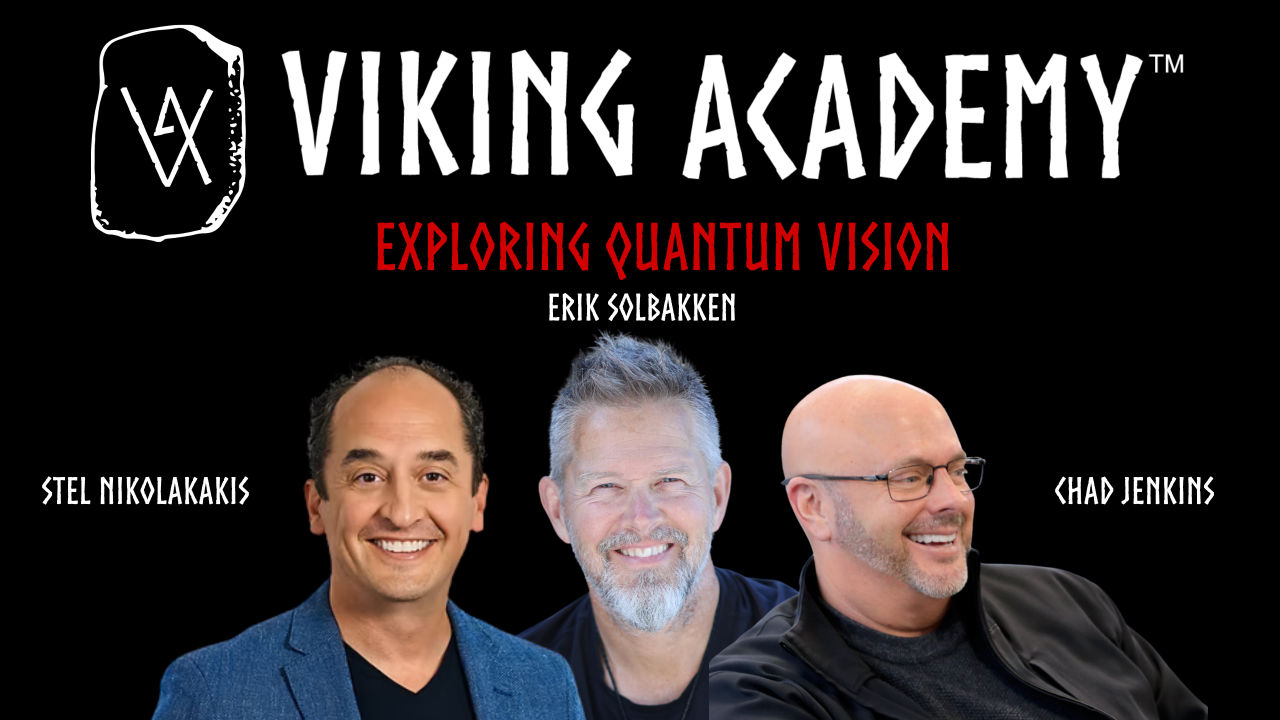
#22: Exploring Quantum Vision with Chad Jenkins and Stel Nikolakakis
Today, we explore a radical rethinking of how we perceive reality—one that challenges the belief that success is purely about strategy, hustle, or logic.
I sat down with Chad Jenkins and Dr. Stel Nikolakakis—two returning guests whose work bridges entrepreneurship, neuroscience, and high-frequency living—to uncover the science, philosophy, and human potential behind Quantum Vision. What begins as a curious conversation about multidimensional possibility quickly unfolds into a blueprint for collapsing infinite potential into present-day results.
In this conversation, we unpack Chad’s iC3 Formula for daily clarity, the emotional frequencies that shape what we can (and can't) see, and how imagination is not only real—but essential. We talk about vision as a living frequency, the power of collaborative alignment, and what happens when like-minded leaders unlock “Third Mind Innovation.”
Topics We Explore:
- What Quantum Vision is—and how it helps you see and shape infinite possibilities
- Chad’s “iC3 Formula” and the daily inputs that build visionary clarity
- Why reframing emotions and managing frequency unlocks higher consciousness
- How imagination and collaboration fuel exponential growth through Third Mind Innovation
- Moving from fear-based hustle to purpose-driven, high-frequency impact
Connect with Chad Jenkins: https://seedspark.com/
Connect with Stel Nikolokakis: https://ca.linkedin.com/in/stelios-nikolakakis-88b71114
Learn More about The Viking Academy: https://www.vikingacademy.com
Episode Transcript:
Erik Solbakken: Hi everyone, and welcome back to the Viking Academy Podcast. Today on the podcast, I have two guests. This time I have Chad Jenkins and Dr. Nick. Okay. Now what we've done here is we've gone through a deep dive. What we're doing is called Quantum Vision. They're telling me about quantum vision and how it impacts your reality. But not only that, it's how you see the infinite possibilities in the universe. As, as Chad put it, collapse it down into this reality. Now here's the thing. These two guys are really, really successful entrepreneurs. We're talking about quantifiable, actionable, results oriented. Things that we're talking about here. This isn't we're, this isn't full woo woo world. Okay? So this like we do talk in the Viking Academy, the mind, the body and spirit, and there's a lot of spirit conversations that we have, which can seem out there for a lot of people. This conversation is got terra firma written all over it, but it's gonna blow your fucking mind. It did, blew my mind. The conversation. We got into it now, the last thing I just wanna say before we get into the podcast is that at the beginning. Chad comes out with a fire hose, okay? He hits us hard and deep in terms of the concepts that that he's talking about. Get through that. Listen to the whole podcast, and then I recommend you go back to the beginning and listen to that intro again. So listen to it for a second time when you listen to it the second time after listening to the full podcast. It will make so much more sense. It'll blow your mind and it will change the way you see the world. It's changed the way I see the world now and I'm really excited to see what it's gonna do for you. So there you go. Chad and Stelle, Dr. Nick on the podcast coming up. Let's go explore.
Erik Solbakken: Gentlemen, welcome to the podcast.
Stel Nikolakakis: Hello, Mr. Viking.
Chad Jenkins: Eric, great to be here.
Erik Solbakken: This is gonna be interesting. we have, I haven't done, I haven't done a, a three-way podcast, so this, that sounded really bad when I, when it came out of my mouth, I was gonna turn, grab it and stuff it back in there. That sounded bad as well. but it'll be interesting to see how this, how this flies, is really interesting. 'cause I met both of you, the last time we were at Strategic Coach and you both mentioned to me this topic that I want to talk about today. About quantum vision? Yes. And both were excited about, you're both like, oh yeah, I want to, and Chad was like, I wanna be on that podcast too. And then Stella was like, yeah, I wanna talk about that. I'm like, well, fuck it. Let's have all three of us.
Chad Jenkins: Let's do it.
Erik Solbakken: Right?
Chad Jenkins: .
Erik Solbakken: So let's do that. So which one of you want to go first on this man? And just kind of set the stage for what we're talking about here.
Stel Nikolakakis: Go Chad.
Chad Jenkins: Interesting. So, couple fundamentals. Particles are just particles. They're in all states at once until they're viewed. So would you argue that a true visionary has the ability to see particles in a different state and one would argue potentially in a different dimension, and upon viewing the particles in that particular state, potentially in a different division, a different dimension? Then that empowers you to bring it into collapse into this current reality. So it's something I deal with on a daily basis, dealing with entrepreneurs all over the world. They have objectives, they have, I would argue, and I quantify vision in four different categories. 'cause all entrepreneurs have ideas. There is definitely a proportionate amount that is not taking action on those ideas. And I begin to ask questions as to why. And I feel like it's an absolute correlation with vision, clarity. It's entrepreneurs a lot of times are projected that you have to have confidence. You have to make a commitment and then confidence to take that first step. And I feel like this, that's an exact correlation to how much vision, clarity do you have? And if you take it step further, when you think about the vision, clarity, I quantify it in. Black and white. So this idea, this objective that you have, this outcome that you want, how clear do you see it? Is it in black and white? Like we grew up with, some of us grew up with a black and white tv. or do you see it in color? It means you can see it. You definitely can tell me a lot about it. You have an idea of a potential path to get there to create this future reality, future being, of course, subjective. Or do you see it in hd? Not only do you see multiple ways to create this reality, whether it be future or currently, depending on your understanding of dimensions, which one is best? You don't know. Or do you have four D vision and four D vision? I feel like collapses all time in space. You're able to tell me what it's gonna be like. Who's gonna be sitting at the table, who's a winner? What does it smell like, feel like? What's the weather like? What's the paths to get there and which path is best and what are the collaborations in my world that are gonna be required to create this future existence of or outcome that you seek? So to that, I feel like it is, you get to four D and you have the capability to see a different potential dimension where this is reality and that empowers you to bring it into the current.
Erik Solbakken: Okay. So that was like down the deep end. Next. Right away. Holy crap. Okay, so let's just, I want to stick back, take a step back here so the listeners understand what we're going at here. So we're talking about vision and you said a couple things at the front end here. Chad, that I just kind of want to unpack is that when we're talking about quantum vision, it's seeing. All of the possi, the particles, the possibilities
Chad Jenkins: in that state,
Erik Solbakken: in this, in the state. But you're also saying having a true quantum vision is to see the particles or the op, the possibilities in all their possibilities, which shall we call it alternate states of reality or different, different, multiverses dimensions. Like different dimensions. Yeah. Dimensions. Right. Dimensions, yeah. Dimensions,
Chad Jenkins: yeah.
Erik Solbakken: To be able to see that and then go, what's a way that I wanna bring it all together? And that's the vision, to be able to see, like, it's almost like, you think about it, this doctor, strange man from, from Marvel comic, it's like he sits there and he goes and he sees all the different possibilities, all the million different possibilities. And he goes, oh, this is the only one. There's only one possibility that. Ironman saves the day. Right?
Chad Jenkins: That's 40 vision. Truly. That's
Erik Solbakken: 40. That's a
Chad Jenkins: great analogy.
Erik Solbakken: Yeah. True. 40 vision where he goes, there's only one possibility where this, where we win. Yes. But Ironman has to, to, sacrifice himself, which I think we can go down a, you could go down an entire philosophical and spiritual road on the concept of sacrifice to get to the end, right? I think there's. you have to sacrifice something to get to this vision, but,
Chad Jenkins: correct.
Erik Solbakken: , but we're talking about seeing, and, and this kind of ties in again to what Stelle you and I were talking about, on our podcast, which is that most people don't see reality for what it really is.
Stel Nikolakakis: Yeah.
Chad Jenkins: Correct.
Stel Nikolakakis: Yeah.
Chad Jenkins: Yeah. just the understanding that every one of us have 2.2 million inputs in a day, and you're filtering out all but 131,000. Means we can wake up in the same bed, go to the same meetings, sit on the same zoom calls, travel and eat at the same places. And you have a completely different experience. And it is your reality than I do.
Erik Solbakken: Yeah. And in that state and, and we're all living in a multiverse. Like when you think about it, everyone's in a different state of, experiencing reality. So, and when you change the way, when you change the way you look at things, the things that you look at change. So technically we're all living a different multiverse, right?
Chad Jenkins: Yeah. We're the only ones that give things. Meaning things are just things. When's the last time you've been with somebody? Yeah. And something happened and they had a different visceral oftentimes reaction than you did. It's the same thing. You're the ones who give it meaning.
Erik Solbakken: Every time. Every time you watch a sporting event. I don't know if you guys are any hockey fans. You ain't got any hockey fans on here next? Yeah. Yeah. Go
Stel Nikolakakis: Leafs. Go.
Erik Solbakken: Yeah, go Leaf. Go. Go. Where though? Where the Leafs go? Gold
Stel Nikolakakis: Leafs win My Stanley Cup go.
Erik Solbakken: Yeah. Just once before I die. Right? That's the comment. Just one before I die. Right
Chad Jenkins: To lose.
Erik Solbakken: But you mean watch the same game? Yes, and you see it. It was an exciting game, but one person goes that it was total crap and the other one goes, that was amazing.
Chad Jenkins: Yes.
Erik Solbakken: Right?
Chad Jenkins: Yes. We give things meaning, which is the power that we all have. I wish that all of us would get to that level of understanding and understand the true power that we have. You're doing it. You're just doing it unintentionally. If you get to the place where you have this awareness and therefore the power, the capability, and not beyond capabilities, very distinct differences between capability and ability. You may own a piano, you have the capability of doing some incredible music. Your ability says you're gonna plink out, twinkle, twinkle, little star. Those are two wildly different things. So helping people
Erik Solbakken: or a chop or a hell of a chopsticks. Yeah.
Chad Jenkins: There you go. Yeah. So it's a getting and helping all of us understand the capability we have and to foster and grow the ability that we have, the ability and capability to elevate to is a huge deal. So that I, I created this formula called the IC three formula every day. 'cause what I'm trying to do is to empower others with what comes. It seems naturally like how is, how do I yield this level of vision? And the, I see three formulas, very simple every day that we're given everyone on the planet. There's no difference between you and I. As long as you have breath, you're gonna collect. And what I boiled it down to is you're gonna collect one of four things or all four things, relationships, awareness, knowledge, and experience. So the only thing I'm encouraging that you might consider is combine that with who, what, or where. And every time you do that, you're gonna create. So you may not create a four D level of vision, but it empowers you if you're running this program to constantly create. And now if, and I, you hear me say a lot of times if you do not have a vision partner that has the capability of four D vision, find one.
Erik Solbakken: Dr. Nick, what do you think when you hear four D vision? you're nodding your head here. What do you, what do you like when you hear four D When you hear Chad talk, say four D, what do you think of that in terms of four D? Okay,
Stel Nikolakakis: so, so first of all, thanks for inviting me. I love the last podcast. It was, it was amazing. And your ability to ask the questions to bring up concepts that can seem somewhat intangible, to make them tangible for people to grasp was amazing. And, so we're, all three of us are in Strategic Coach, right? An entrepreneurial program, and I'll use that as the metaphor to explain how I perceive how my vision shifts. And I'm NeuroVisual optometrist by profession. but this is one question that was posed at Strategic Coach and I'll, I'll pose it to you, Eric, and the listeners. how many of you have heard of quantum physics?
Erik Solbakken: Yeah.
Stel Nikolakakis: Everybody put their hand up right when it was POed. So then the second question was, how many of you understand quantum physics and then all the hands go down.
Erik Solbakken: Yeah.
Chad Jenkins: ,
Stel Nikolakakis: right.
Erik Solbakken: Yeah.
Stel Nikolakakis: And, so now you hear the word quantum physics and you, it's automatic that it's real, even though we don't know and understand it. But obviously there's been some applications and for it to make it real. Where it is not negated in any way. Okay. So first part, second part. When I say quantum vision, right. What does it mean to me for most people, when they see something that's real, okay. Or solid. Okay. Physical. And again, physical, they make the assumption it's real, right? And if we play within the visible spectrum of light, we see that those frequencies.
Erik Solbakken: Okay. Right, right. Yeah, because so I, I, I say that's what someone says. I don't believe it unless I see it. Unless it's real. Right. I won't believe it until I see it. Right.
Stel Nikolakakis: Okay. But here's the thing though, like what we see is only a small portion of what exists. Really small portion. And if I talk frequencies in terms of radio waves, UV rays, gamma rays, all these rays, right? We can talk in terms of frequency. So the higher order beyond and above this visible spectrum, the tighter the frequency it is, okay? Right? Yeah. Below the spectrum of light, the more broad this, the, the fre, the frequency is, okay? Now here's the thing, the other analogy I give is this, okay, so you have a dog whistle, and I blow the dog whistle. Does it have a frequency? I've
Erik Solbakken: told. It does. I've been told
Stel Nikolakakis: it does. But how do? Have you experienced the frequency?
Erik Solbakken: Yeah. No, no.
Stel Nikolakakis: Right. You, you experience it through the dog. The dog has access to that frequency, and we have experienced through the dog, but that doesn't mean that the frequency doesn't exist. It's just not in a, in a, in a space that we can necessarily grab it. Okay.
Erik Solbakken: Okay.
Stel Nikolakakis: But it exists. It's a high frequency that a dog can capture it, or the dog's auditory system could capture it. We necessarily can't as human beings. Alright, so let's start there. Okay.
Erik Solbakken: Yeah. Okay.
Stel Nikolakakis: Now, if we want to get to higher order frequencies that we can't necessarily experience, like, like see.
Erik Solbakken: .
Stel Nikolakakis: Okay. And there's a great book by ah, Dawkins, what's his first name? Anyways, it's called Letting Go. I don't know. Ugh, I can't remember the author's name. It'll come to me. So letting go is a book talking about how do we capture the higher order frequencies and in the form of emotions. Okay? So Lord of frequencies are the sadness, the angers, the rages, the so on, and so on and so on, okay?
Erik Solbakken: Oh, this is
Stel Nikolakakis: power
Erik Solbakken: versus force. This is Dawkins. Dawkins.
Stel Nikolakakis: It's Dawkins. Yeah. He talks about it in both. Well, let him go. He, he, he talks about the frequencies of it.
Erik Solbakken: Okay.
Stel Nikolakakis: Great books. Both of them, by the way. Okay, so if you have lower frequencies, which are the negative emotions, right? Sadness, anger for your right, what would the higher frequencies be? Or the highest frequencies?
Chad Jenkins: Well, happiness, joy,
Stel Nikolakakis: happiness, joyous, joy, love, peace, gratitude. They're all in this higher frequency. Alright, so now if we. Visualize. Okay, so we close our eyes and we have this image in our mind's eye. Is it real?
Erik Solbakken: It can feel real,
Stel Nikolakakis: but it could feel real. Is it real? Can you grab it?
Erik Solbakken: It well, I, I a defini. Well, again, what's your definition of real? If the definition is I can see it. I, I, I can touch it and feel it, then it's not real. But you can't touch and feel, you can't touch a sound, but the sound is real. So you're hearing that. Right, right, right. But in the vision, I can see it, but I can't necessarily hear it or touch it. So then, is that not real? So. It's, it's real enough to me. I see it in my mind's eye. I like, and I see with a lot of entrepreneurs in this, it's like the bi the ability to see a future, a g brighter future is like our superpower's go, oh, that's, I see that. Right? I see the opportunity. Right.
Chad Jenkins: Truly see it. So
Erik Solbakken: yeah.
Stel Nikolakakis: The reason, the reason I bring it up is I'm, I'm trying to define that, if, if it's real to you
Erik Solbakken: .
Stel Nikolakakis: That means you have a vision of some sort. Okay. Right now the brain can't tell the difference. Your mind can't tell the difference between what's real and what's not real. Okay. So even if you think you see something, or if you see something to the brain, it still sees it. The unconscious might still seize it. Okay.
Erik Solbakken: Yes.
Stel Nikolakakis: So what's quantum vision then, right? That's what we're trying to get
Erik Solbakken: the answer to.
Stel Nikolakakis: Yeah. This is where I'm going. So what's quantum vision? So what is it and at what level of frequency are we talking about that creates this quantum thing? And then what Chad mentioned was
Erik Solbakken: just to, sorry, just to, I want to just grab that. Just
Stel Nikolakakis: Yeah.
Erik Solbakken: The ability to see all of the particles and their possibilities and the different combinations is what we're talking about is quantum vision, is to be able to see all of the opport, the possibilities and the combinations of possibilities is a quantum vision to see at the quantum level.
Stel Nikolakakis: Right.
Erik Solbakken: Okay.
Stel Nikolakakis: Right. Okay. So then the question, what Chad mentioned is, here's all these particles, here's all these possibilities. Here's this space of having access to your ability to visualize. Right. Get this 40, I think it's higher than that, but four D, five D, it doesn't matter what you call it, but now if I can see and I can create a vision, okay. Whether it's the future or something, that means something to me. Okay. Now it's of higher order because it's not here. It's not in physical state right now. Okay. It's something that sits up here.
Erik Solbakken: Yeah.
Stel Nikolakakis: Here's the key ingredient though. I need to combine that with the feeling that's also connected to that frequency,
Erik Solbakken: right?
Stel Nikolakakis: So if something that I am seeing or visualizing, okay? And remember what Chad also said is there's no time and space at that point. So if I can visualize something that has meaning for me,
Erik Solbakken: that's the
Stel Nikolakakis: emotional part. Much the emotional part.
Erik Solbakken: Yeah.
Stel Nikolakakis: At a much higher level of love, of peace, joy, okay? And those two connect. Now my brain is already set up to really look for it so that it looks, and it sounds, the key word that you hear is manifestation. It becomes reality. It's always been there. It's just now it becomes aware to the person in front of us, to, to the object in front of us. So
Erik Solbakken: for example, like I watch Chad do this all the time and he blows people's minds away when we're in these strategic coaching levels with all these entrepreneurs, with all these great visions. And Chad will sit there and I can see him thinking, I could see the wheels going. And he's like, oh yeah, you combine that with that, with that, you bring it together, boom. And he puts it in front of somebody and they're, they just look at it like, where did you see how? And they go, oh my God, this is so powerful. It's almost like they go, how did I miss this?
Stel Nikolakakis: Yeah.
Erik Solbakken: Like Chad, you see at the quantum level, you see the poss, like, you see the possibilities and then you pulling them together and then you go, oh, and you put it in front of somebody, the idea, and they're like, holy crap.
Chad Jenkins: .
Stel Nikolakakis: Yeah.
Erik Solbakken: Right. But what so, oh, there's so many different roots. I wanna go down here. So I'm starting to understand what we're talking about now, but you're talking about, let's, let's just keep going on where you were talking about here still is that you're talking about that the, the energy frequency. aligning with the vision or aligning with the, the quantum vision, that is the triggering point that creates, gets your mind, your eyes seeing and your ears looking, hearing yes.
Erik Solbakken: What you're looking for, but that's and what your
Chad Jenkins: brain is looking
Erik Solbakken: for, what your brain is looking for. Yes. That's the beginning of the, shall we call it, the, the manifestation process.
Stel Nikolakakis: Well, okay.
Erik Solbakken: Or
Stel Nikolakakis: Chad says, Chad said something important. He said, if, if, if you can align with someone that also has four D vision, okay. And then that's when it gets exciting. Right? Now think about it if, and think frequencies. Now have you ever, done something with someone and they say to you,
Erik Solbakken: I've done lots
Stel Nikolakakis: of things
Erik Solbakken: with
Stel Nikolakakis: a lot
Erik Solbakken: of
Stel Nikolakakis: people, this
Erik Solbakken: podcast.
Stel Nikolakakis: I don't dunno. Yeah, I don't know. I'm not sure if that's gonna work. I can't believe like I did something to me and yeah. Okay. You ever Right. It's like negative Nelly or, yeah, yeah,
Erik Solbakken: yeah.
Stel Nikolakakis: They're always looking at the problem, like there's no, there's no movement in it. Right. So that the way that they're gonna perceive the world is based through the filter of, I'll call it a low frequency. Okay. And then a lot of times you'll say, Hey, what's, what do you, how's the your year look from now? Like, what are you excited about? So year from today, what are you excited about? I don't know. It's the right, you hear all the, they, they don't have ability to see anything at that point. Okay. Now the opposite of that is, this is what it sounds like when somebody's playing in 40 space. That sounds interesting. Tell me more. Tell me more. Okay. And then the other person's like. Holy cow. Okay. I don't even know how to articulate this. This is the key words that you're gonna hear. I don't know how to articulate this. Something is getting me really excited. everything that's happening right now, I see an opportunity. I'm not quite sure what it is. There's an AI component to this thing, and I really understand ai, but okay. When you hear that, that's giving you an indication that there's movement, there's something that's gonna be there in order to then allow the vision to come out of some sort. Okay? When you have two or more people, places, or things, as Chad was saying, what it does is it elevates an awareness and an excitement level that allows everything to have what I call coherence. Okay? I'll give you an example. In Strategic Coach, for the listeners that don't know, every hour or so, we take a tool and then we break down how we perceive the tool and the learnings within the tool. Now we're all in different businesses. We have different, so many different things. But by the time we're done, the exercise, it's like this one common theme comes out of it and it's like, wow, I didn't even know it was gonna take that turn. It's like now with your podcast Yeah. Where we're going, quantum vision, where the heck's this gonna take us? Now what happens is the sharing allows therefore to then be an ability for the other person to take in the information. And I'll say from an energetic level, but it's a higher frequency component of it. Where now the creative, which is what Chad was referring to, the creative internally starts to get processed. Okay. And then the second person will articulate what their concept was that they wrote down. And what you hear commonly is, as Eric mentioned too, which I never thought about it this way, boom. And then it takes on a different turn. So the key piece that I wanna mention is that when you have, think of wavelengths or frequencies, it doesn't matter if it's light, it doesn't matter if it's sound, doesn't matter if it's emotions, it's all the same thing. When you have two people or ideas that come together, what happens is once those frequencies connect and you have coherence, it creates a one plus one equals three dynamic.
Erik Solbakken: That's the, the alignment. When you find someone that you're aligned with and you just, you just have the, like, I, I gotta say for both of you guys, like the, the minute I met both of you, we started talking and instantly there's just this bang and it was like, Boom. And we're just, you're vibrating, you're aligned, and it's energetic and it feels like it's raising the roof,
Chad Jenkins: it's, it's raising it because there's more communication happening than the conventional wisdom that normal is today. Not physical, not verbal. But I would argue at a cellular level that's happening specific to the frequency, and one typically is vibrating at a higher frequency, but one becomes dominant and the other begins to elevate to that level. And then you're able to communicate at a much higher level without using the conventional wisdom that we understand. Communication happens today, at least as a population, you can move much faster. You, there's words. Words. We'll use words because again, it's the convention today, but you are truly communicating and able to leave stuff out. I see more than I can say all the time, but with certain people, I don't have to use that amount of words to convey the communication. So the reality is you're moving much faster and I feel like your description, the first time you begin to speak with either one of us, that's what you felt.
Erik Solbakken: Yes. Yeah.
Stel Nikolakakis: Sorry. Can you, can you share third mind innovation? 'cause I think that's a really good concrete way of people
Chad Jenkins: standing,
Stel Nikolakakis: sort
Chad Jenkins: of concrete. Yeah. It's interesting. Yeah. There's some folks around the world. I'm so fortunate that Mondays are spent engaging with entrepreneurs, helping them with four D vision to create this a path to the objective that they want. So there are some, Eric, you mentioned that the first time we began to engage, you felt a different, you could move. It felt like a higher frequency.
Erik Solbakken: .
Chad Jenkins: Third mind innovation, TMI is my reference to it. About a year and a half ago, I began to really study. There are certain folks around the planet that whenever I jump on a Zoom or happen to see them in person, I can just move much faster. What is happening here? I. And so I began to really study it and as, as it turns out, I do day night, every Thursday with my wife for I guess now 18 years. And one time she was unable to go because of sickness. She had to stay home with the girls. And I was just fast off off a plane. So I went to grab dinner by myself and I began to do this research on third mind innovation. I just put it in to see what in the world would come up. As it turns out, Ford, Carnegie and Edison would get together periodically, and they felt like they were tapping into the universe's wisdom and creativity.
Erik Solbakken: .
Chad Jenkins: Because they could move much faster. And they began to see things and share them with each other and would be able to respond to what was new. And they didn't feel like it was coming from them, but through them they called it Third Mind. And they would get together quarterly. A year and a half after I established TMI third Mind Innovation, and it's just an awareness that I had. I found out that it had been going on long, a lot longer, of course, than just me becoming aware of it.
Erik Solbakken: I, I was aware, I was aware of Carnegie's, his mastermind, the concept around the mastermind, but this sounds like it's even more honed into, to the, the like-minded frequency at. That level. Well, you see, that's what happens when we're, when we're at these, events, right? You can instantly, it is feel when you walk into the room. So we have the three different levels of rooms there, right? You can mi you can, I can feel it the minute I walk into one of the rooms. I know if I'm a free zone room, I know if I'm a 10 x room, I know if I'm in a signature room, you can feel the energy vibration and it's almost like sure, a di divine rod that kind of, I, I hone the room and then all of a sudden someone gets closer and it's this law of attraction and boom, I start having a conversation with them and it, it goes up. Or I start having a conversation with them and instantly my insides are just like, get me the fuck outta here. Like, I just gotta, I just gotta run away.
Chad Jenkins: I can understand the latter of that
Erik Solbakken: for sure. Yeah.
Chad Jenkins: Yeah. The earlier is way enjoyable. That's why I do what I do on a daily basis. I'm looking for that. Why not?
Erik Solbakken: This is,
Chad Jenkins: we all have this capability.
Erik Solbakken: So that's tapping into the divine. It's tapping into that third, the third mind integration. You're, you're tapping
Chad Jenkins: innovation.
Erik Solbakken: Yeah. The, that, that, that and that for me. That, that is what excites me is getting into that, that true exploration of the, of the, of the spirit. That's the mind, the body and spirit. I think almost coming all together. It's almost like a, Like a, the three come together when you're with the right like-minded people and all of a sudden you can feel it physically, you're stimulated mentally and spiritually. You feel yourself higher vibration. Like to come back to what you said, Dr. Nick, right?
Chad Jenkins: Yeah. Yeah.
Erik Solbakken: Wow. So here, here's a question for you guys. How do you, and, and, and Chad, you and I talked about this on, on our podcast, how you get into this state, but how do you consciously. Stay on top of, or how do you consciously hone this quantum vision to expand your quantum vision? 'cause obviously both of you have been working on this and thinking about it a lot more and, and actively engaging so that the quantum vision ultimately taps into this third mind integration. Right. And that's where, is that where you, are you finding a connection between the two for yourself, Chad, like that you, you find your, your ability to see quantum vision expands based on how much interaction you have with a third mind integration?
Chad Jenkins: Yeah. So I know the ones that I can get there immediately with, one's on the call today. typically it starts around five 30 in the morning headed to the gym. And if either one of us are available, why not? And it takes 60 seconds and you're there. Yeah. So that just the other person's vibrating at a, at a, and then like frequency. They have a general level of curiosity in alignment with what you also possess. It doesn't matter topic specific though. Sometimes that can be a catalyst to get the other party up to the same level. then you can use certain tactics like that if you're just trying to be intentional about it. And then once you're at that particular level, you can navigate to other topics. I mentioned the IC three formula earlier, and so I'm in search of the same thing. How can I empower other entrepreneurs to get to that particular place to run the program That creates endless value creation would to do that. I feel like you have to elevate to that particular level. So I begin to understand what's really going on here. And this is this. Currently the IC three formula is the best that I've been able to verbalize and create for others to follow the path. some I feel like it comes natural. I'm absolutely in search of them. I would say that there are more of them out there, but they're specific by category. So I have some very high end longevity level doctors around the world that in their craft, they're absolutely elevated to third mind innovation. so it's fun to chat with them specific about something they're so passionate about. Dr. Nick talked about the feeling that's required to ultimately collapse this four D vision potentially in a different dimension into the current reality. therefore, if you find them, them being those that are so passionate about what they're doing, that they have the ability, their visionaries, by default, they have the vision and the passion driven to create a bigger outcome for others. That's a clear indication that they have that level of four D vision, just not horizontal, but vertical, which are still amazing to be engaged with.
Erik Solbakken: Y you just said something there. I I quickly marked it down because it, it, and I wanna, I want to get your take on this. You said, how do we collapse this quantum vision into our reality,
Chad Jenkins: current reality? Yeah.
Erik Solbakken: Our current reality. I'm curious, why did you pick that? That, language around that is collapsing that into our reality?
Chad Jenkins: Mm. Yeah. So if you, that's a, we'll try to make it shorter. if there truly,
Erik Solbakken: it's
Chad Jenkins: still
Erik Solbakken: laughing right now. I'm
Stel Nikolakakis: curious.
Erik Solbakken: Yeah,
Chad Jenkins: yeah, yeah. So if, if there is, you put this
Stel Nikolakakis: in, in a half
Chad Jenkins: hour podcast. Yeah, yeah. If, if there's no time in space, if everything was created at the same time, there is no future. There is no past. There's just now. So what other explanation do you have other than multiple dimensions, particles in a different state, all. Particles in a different state. So your ability, this is how powerful each of us are. I'm able to see you two gentlemen on Zoom currently in a particular state. That's the power that each of us have is you're able to see that at the same time you're, everything is moving so quickly that it, it has to be moving so quickly if truly everything is all right now. So to be able to see different dimensions, then you're able not only just to see it, but then you have to bring it down and collapse it into this current reality that somebody else also can experience that other dimension. So you're just moving them between dimensions. But you have to be able to see it and then collapse it.
Erik Solbakken: Okay. Now, now it it, I instantly had that click because the collapse made sense. Because if everything's happening, it's like everywhere. All at once, all at the same, like it's all happening all at once. That means it has to be moving so fast. Everything so fast happening all at once. There's infinite realities all happening at the same time. Of course, you're collapsing down one of those moralities, collapsing it down into this, so you can see it, you can, you can, you can experience it
Chad Jenkins: and you're taking others with you. If you're able to elevate them to the same frequency that you have, you're literally collapsing it into the current reality
Erik Solbakken: as multiple. And the reality, the reality that the, the say, the three of us can comprehend at this, right. This moment in time.
Chad Jenkins: .
Erik Solbakken: Because there's other realities that are happening that you're experiencing and probably aware of that I'm not aware of. And Stelle, you're not aware of. Yeah. And, and the same way around like all three, like there's, there's all sorts of things that are happening that we're aware of that the other two aren't aware of.
Chad Jenkins: Correct. Even right now.
Erik Solbakken: Yes.
Chad Jenkins: Even on this podcast.
Erik Solbakken: Yes.
Chad Jenkins: We're just jumping different dimensions. No. And, and I have no training, no background, no education. It's a little bit of curiosity.
Erik Solbakken: I would, I would say a little bit more than a little dude that, that, that, that, Stelle, what do you do to get yourself into this mindset where you're looking for the quant when you're like, and now by the way, you guys have you, this is the one thing I love. It's like, once you, once you can't unknow, right? Now I'm going to be, and I hope the listeners is getting the same out of this as, as I'm getting outta this podcast. 'cause now all of a sudden, now I'm going to be, look like I'm looking at the world right now. It's just changed for me.
Chad Jenkins: .
Erik Solbakken: Literally changed. Like I
Chad Jenkins: You're literally creating this reality
Erik Solbakken: Yeah. That
Chad Jenkins: you see
Erik Solbakken: Yeah. The
Chad Jenkins: chair behind you. The couch. Yeah. The, the cup on the table.
Erik Solbakken: The fucking, the
Chad Jenkins: Viking
Erik Solbakken: acts. Yeah.
Chad Jenkins: Every bit of it. Like that is you're creating it and I'm creating it as well. That's what I see.
Erik Solbakken: Yeah. Still.
Chad Jenkins: Yes.
Stel Nikolakakis: Like how do you gonna open up a rabbit hole in a half? Okay. So I, I'll try to make this as real as possible. So it's graspable. Okay. And one thing that I've always done since I was young, is model success. Okay? So if I see someone that's successful, it's like, okay, what are they doing?
Chad Jenkins: .
Stel Nikolakakis: That's bringing their success and duplicate it. Okay. So what, here's some common themes that you hear a lot. Okay. Successful people, when do they wake up? Not at three in the afternoon.
Erik Solbakken: No early.
Stel Nikolakakis: Okay. So now my curiosity is why do they wake up so early?
Erik Solbakken: .
Stel Nikolakakis: Why not just stay up late at night?
Chad Jenkins: .
Stel Nikolakakis: What do they do when they wake up that early? Okay, so here are the questions. What do they eat? How do they eat? How do they live? what's important to them? All these things were curiosities for me. Okay. And there's pretty consistent patterns that showed up. Now with regards to, what Chad was saying? It's like, we're both up at five o'clock in the morning and doing our morning ritual. If you look at ancient cultures, there was always a morning ritual.
Erik Solbakken: .
Stel Nikolakakis: Everything's around sunrise. Okay. There's always something that happens. The meditation's happening in the morning. So, and I don't want to get into the details of sort of the ancient cultural thing, but it there, there's gotta be something to it that's connected. So here's a morning ritual to get the day started on a launchpad. Okay? Now how many times have you woken up going, oh my God, here we go. Okay. You never see successful people say that.
Chad Jenkins: No.
Stel Nikolakakis: They get up and they go, let's go.
Chad Jenkins: .
Stel Nikolakakis: And then my curiosity was saying, what's getting them so excited? Okay. And usually they'll see something that's purpose-driven, something that matters, something that's meaningful, right? But they've created a habit. And here's the thing, creating those habits as a human being is not easy. We're not developed to think and say, Hey, we had a high frequency. We're developed to be sad, angry, fearful, and all these things 'cause they're survival mechanisms. But now the question is how do you turn that around so that it's the fuel to support this vision. Okay. Quantum just means it's higher. And then allow that vision to pull you towards something that matters, which is connected to purpose. Alright, backtrack to the morning. Now, there's a great program that Kevin Trudeau created called Your Wish Is Your Command. Okay? And I'm gonna rephrase it a little bit. Okay? But these are the key five principles that he talks about. the first one he says is, how coachable are you? What's coachability? Coachability Index? Okay? So if you learn something or from someone that is creating success, what are the chances that you're gonna be coachable to say, I'm gonna do exactly what they do. The second you turn around and I go, oh yeah, but. Now kiss that one goodbye. Okay, second one is called the training balance scale. I'm gonna shift it a little bit, but for me is how much focus is on purpose or your why and how much fo focus is on details of what you need to do. Okay? And it should be a 99% minimum to one difference. Now, if you don't know what your purpose is, you don't know what your why is, you got work to do, that part starts to oscillate and then you start moving towards the direction of purpose-driven initiatives. Why? Because they drive you. Okay. Or I saw the drive that was happening with, again, successful people.
Erik Solbakken: Sorry, just to clarify that again. Just to get, and any of the listers got confused on that 'cause I did slightly so. So on the purpose, purpose and details is you want and
Stel Nikolakakis: details
Erik Solbakken: you want it to be. Which way?
Stel Nikolakakis: So imagine it's purpose, right? So imagine like
Erik Solbakken: purpose is your 1%, 99% is your detail. No,
Stel Nikolakakis: 99% should be purpose driven.
Erik Solbakken: Yeah. Yeah, yeah, yeah.
Stel Nikolakakis: And 1% should be on the details of how to do it.
Erik Solbakken: That's where your focus is.
Stel Nikolakakis: You got it.
Erik Solbakken: Yeah. Yeah. Always focus. Yeah. Yeah. Okay, good. Okay.
Stel Nikolakakis: Okay. 'cause you have to remember, the more you, you, the more you focus in the direction and what your purpose is.
Erik Solbakken: Yeah. The more excited that, that, for me, that's the vi, that's a Viking Academy in a fucking, in a nutshell, boys, that's like, it's, I want people to live with passion and purpose. And my, my, my, my thought or my ethos in this and where it's been going is that when we're. Actively exploring our mind, our body, and our spirits. Like in that spirit, that is the adventure, that's the discovery of, of who we are and why we're here and what we're here to do. And then you have this passion and purpose, and now you're, you're off. Let's go. Boom.
Stel Nikolakakis: Yeah,
Erik Solbakken: like, let's fire. Right?
Stel Nikolakakis: Get gets you up in the
Erik Solbakken: morning,
Stel Nikolakakis: get you excited to get you up in the morning.
Erik Solbakken: I just, sorry, I just wanted, I just needed to clarify that because again, it, some of the listeners I got, I got flipped over there for a split second, but I'm, I'm, it's interesting 'cause once you said it, I'm like, well, of course. 'cause that's,
Chad Jenkins: of course, it's
Erik Solbakken: funny because of course that's just the way I behave, but I just, I'm, I want to get some concrete things to, for people to follow. So yeah.
Stel Nikolakakis: Look, a, a lot of the things that I'm gonna say, it's easy to say of course. Okay. But you have to remember, our behaviors are driven by 95% of our unconscious programming that's going on inside our heads. Okay. So think about how that needs to get unprogrammed in such a way that guides us to what our purpose is. Okay? So, it sounds simple. It's not that, it's, it's, it's simple, but it's not easy. Okay?
Erik Solbakken: Yeah. Yeah.
Stel Nikolakakis: Now, when I, when I say
Erik Solbakken: of course, I'm saying, well, yeah, of course. 'cause that's how I already behave. That's what by that. Okay. That's what that here,
Stel Nikolakakis: here's the next one.
Erik Solbakken: Yeah.
Stel Nikolakakis: Who are you listening to? Who are you hanging out with?
Erik Solbakken: I'm hanging out with you guys.
Stel Nikolakakis: Okay. Now, if I'm listening to someone that's already successful in where I want to go, or I'm also hanging out with people that are also in four D with me. Okay. It's a key ingredient. What do they say? Birds of a feather.
Erik Solbakken: Yeah.
Stel Nikolakakis: Flock together.
Erik Solbakken: Yeah.
Stel Nikolakakis: Okay. So now he, so what? So that's what number three?
Erik Solbakken: Yeah, that
Stel Nikolakakis: number. Bridging index, training, balance scale. Then we got who you're listening to.
Erik Solbakken: Yeah.
Stel Nikolakakis: Now the next one. When you start something new, okay? It's easy again to be taken out by the unconscious programs. Are you good enough? I don't know if you could do this. I'm tired, blah. All these other things. So what do you do? The second? So it's the, it's the training skill. Most people have heard this, right? You don't know what you don't know initially. It's like driving a car. You have no idea how to drive a car. You're not aware that you don't even know how to drive a car. So you have unconscious incompetence, okay? You don't know what you don't know. All of a sudden you meet some cool dude and you're like, Hey, that looks cool. I'm gonna start waking up in the morning. But I have no idea how to do that. So now, conscious about the incompetence of the fact I'm getting up at five o'clock in the morning.
Erik Solbakken: .
Stel Nikolakakis: Okay? Now this is where it gets cool. 'cause you're gonna go hit the alarm clock. You're like, ah, why am I doing this? Okay, what's my coachability next? Okay, he's doing, I'm gonna do it. Bing. Here we go. Now you do that enough times and now you become consciously competent. you can do it. Now I'm up at five o'clock in the morning. Okay, here we go. Need to think about that alarm again and again and again and again. You do that enough times and now there's an unconscious competence. You just do it. It's in, it's in, it's a rhythm. It's a rhythm. It's part of who you become, and then you keep repeating this pattern, this pattern, this pattern, and now all of a sudden you start getting those results.
Erik Solbakken: Yeah.
Stel Nikolakakis: Okay. So when I say I have a morning ritual, everybody hears, wow. Yep. I get up at five o'clock in the morning. Yep. I juice every day. Yep. I meditate every day. Yep. I go to the gym five days a week. Right. This is a process. And then you start looking and you go, okay, so now I have this morning rhythm and ritual. How do you think my day starts low frequency or high frequency?
Erik Solbakken: Well, you're resonating in a high frequency,
Stel Nikolakakis: you're resonating in high frequency. Yeah. So if I'm resonating in a high frequency, right, and imagine now I'm gonna use the radio analogy. So I'm, I'm re I'm resonating on 1 0 7 0.9. I'm dialed in.
Erik Solbakken: Yeah.
Stel Nikolakakis: What am I listening to? Other people that are also resonating on 1 0 7 0.9. Now if I choose to, I can adjust my frequency to go to 99.9. Go to 1 0 1 0.3. Go to 1 0 2 0.1. Okay. And then I choose the frequency that I want to create my reality, and based on that moment. Okay? Yeah. When you have the ability and flexibility to have the range of frequencies to choose from, now you control the system. What by controlling the system is now you create visions of possibilities, tune into that frequency, and then this now goes to the conversation Chad was talking about. How do you now take that and bring it down to reality and it comes up as a good idea and they go, wow, would you come up with that idea? It helps so many people. So my personal vision can have a global impact based on the levels of frequency that now I can run on.
Erik Solbakken: You've given me a, a whole, there's a whole bunch of things on that, on the check. did we hit all five here? We had coachable?
Stel Nikolakakis: No, no. Number five. Number five is Repeat. Repeat it. Repeat and return. Repeat and return.
Erik Solbakken: Yeah. Okay. Repeat and return.
Stel Nikolakakis: Yeah. Number five is repeat and return.
Chad Jenkins: Run the
Erik Solbakken: program. Run the program. That's that. I love that analogy of. I remember, hearing, Tony Robbins talk about this is priming yourself because the way we experience life is, is how we, how you think about life is how you experience it. So why not prime? Absolutely. To experience the best possible version of it. But I really like the visual. There's a, I want to com combine what you guys talked about here, this visual of setting the frequency as high as possible as soon as you get up in the morning. So you can adjust your frequency up and down. You've got full range of motion. 'cause you can always go down easily, but going up is harder, right? Because once you've kind of bumped that ceiling of complexity, you have that frequency. You can, you can, you can go into where you can then collapse the four d, the, the quantum vision into this reality. You put the two together, right? So you've got this ability to go up and down and then you can collapse the four D or the, the quantum vision into. This reality. Did I combine those two together? Right.
Stel Nikolakakis: No, it's really good. It's, it's, it's, it's, it's the best way to explain something that you need to experience.
Erik Solbakken: Yeah. And then, and then becomes the experience part. Like how, how do you experience Well, and then Chad, this is what you do all day. You're doing this all day long, right? Yes. And like, you're meeting and talking to entrepreneurs all the time and, and, and saying, okay, you're so literally, you're already primed to look for, you're already looking. You have quantum vision. Do you guys say that to yourselves all the time? I have quantum vision.
Chad Jenkins: . I don't say, I'm trying to answer it. I'm trying to figure out exactly how do I produce the outcome That is the ability to see the capability of two or more people, places, and things coming together to create. Oftentimes it's being driven by an entrepreneur wants a particular outcome. They have an objective, they don't know how to get there. Sometimes they're fuzzy. Again, I go back to the four devils. They're black and white in their objective and their outcome and their wants and their ideas. They're black and white. Sometimes they're not even color hd. But if I, I can just tune into and began to see a picture and bring that from black and white to four D, it always, always, always engages and requires collaboration. There's nothing, anybody on this call or who hears this is ever done by themselves. It's always in collaboration with another person, place, or thing, or multiple people, places and things. So to be able to close your eyes and see the per the people, the places and things that come together to create this opportunity. That relates to your objective or outcome or want, or your idea is the cohesion between current reality and future would be the conventional term currently. And of course on the call, it'd be just a different dimension.
Stel Nikolakakis: You're
Chad Jenkins: right. But taking 'em along that path and being able to collapse it into a reality of which now they can see it too, it gives them what I would classify as a trajectory pivot along their own journey. It empowers them to create the outcome that they look for.
Erik Solbakken: And that whole process that you explained about what you're doing there is the process of having quantum vision. I. The best that I can because everything, the infinite possibilities and combining them. So you're doing, you're, you're, you're engaging in quantum vision all the time. That's what you're doing all the time is where's
Chad Jenkins: all the
Erik Solbakken: time? And, and it's all a collaboration because again, seeing the infinite possibilities is going, what needs to connect, what needs to be combined with what, what needs to be collaborated with, what to put together to, to collapse it down into this reality so that it becomes a possibility for the person to see.
Chad Jenkins: Yeah, there's some fundamental rules for me. Everything that you see, everything that you've seen and everything you will ever see, all started as an idea in someone's imagination. Nothing has been done by an individual. It's all been a collaboration of a person, place, or thing to create what we see now. So what's holding us back? Vision.
Erik Solbakken: Okay. I, I, okay. I just want to go in a little side slam here. When you're talking about that, listen, we're talking about the zoom call. We're talking about all the things that we're looking at in here. But when you're talking about a true collaboration from, shall we call it the creation of the world? We're talking the collaboration with the creator.
Chad Jenkins: It's all one.
Erik Solbakken: Yeah. All one.
Chad Jenkins: It's all one. We're all connected. Consciousness is all connected. I'm connected to you. We're connected to steal still's, connected to everything. This lady passing by my car. We're all connected,
Erik Solbakken: but anything that we have,
Chad Jenkins: so to create this current reality is a collaboration. Would we agree upon that?
Erik Solbakken: It would be a full collaborate. Yeah, it's an interesting concept. 'cause what you just said there, kind of, the concept of saying God is out there and instead where it's like, no, we are, this is what Jesus said. You are Son,
Chad Jenkins: everything.
Erik Solbakken: You're God sons the most high. We you are God, we are everything
Chad Jenkins: are, yes, we are. This telephone is this vehicle.
Erik Solbakken: Everything. It's all,
Chad Jenkins: everything, everything,
Erik Solbakken: everything.
Chad Jenkins: We're all connected. We all come together to current to create this current reality.
Erik Solbakken: Yeah. And the, but the paradox is, is that it's all one thing, but yet it's been split up into multiple infinite things. Like in my father's house, there's many mansions. There's all these things and they all collaborate together to connect, to come together to create a new reality. But it's all one anyways.
Chad Jenkins: When you're viewed, when you view it, particles are just particles. They're in all states at once until they're viewed.
Erik Solbakken: Yeah, until what is, what is that box? The, the, experiment. It's the, when when the light particles, they come and they split them in that,
Chad Jenkins: Yeah.
Erik Solbakken: Scientific experiment. And then they said
Chad Jenkins: they're going through slits,
Erik Solbakken: what you're talking about. Yeah. They go through slits and then if you observe it, it makes a different pattern than if you don't observe it, run it through, and then you go and look at it and then it's a totally different pattern. So that is correct. Light will change just by looking at it. Yes. Like things change the minute we look at it, which is like, like, we'll call it the scientifically proven that's what happens.
Chad Jenkins: .
Erik Solbakken: Right. The whole still, I just want to come back to this, 'cause when I saw you last time, you, you had this, shared it in one of the groups, I think it was in Toronto last time. And you just went boom. And you had this huge aha where you were explaining how. You saw things differently, like you guys are constantly seeing, I think I've watched you both constantly seeing higher and deeper levels of reality, or shall we say possibilities. It's like every time we get excited get that dopamine hit, it's because we found another connection to the infinite possibilities of all the particles. Like that's when the dopamine hit comes in is when you see a new connection between the particles, which gets you closer to understanding that it's all connected, but it's just, it's like an infinite game. It's like it doesn't have, what? Like it's an infinite game. There's like this constant you can explore till you're, explore till the cows come home. Right? And
Chad Jenkins: yes,
Erik Solbakken: you'll never find the end of it.
Chad Jenkins: That's correct. That's the fun part. So if you don't have a vision partner, find one.
Erik Solbakken: Okay. Talk to me a little bit more about that. When you say vision partner,
Chad Jenkins: someone who can see in four D.
Erik Solbakken: Right.
Chad Jenkins: A true, what I would argue is a, a true visionary.
Erik Solbakken: So you would say, like, given your experience of meeting entrepreneurs, how many of them are true visionaries at CN four D? I guess it would be a de It's not a black or white. It's, it's a, it's a, a
Chad Jenkins: scale. It's a,
Erik Solbakken: it's a scale. A scale, yeah. A scale of,
Chad Jenkins: of
Erik Solbakken: moving that on.
Chad Jenkins: Yeah.
Erik Solbakken: But how many do you see, see in four D, like I see clearly that you see in four D that's what you do every day?
Chad Jenkins: I see a lot of things. Yes, sir. I would say in the ones that I engage with still, I love you give a, give a percentage. Yeah. Do you think ten five or ten five?
Stel Nikolakakis: I I think there's, I don't know, this question's difficult, right? Because it's, it's, where, well, I'll give you an example, right? Like Chad and I have a collaboration called co. Okay. And if I look back to when it started, I didn't have the same vision that I do now. And I'm sure it's not gonna be the same as how I see it, a year or two from now, but it's much clearer for me now. And, so one of my unique abilities is to be able to reframe the past for people in such a way that creates a compelling vision of the future so that they could be more present in the moment. Right. So, I'm highly trained in NLP, timeline therapy, vision therapy. Like there's a, a lot of tools that I have, but it's part of what I'm unique at. Okay. So in, I'll go back to the frequencies in terms of, if somebody's driven based on fear, for example, which a lot of entrepreneurs are, it's what drives us. Okay? But the thing is, if fear keeps pushing us, it leads to burnout. it, it's difficult, it's not efficient,
Chad Jenkins: which, yeah,
Stel Nikolakakis: okay.
Chad Jenkins: Lack of clarity of vision,
Stel Nikolakakis: right? But, but again, Joel,
Erik Solbakken: hold on. Stop. Stop. You think fear is just a lack of clarity of vision
Stel Nikolakakis: or it's
Chad Jenkins: here,
Stel Nikolakakis: it drives. So go ahead, Chad. Come in on this thing. But for me, I see it as the driver. Okay. That pushes when somebody doesn't have a clarity of vision to pull them.
Chad Jenkins: Correct.
Stel Nikolakakis: Okay. Because it's a lot easier for fear to drive because we're so used to it. It's hard even having these conversations with an intangible say, what's your vision of the future? Okay. Now, the way that this happened is we were in a room with Chad and he said, you need to talk to that guy. You needs your help. And I'm like, I don't know who this guy is. Sure enough, we're in a breakout session and I find out that he has an emotion that's blocking him. And I'm like, how did? He goes, I just know. I'm like, how the hell did? Right. So what ended up happening? Deeper conversations and the ability for me to use my uniqueability. what it did is reframe the past, change the vibration, change the frequency level so that they had a clearer vision of the future. We good? Yeah. So now my collaborative partner comes in and he says, all right, let's have a conversation now. And uses his unique ability to be able to make the vision clearer for them. Sorry, I shouldn't say that. Hold a safe space for them to have clarity of what their vision is from an entrepreneurial, very structured, capable understanding of making it real. Because once they see how they can make it real with the construct, now it's like, all right, we can have this conversation. But the reason why it tends to be more successful with two entrepreneurs or places or things that are riding at a higher frequency is because they're gonna come up with a third mine innovation or ideas that didn't exist before, and it excites both of them. Okay. So the combination between letting go of the past, which is again, is part of the story, right? If I hear somebody's being challenged, it's like, game on. Let's go. And I use Oprah as an example. There's challenges there. Reframing those challenges gives you a pretty clear indication of their purpose and a clearer, dimension in terms of the vision. So think of it this way. So Chad said, black and white versus color versus 3D versus HD four D. Call it whatever you want. what black and white looks like? what black and white looks like?
Erik Solbakken: Oh, yeah, I was, I I used to have a black and white TV when I was a kid.
Stel Nikolakakis: But do what makes it fuzzy or not Quite as clear? Anger, sadness, hurt, fear, guilt, victim problem. What am I doing here? okay. There's a whole bunch of things now, when we grow, when we transform, when we discover something, when we do something different, all of a sudden now it's clear. It's, it's, i I have a color picture what's going on here? Still might be two DI don't have depth. But at least I know it's there. Okay. The more I understand who I am and again, where my direction is, now all of a sudden I have space between things and people. Whoa. Now it's 3D, because I'm in this reality that has depth to it.
Erik Solbakken: Right?
Stel Nikolakakis: Okay. Okay. The second it has meaning to me, and now it's purpose driven, there's global impact. it matters. Now the space happens within me, which then opens up the space, the possibility, which then gets you connected ultimately to the oneness.
Erik Solbakken: You, I got you on all that. I, I'm a hundred percent on the side. You said there's a collaboration you guys are doing. What was that? Collaboration. Tell me a little more about that.
Stel Nikolakakis: Covis
Erik Solbakken: Co vision. Talk to me.
Stel Nikolakakis: Chad, you wanna add more?
Chad Jenkins: So it's, it's, I'm happy to do so.
Stel Nikolakakis: And feel free to talk about Culver if you want, because,
Chad Jenkins: as, as a default, all entrepreneurs and I would argue all love, humanity has ideas you are given by your creator. This thing called imagination. And I would say that is in her, her, or whatever you would like to call it, that is it around the third grade, we begin to train it out of you take it from you, rob it.
Erik Solbakken: Yeah,
Chad Jenkins: you are, you begin to be trained to have convergent thinking and they take away divergent thinking. Some of us return, some just bug the system. So in entrepreneurs with ideas for some reason, I typically can feel when there's something holding them back. I don't have any skills, don't have any training. The other gentleman on call, very pedigree, very trained, very experienced. Very capable with crazy ability. So Dr. Nick is able to find it, help identify it, and open it up. So he removes those rubber bands that are holding them back from what I would classify as their authentic potential.
Erik Solbakken: .
Chad Jenkins: But then clarity of vision has to come into play to align with that full potential, and that's where I enjoy working with them. So he releases them.
Erik Solbakken: Yes.
Chad Jenkins: I help him see the future and the CoLab that we've created, which is entrepreneurs all over the world open and ready to collaborate with their unique value contribution to give it to you or to whomever to help create this future reality. Or as we talked about earlier, collapse that dimension into the current reality.
Erik Solbakken: I, I love
Chad Jenkins: that. So that's what Covis is,
Erik Solbakken: dude, I love that. That's fantastic. I, and I also just love the concept of collapsing, collapsing it into this current reality. But you guys are c clearly taking your individual unique value contributions, collaborating together to bring, to bring these entrepreneurs into that third, the third mind integration where they're integrating with other collaborate. Because if you can bring the other collaborators in there and they can, and if they're vibrating at the right frequency, the work that you've done, Nick, and then the work that you do, Chad, to bring them to that higher frequency, and then you can bring it in other higher frequency collaborators, which is your expertise, Chad, is to find those connect, like how we need to connect it all together. Boom, you bring that together. Then you've opened that third mind Integr. Hopefully you've opened the third mind integration, right? Which,
Chad Jenkins: yes.
Erik Solbakken: Then it puts,
Chad Jenkins: causes a trajectory pivot and
Stel Nikolakakis: you struck and then
Chad Jenkins: you their
Stel Nikolakakis: it to come into physical present reality.
Erik Solbakken: Right?
Chad Jenkins: Correct. Tons of fun.
Erik Solbakken: Yeah. You, you guys have totally done a number to me here. This is awesome. This is, the best part. I knew it was gonna be a great conversation. I had no idea what it was gonna be, which is part of the fun. That's the excitement, the discovery, but just my, like seriously guys, I'm looking around at everything now. Totally differently.
Chad Jenkins: Knowing that you do create it and you have the power to create it.
Erik Solbakken: Yes.
Chad Jenkins: Did all exist all at one time. Which dimension do you want to participate in?
Erik Solbakken: , yeah, I wanna, I want to hang out, resonate. I wanna, I wanna vibrate with you guys.
Chad Jenkins: Yeah.
Erik Solbakken: Bring it back to the beginning of the podcast, where very inappropriate conversation. Eric. You wanna vibrate with your friends?
Stel Nikolakakis: I like it. That's the best reason I've ever had.
Chad Jenkins: Yeah.
Erik Solbakken: Yeah.
Stel Nikolakakis: .
Erik Solbakken: Guys, anything else you want to add here before we, we sign off? This has been, this has been a brain burner for me. This has been awesome.
Chad Jenkins: . There's a lot more, but this is probably enough for the time in which we allotted. Let that marinate.
Erik Solbakken: Yeah.
Chad Jenkins: And then we can do it again.
Erik Solbakken: Let, yeah, let's do that. I, I definitely wanna do this again.
Stel Nikolakakis: One thing I wanna, I'll, I'll finish with this. The, Chad mentioned, right, that you can't do this alone. And the one piece in terms of who you listen to, who you hang, hanging out with, to get into a, Group or, an organization or people that, believe in you before you believe in yourself is how it all began for me.
Erik Solbakken: .
Stel Nikolakakis: And, just be aware of the environment that has what you want intuitively. 'cause sometimes you just don't know, right? Because that to me was the, a huge, huge, huge game changer. So I just wanted to make, if somebody asked how, where do I begin? I think that's where I would start.
Chad Jenkins: .
Erik Solbakken: Well, and, and if they're listening to this podcast, the first place you can start is join the Viking Academy. It's free, it's a free open source, and you get in there, you get access to all the podcasts, all its resources. I, I like what you've said. You've, you've, you've created a, a, a spark of creativity in me. This third, I, third mind integration. I see that at the Viking Academy is creating that space for people to come together to start. Opening up their minds to this, this quantum vision for themselves and to actively play. That's the other thing I just want to add at the end here guys. When we start talking about this, I get this energetic feeling of when I was a kid again and I was
Chad Jenkins: yes,
Erik Solbakken: exploring and discovering the world for the first time and going, oh, look at this. Like, you ever see these little, little kids? And I always get down. As soon as I see little kids, I'm like, oh, welcome to the planet. Isn't this fun? And they're just like, their eyes are wide, spacious, and babies, they're like looking around going, what is this place when you guys have been talking? And I feel the energy. I'm like, this feels fun. It feels energetic, it feels playful, like when I was a kid.
Chad Jenkins: . Get ready. A s gonna give you the opportunity to do that when all these rudimentary tasks that we can interpret today, value is created when someone executes a conventional task that's about to evaporate, what's one to be left? Your ability to be more authentically human. What do? Get back to that. Third grade, 8-year-old with that big imagination.
Erik Solbakken: Yeah.
Chad Jenkins: You just came outta theta state. Yeah. So you're beginning your trek into full consciousness, at least at the level in which you are at that age heavy imagination. And the good thing is you combine that with an awareness that everything is in collaboration, let your mind expand. Vision is the catalyst. There's capabilities all around you. What the capabilities typically do not have vision. So your vision combined with someone who has capabilities, creates an outcome. So wonderland
Erik Solbakken: and joyful and fun and creative ads.
Chad Jenkins: Yes.
Erik Solbakken: I, I love how you said that too, because I've been saying that a lot and with my other business, the Accountant Success Formula, I've been talking to these accountants. I'm like the, all these mundane numbers in boxes. I've been talking about it for 10 years saying, guys, yes, it's going away. It's going away quick. It's going away really fast. But here's the best part. What your clients really want is you, is you, is who you are as a human being and connecting with them and understanding them. Yes. So stop just trying to make every, like, accountants are so big on trying to make efficiencies and make everything go faster, quicker, quicker. I'm like, that's a race to the bottom. It's about your humanity. But this vision of that AI is taking away the mundane tasks so that we can be all become more human. I love, yes, that's it.
Chad Jenkins: Yes.
Erik Solbakken: That's beautiful. Yes. I think we're gonna put the cherry on top of this podcast, right. With that one.
Chad Jenkins: Awesome.
Erik Solbakken: Awesome.
Chad Jenkins: It's enjoyable.
Erik Solbakken: Thank you.
Chad Jenkins: Thank you, gentlemen.
Erik Solbakken: Thank you so much for being on the podcast, guys.
Chad Jenkins: Yeah. We'll do it again. See you guys.