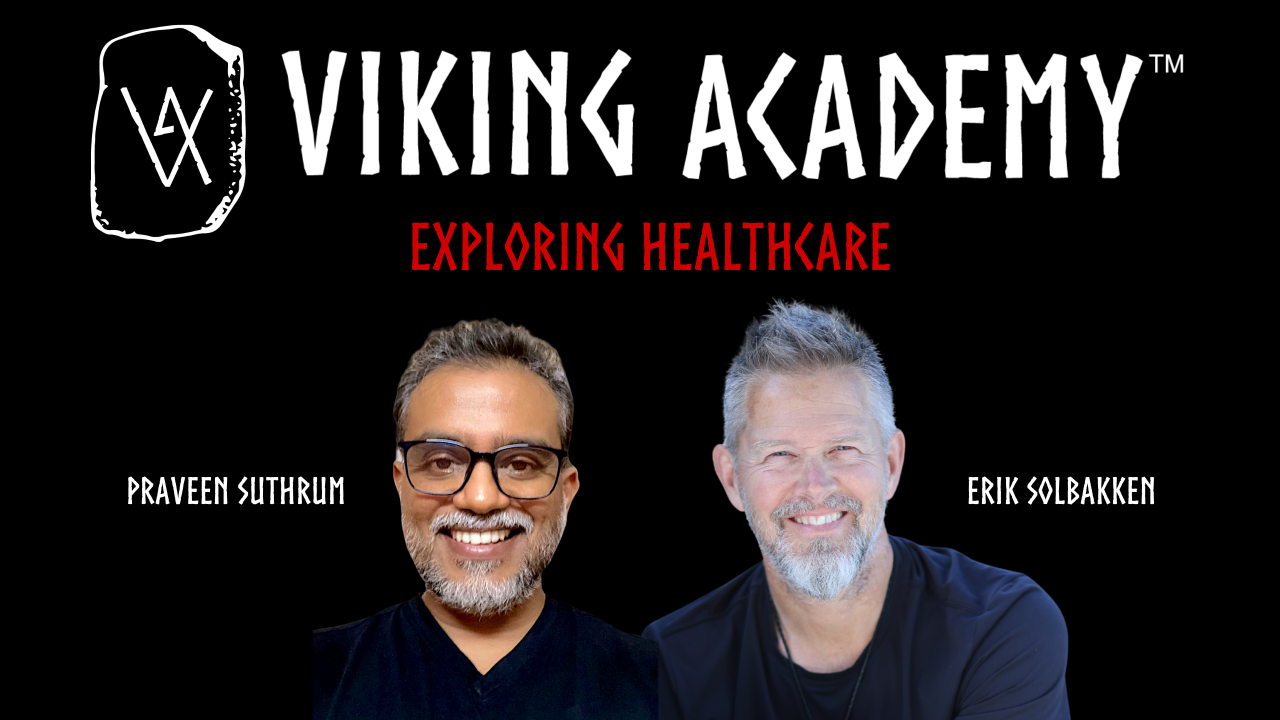
#15: Exploring Healthcare with Praveen Suthrum
Today, we are exploring the future of healthcare with entrepreneur and futurist Praveen Suthrum. We are diving into gastroenterology and how AI and digital innovation are reshaping medicine—especially when it comes to the body. As the Viking Academy emphasizes mastery of mind, body, and spirit, this conversation focuses on rethinking healthcare and taking control of our well-being and our bodies.
Praveen, cofounder of NextServices, has been at the forefront of integrating AI, automation, and innovative solutions to enhance healthcare delivery. He also cofounded NovoLiver, an initiative dedicated to reversing fatty liver disease through lifestyle changes. In this episode, he breaks down the shift from “sickcare” to true healthcare, highlighting how emerging technologies are changing patient care.
If you’re interested in the future of medicine and its impact on the body, this episode is a must-listen.
Topics We Explore:
- The true meaning of gastroenterology and why it matters
- How AI is transforming healthcare
- Why patients must take charge of their health
- The shift from “sickcare” to true healthcare
Connect with Praveen Suthrum: https://www.linkedin.com/in/suthrum/
Learn More about The Viking Academy: https://www.vikingacademy.com
Episode Transcript:
Hi everyone, welcome back to the Viking Academy podcast. This week we have Praveen Suthrum. He's a co-founder of a company called Next Services. Now, uh Praveen and I get into a conversation about GI Specialists. Not G.I. Joe, not the G.I. Joe doll with the kung fu grip. No, no, no, no. We're talking about gastroenterology. So, gastro.
Gastroenterology specialists. Okay. Now, what does this have to do with the Viking Academy? Well, I'm going to tell you. We talk about the mind, the body, and the spirit. And so in this episode, I wanted to dive down into more about the body. Now, Praveen is what they call him is a futurist, a healthc care.
Futurist. He sees where things are going to change in the healthcare profession. Now, in this podcast, we cover off a whole bunch of things. First of all, I find out exactly what gastroenterology means. Um, we talk about the shift that's coming with AI and what's happening to the healthcare profession.
In addition, we talk to kind of the trends that are happening with individual patients like you and me. Like what are we needing to do moving forward? Now, one of the things that happens in this podcast is it takes a little bit to get started. So, stick.
With it because near the end, we hit the gold, the mother lode, the thing that really gets me super excited. I didn't realize until we got probably about near the middle part to the end of the this podcast that Praveen and I are actually doing the same thing. the Viking Academy.
Is completely in alignment with what he's doing in the gastroenterology sector of um the profession, but in a way that you would never expect. It all comes down to the sacred and the seed of the self for you.
To actually completely embrace who you are. It's a beautiful finish to the podcast. I hope you enjoy it and follow through with it as I had a lot of energy and like you'll hear it in the podcast.
I but my energy builds up near the end and it's like crescendoing just as we finish off. So there you go. Um so let's go get the podcast going. Okay, let's go explore.
Praveen, welcome to the podcast. Thank you, Erik. It's nice to be here. So, where where are you uh jettisoning in from or where are you zooming in from? Uh I'm uh calling you from San Francisco. Oh, so we're in the same time zone. This is me. So, we're straight.
I'm just If you just look straight up, I'll be right above you. I am. Right on. So, Praveen, I I was very interested. I'm looking forward to this conversation with you because on the Viking Academy, you know, we dive into.
The mind, the body, and the spirit. And we're ex kind of call it personal development wrapped in a Viking blanket like to kind of envelop the Viking spirit of exploration and discovery.. And I've I've been doing a lot in the body.
Or a lot in the mind and a lot in the spirit, but we haven't had a lot of time to talk about the body. And when I had the opportunity to have you on the podcast to start talking about the shift that's happening in healthcare, I.
Thought this is going to be great. So um could you maybe just explain to me the gist of the book that you did? It's called the shift. how digital uh innovation is irreversibly transforming gastroenterinology and healthcare. I think for the readers first of all what.
Is gastroenterology and I'm I'm I want to make sure I'm pronouncing that right and then let US know about the book and what spurred you on to write it. Sure. so it's gastroenterology. It's uh essentially digestive health, right? Like but the book is not uh about how to get better as far as your.
Minutesdigestive health is concerned. In fact, it's it's for uh the industry of gastroenterology. Uh that's helping patients um avoid colon cancer and uh get better in terms of their digestive health. That is what GI doctors or gastroenterologists do. But the book has.
Broad applicability uh for all of healthcare. Uh because this shift which is driven by AI and other exponential or advanced technologies is going to affect not just gastroenterology, not just healthcare but pretty much all industries. uh and uh this book is number one it puts together uh the.
Shift which is occurring like so from a technology standpoint from a business standpoint on and how to take advantage of it but also it deals with uh the mindset shift that the industry has to go through in order to get off this survival mode uh and actually take.
Advantage of this and use the disruption which is happening across the board as the very tool to disrupt itself and uh keep going forward. So that's that's the big premise. What I've also done is I interviewed several experts in the GI.
Field and these are physicians, these are scientists, uh these are innovators who are building uh devices, uh equipment, variables, software, apps. Uh there's so much of innovation happening in gastroenterology. uh so all it also puts together these uh 30 plus uh different interviews and.
And then uses their voice uh also to help the reader understand uh where everything is going. Uh so you may take for example we may have a generic book uh on how AI or exponential technologies are defining all industries.
And then and then you may have a healthcare book but this specific book is going so deep into one single medical specialy uh that when you go deep enough you're going to find it reflect all the trends which are going on all around US.
And um when you when you go that far deep in into one specialty, you're going to somehow understand uh all the trends which are affecting all of US society uh business-wise and also uh for any particular industry in this case that happens to be healthcare and gastroenterology.
So you said a couple things here that resonate a lot with me.. So I'm I'm a CPA by trade.. So I was a CPA and then I started a consulting firm called the accountant success formula. I I wanted to serve, shall we say, the end patient.
Being the business owner, but I knew that there was something wrong with the actual uh profession and then I was so I was always looking forward to the future.
To saying like we need to start moving the profession this way so we can start taking care of our clients which in your case would be patients and so I resonate.
With you on that where you're actually you're this book is focused on the profession but not only the profession but GI specialists specifically saying here's what you need to look at.
But that's the first thing. The second thing is that you mentioned that as you went deep into that the same way when I've gone deep into say working with the accounting profession um you start seeing this ripple effect that's happening across all different sectors.
And this this this whole change. And so one of the things that I noticed is and you mentioned it a lot in here and and in your write up they called you a healthcare futurist which I loved by the way. I think that's awesome because you're looking forward and it's.
This proactive approach to life and it you know from a business perspective the traditional accounting world is always like oh it's all about the past the past.
The past and they're just fixing the past or just putting a band-aid on the past. I kind of liken that to healthcare. It's always been about oh if you have a problem come and see US. Now,.
The whole shift is moving away where everybody's starting to go, "No, let's be proactive with our health. Let's be proactive with our financial well-being. Let's be proactive with our mental health." And so, everybody's moving forward and saying, "Let's look at this better future and how can we how can we.
Lean into that instead of just being reactive?". And I'm assuming that's the trend that you've seen in the healthcare, especially in the GI area, that it's always been a reactive instead of a proactive approach. So there are two angles to this Erik like so the book itself uh when you say patients it's it's not exactly patients.
It's the physicians and the industry that is serving the patients that is of concern that's as far as the book is concerned right yeah and that's the same way the accountant I that's what I'm saying is I worked with the accountants to help them so they could help the.
Their business owner clients like so I'm helping the profession so your book is focused on in the professional side. Yeah. Yeah. Uh now now your question uh is on the future or why to look at the future. Can you repeat your.
Question again? Well, what I'm just seeing is you're saying you're seeing a trend across all the healthcare and maybe we'll dive a little bit deeper into this because I'd like to understand.
Kind of the ethos of the book because I haven't like I haven't read it. Not being a GI specialist, it didn't I wasn't quite sure where it would fall into. So when you're talking about the future, I see all of the people that are using these specialists, they are people are wanting forward thinking.
They're wanting to be proactive with their health. What specifically in the book are you showing the GI specialists to embrace to be more proactive versus reactive? Okay. uh yeah let's unpack this uh you know a little bit.
Like so one is uh the vast majority of the patients uh and I'm going to go beyond the book and reflect on on your question a little bit more widely uh to begin with the vast majority of the patients are not proactive uh they are reactive we are not habituated to going to a doctor unless there's a.
Symptom that's bothering US and we want to make the symptom go away. So most of the people are really not proactive. That's the you know let's let's start there. So now the industry that serves uh the mainstream uh patient care and the mainstream healthcare is also not proactive. Uh it is a very reactive.
Uh system. Uh so it's it's not like when you go to a physician uh we're talking about diet and we're talking about well-being, we're talking about mindfulness. That hardly is the case. minutesuh what happens in most of the physician patient interactions is uh there's a rush uh the consultations are.
Very short uh because the doctor does not have time uh because there is so much of administrative burden uh so much of technological burden and uh the and the patient really doesn't get enough of the physician to have an in-depth conversation about his or her health.
Now if you examine this issue a little bit more deeply as to why the physician does not have time especially in the US like so most of um the audience uh that um the book in outlines and you know.
Works with or or is based in the US. Now if if you look at uh the healthcare system in the US and if you look at the GI profession in the US, they're just very busy. They're moving from the consultation room to the surgery center, they're moving to the hospital and then.
They have home to take care of. So it's a very stressful uh profession, very stressful profession. And when you look at this one specialty because of the prevalence of colon cancer in this country uh the and the guidelines that have come forth a bulk of the profession relies on screening colonoscopy as one of the.
Methodologies like from you know to take care of these patients and when you look at procedures like screening colonoscopy what's happening is with the digital revolution these procedures are getting disrupted like so for example when there's a new technology such as liquid biopsy which is with a blood test.
One is able to detect 50 different types of cancers not just colon cancer and that's coming it's in uh we don't know whether it's coming 3 years from now 5 years from now but but that day is soon going to be a reality.
Uh there are tests uh such as stool DNA tests and stool RNA tests. You send your stool sample and the lab does a DNA test or an RNA test. So when you when you do this when these tests or these options are available the mainstream.
Gastroenterologists are getting disrupted or won't get disrupted or be overwhelmed like there'll be so much of uh detection of colon cancer that they would be overwhelmed in their surgery centers as to oh like how do we now do procedures on so many and affirm or not.
Affirm that they have colon cancer. So whichever way you look at it uh there is a disruption to the norm on the horizon like it's you know life cannot continue uh the way it has in the last 10 years.
15 years it won't continue that way like so and now when this disruption is coming. So that's one angle. The other angle is the costs are rising. There's advent of private equity uh in this space and in many for many other medical specialties and private equity has its own direction like so they need they.
Invest money uh and they need to get their return within a 3 to 7year time frame an average of five and then they're going to exit and it's going to move on to another private equity partner. So there's a lot of because of.
Consolidation there's also a lot of business pressure on medical doctors. So from a so we've talked about technological shifts uh and clinical shifts. We're not talking about the business shifts uh and the shifts or the pressure because of business reasons. So there are administrators, there are CEOs uh and they are under targets. they are.
Under pressure to perform and deliver business results because of the huge investment that's been made in some of these special specialties and even if one is not under the umbrella of private equity you're still associated with the hospital. If one is not associated with.
The hospital uh you even if it's a solo practitioner still the costs are rising across the board. Labor is hard to come by and it is very expensive to sustain uh you know your medical practice. So there's a significant.
Revenue pressure and cost pressure.. So I can't see patients as a physician of you know one can't see a patient like the old days where you're able to spend maybe half an hour with a patient and then really unpack whatever is going on with a patient. So people don't have.
Time. It's in and out 5 minutes 7 minutes maybe at best 15 minutes you know and you're out. so there is that pressure. Now added to all this uh the physician community amongst all other professions especially in the US uh is under significant psychological stress.
They see death uh all the time. You know you have sickness all around and uh at any given time there are many many regulators watching every move that you make. It's a highly litigous uh profession. You know, there are medical, legal, legal uh issues and uh you're under.
Uh under emotional and psychological pressure all the time. So there's a mindset shift which needs to occur. Uh the physicians it's a less known fact but has one of the highest suicide rates uh in uh any profession.
MinutesSo when you look at all this and then when you see this disruption on the horizon you know we have we talked about liquid biopsy digitization which is occurring we talked about AI is coming uh across all industries there's.
Robotics uh you know there is autonomous vehicles there are sensors uh there are uh there's medical disruption happening on the medical equipment side so there's lot of disruption that's coming. My premise uh and my appeal to the healthcare industry is that you know all of US have gotten into this space uh for a higher purpose and a.
Higher reason. It's not because most people you know they don't end up becoming doctors or get even get into just because they need to make money. That's very few. I'm not saying it's a good or bad thing. It's just what.
It is. Many people are in healthcare because they've been driven by a higher calling, a higher purpose and they want to be of service uh to other human beings out there and that's why they got in. But that whole purpose is lost.
And it's forgotten. They've completely forgotten why they became doctors in the first place. So my premise and appeal is the following is that disruption is occurring and things are getting disrupted and are going to be disrupted anyways. So now can you use this as an.
Opportunity to tackle the systemic issues that you have been bothered by for so many years and maybe even decades. And so it's it's it's that leadership. is that appeal for leading this uh even as a revolution and that's what I'm calling out for uh for this book and I.
Always uh tell people that the digital and the business is my shop front but what we are actually dealing with is mindset uh and you know it's it's leadership we may have the digital and the business uh reasons to step ahead you know with this but what actually drives US and moves our blood to really.
Make big changes uh is a shift in mindset that needs to occur and I think that's where I was talking about from the beginning there is I'm sensing a change and a shift in people all over the place not just at.
The professional level but the consumer level shall we call it the patient level this movement towards a bigger why. Like we need that really compelling future why and that compels US to move forward. And everything you were talking about there about what's happened with in the medical profession was tugging at my heartstrings for a couple of different.
Reasons. One, I personally felt it when I was a practicing CPA.. So I call myself a recovered accountant. Okay?. So I don't I haven't done a tax return home for 10 years, right? It's great. I love it because it was becoming overregulated, overcontrolled, over.
Bureaucratic and was crushing US. And it's like just like with the doctors, clients come in, you got to do quickly, spin them around, boom, and do it as fast as you can. You have all these.
Pressures, right? Now, it's not as life and death, literally not as life and death with the accounting profession as the medical profession, but I can feel that from my past, right, for understanding that from a business perspective.. But I also have a lot of friends in the medical profession that are burnt out, stressed out. A good.
Friend of mine, his wife, um she she's gone through so much and she's told me what's happened in the in in in the in the hospitals and I'm like shaking my head going, "What's going on here?" And so you've got this ground swell of problems within these professions.
You've also got a ground swell of a consumer base and call it the patients consumer base where they're starting to look forward. they're they're starting to shift towards future uh proactive healthcare. Like there's a big movement like this clinics are popping up left,.
Right, and center all over North America, which is always proactive healthcare and people are starting to get on the onto that. Um so I and so I feel this this swell that's happening around the whole e every level like every level of.
Person there's this movement towards we need to start taking care better care of ourselves and the interesting part and I love your take on this is where I see this dispondency in these professions that have been the traditional grind them out and just stressful out like all the things you said about with the.
Medical profession and people after co especially after COVID they're like forget it I'm not going into that profession anymore and they've left the these professions in droves like you're seeing this bleed of drain brain that just left the accounting profession they just and we do not have anybody coming.
Back in I'm I'm not sure if it's the same way in the healthcare profession in profession okay you're nodding so that means a yes so people are not coming back in but the wonderful I think the convergence here is that you have this AI technology that's going to be able to infill and take away a lot of.
That admin administrative painful stuff that can free US up to start providing that why again like what you said like the reason why people get into healthcare prof they really want to help somebody and so here's this AI is coming in and a lot of people are saying.
Oh it's going to be catastrophic all these jobs are going to be lost and blah blah blah and I'm like let's lean into this this is a great opportunity to free US up from the mundane and to from the bureaucratic layers to actually do what we were here to do which is take care of people.
Yes. Uh I agree with you. So that's and that's the ethos of the book. That's the premise of what you're talking about is to lean getting the profession to lean into it. How how much re how much positive reception have you received on.
This from the professional side? Because I personally have found a ton of resistance from the traditional accounting world like when I that's just one of my businesses by the I've got.
Multiple other businesses, but what have you felt in terms of reception on the on the professional side? Quite a bit actually. Um, you know, quite a bit. Uh, the book uh actually builds on a program called the GI mastermind uh that I had started uh when COVID had gotten started and u that program circles.
Around three aspects digital business and leadership. same thing as in the book. Uh and um these are leaders in gastroenterology uh heading large and small organizations uh but they're all trying to build the future on their terms. And in that mastermind program, we would have several conversations about the future. Several conversations about the future.
And there is such openness uh at least amongst this segment of the industry uh to build and lead the future on their terms uh that it is it is it is very impressive and since the launch of the book like I'm just back last week uh after attending a meeting with the.
American College of Gastroenterology uh the society had organized has an AI in GI summit. It's the first one, an AI in gastronenterology summit. The objective is to publish a white paper and there were several experts, innovators, physicians and physician scientists from across the field who were who were there. The openness to agree and.
Disagree and explore the future in terms of AI to observe that was uh amazing. It was really amazing. people were listening uh you know a lot more more than like you know arguing and saying hey this is my point or this is it.
Wasn't that it was about everyone exploring and saying that hey like we're in this together and we may not have all the answers but at least we need to ask the right questions and we need to figure this out for the well-being of.
The industry for you know not just patients alone but also the physicians who are serving the patients and for the future future generations of physicians who are who are going to come into this future.. So I've seen a lot of openness. I've also seen openness uh with other GI societies like so I'm working with the.
American Gastroenterological Association AGA which is another uh GI society and very interestingly uh our conversations have led up to a series of collaborations that's that are going to happen this year uh that is on the lines of let's collectively work towards shifting the mindset of the industry. Uh so to answer your question there is openness.
Yes. So here's a personal question. Mhm. what got you into this um cause like what spurred you to go into this um into this arena and what is it that drives you to move this forward? Yeah.
Yeah. Uh to begin with, I'm not a clinician or a physician. I don't come from this background. I come from a technology and a business background. Now as a 21-year-old I was diagnosed with hypertension and uh it so happened that I happened to pop a pill for the next 21 years and with the aid of uh.
Certain uh cardiologists and so on I and correction in lifestyle under very careful medical guidance uh they tapered my pill and then I I it was kind of reversing the symptoms that led up to that condition. So there's a very personal affiliation to the medical community uh and what they can do and they what they.
Cannot cannot do. Uh so as a as a patient I've experienced healthcare system up close. I became curious. My initial premise was patients if they get access to healthcare uh then you know healthcare is going to be better. Later my premise was oh like you know there needs to be better education.
And there needs to be also a wellness focus. It can't all be about sick care. Healthcare needs to be better. It needs to be about healing. And then it finally it just became very simple stuff. It's uh it's it became very apparent and obvious that the two principal actors in the healthcare system are patients and physicians.
So if physicians being the principal actors are not ready or geared up to leading and embracing and they're you know they're lost in uh in in burnout and stress and all these issues and administrative hassles uh then then how are they going to really take care of patients and then the everybody suffers. So this has been.
The primary primary driver uh for many many years. So on on the basis of this I tarted the business along with other colleagues uh and it's called NextServices uh and uh that has two angles to it. One is uh back office administration which is now being transformed by AI and.
Automations and then uh software development. So there are products such as an endoscopy report writer uh an electronic health record software and we've also built software for other companies other healthcare organizations. So the work with NextServices as an entrepreneur once again gave me very direct perspective of uh.
The industry of of uh the field of the nitty-g gritties of everyday work that has to happen to make sure that healthcare keeps running. So you know these were initial foundations and where I have arrived uh you know right now minutesis what actually the underlying underlying aspect to all of this is it's.
Mindset. So it's more important than anything else more than business reasons more than technological reasons is actually mindset and if the mindset can shift uh then a change uh is possible and along the way u during COVID, I trained as a yoga teacher so and a yoga for cancer teacher.
So it gave me very unique insight into disease uh and how disease occurs and how it can be reversed. Uh not just through movement but like in terms of breath in terms of in terms of um shifting mind and little bit understanding as to what patterns do and how those patterns mental patterns and.
Minutesemotional patterns can multiply and lead up to disease of the physical body. I saw it firsthand. I've also been involved in disease reversal startup you know once again started during the pandemic. It gave me very upfront and uh insight into.
Medical conditions of various people both in US and in India. So all these experiences have led up to the point where I am uh where I am with things right now is as far as healthcare is concerned. It's so important for healthcare now especially in the age of AI to reconnect.
Back uh with your core purpose. Why are you doing what you're doing? why uh and reconnecting with that purpose and bringing back the sacred uh into the profession and and supporting it and moving forward in a much more conscious manner. Uh that is so key.
Because whatever you do if it's not plugged in back into um the sacredness of it or your core purpose and why it gets disrupted by AI you won't be able to handle handle the disruption.
Because you're going to go through in your own emotional whirlwind and you won't be able to be steady through the disruption unlearn and relearn and keep moving forward. So you got to be so grounded and rooted uh in in your why.. And I like so.
If I have to now summarize my whole response to your question, I think just helping people not just in healthcare but helping people period. uh exploring and having an experiential insight into their uh inner being and.
Plugging back uh in so that all your work or or anything that you do in the outer world has uh has meaning meaning that's relevant to you not for somebody else but not to you. So, let me pause here. But yeah,.
I for anybody that's watching the video, you probably can't see me, but my head's moving up and down like a bobblehead doll. I'm just like, "Yeah, yeah." And then you said, "Reconnect to the sacred." I'm giving them big thumbs up and, you know, rock and roll signals here. This is Praveen. You're you're you're you're.
You're hitting exactly on the entire ethos of the Viking Academy like this the exploring the mind, the body and spirit, but being connected to that source, that sacred, that inner knowing, that why, that purpose, the reason. I.
Believe that every the universe made US all for a reason, but we're the only species on the planet that doesn't know why we're here, right? And that's part of the like that's part of the joy and the and the fun of it is that we get to go explore and discover who we are.
And that's the adventure. Like that's the joy that the universe has given US, the gods have given US is like here's your playground. Go figure out why who you are and why you're here. And everything you're talking about is resonating with me because I and I can see it even from like let's go fully.
Practical. If you're rooted with knowing, if you're rooted in the seat of the self and you are connected with your creator and your and your being, you know that everything that comes at you from the outside world is for you, not against you. So the AI that comes forth,.
You go, "Oh, well, why did the creator put this in front of me? How can I use this as a tool to serve others more?" And so you're completely grounded in self and being able to use the external that comes at you as tools and gifts.
From the gods, shall we say, to be able to fulfill your why here on the planet. If you're not rooted in the self, which is what you're saying, we're going to get spun around in circles because now we're caught up in the 10 thou the world.
Of the 10,000 things, right? As the the the Dao. Um I love the Dao. And it's like, you know, you get caught up in 10,000 things. It's just the world's got too much complexity to it. And if you're too focused on the self, the small self, me, myself, and I, the.
Little self, instead of rooted in the sacred, which I love how you said that, you're going to get spun around by what's coming. And so that's your underlying message. And that's ultimately the message I'm bringing forward with the Viking Academy. Yeah.
That no that is that is my uh you know when I'm with the scientific community uh everyone worries about being ridiculed by each other by peers and all of that right so it so we think it's um it's not cool to use words like sacred or consciousness or like you know.
Uh all of this but everyone individually I know is getting there so we have this self with our friends and at home and then we present this uh weird self at at work and in our professions. Uh but but given where AI is taking the world and where we are arriving, I think sacred is.
Cool again like so it's it's okay. I think it's important to talk about it and important to be whoever you are and whatever uh you know whatever you represent and how however the life life makes meaning for you and to talk about this because it's.
Now US versus AI too like so we if you don't do that and if you don't bring forth your humanness if you're not more human uh then what use are you like you know then you know AI is much more empathetic is able to do most of the.
Tasks is very smart very analytical and it's getting better and better every day uh so then what do I do with other human beings like so if you're not if you're not human and healthcare once again is such a profession that it demands you to be more human uh but.
Doctors to begin with were healers yes they've just forgotten the healing aspect of their profession and and and yeah. Um, go ahead. I know you want to No, no, this this is fantastic. Like it took US a bit to warm up into this.
Podcast, but now we're in the meat. Now we're in the fun stuff here for me. This is like this is where that raising level of consciousness and I I remember reading about it for years.. So I've been I've been actively reading and studying uh spiritual spirituality for.
The last 17 years. I'm a recovered alcoholic.. So I had a my crash and then I focused on you know and then that's a whole recovery movement. It's about finding your higher power connecting to your higher power. I've the you know read the bag of Vad Gita Nisa Garata Maharaj I've you know the Quran the.
Bible the like the 12step all of them and they all point to the same they're all pointing to the same kind of ethos which is there is a divinity within each one of US that if you go inward and you you you trust it and you follow it, it will give you that divining rod showing you.
Where to go and how you and when you have that purpose and for me I when I have that purpose and I'm like seated in the sense of the big self the big S self when I'm seated in the in the uh seat of self and I'm trusting and I'm asking for.
Guidance whatever comes at me externally are all just gifts and or tools that I'm supposed to use to help serve others more and it becomes life becomes more joyful it's funny the less I think about me the more I think about others the more joy I have, the more I think about what does the gods.
Have in store for me. You know, that's another word. Anybody brings up the word God, instantly there's a oh, oh, they're they're talking about religion again. I'm not talking about religion, folks. I'm talking about that spirituality, that consciousness, as as Praveen said, you know, that sacred that's.
In US and it's inside of every single one of US. That seed is there. It's just if you and more and more people are starting to wake up to that because they realize the external world is just a it's crazy. Like it's nuts. Like there's so much going on. It's too much to.
Handle. And so I'm like yes, I totally hear you. And so you're doing your specific purpose in this niche with gastrointestinal uh GI specialists, showing them how to reconnect with self and their purpose and their why. And this is the other thing I really love and I wouldn't mind.
Your your thoughts on this is that I see not only is it stirring within US, but it's coming from without US as well. From the outside, AI is coming in to wake US up. AI is actually helping US become more human by going, "Oh, we.
Better wake up and actually start bringing more, as you said, bring more of our humanness to the table because this AI is going to take away all of that mundane stuff that was keeping US from connecting with others.".
And not just that, AI is actually better than many humans. Oh, yeah.. But Oh, yeah. Hands down. Yeah. We're we're humans are at multiple businesses you have if you have any employees you know they're employees are uh inconsistent uh unreliable and uh unpredictable like because they're human right but AI.
Isn't and and uh it's also a conversation with one of the generative AI tools and you have a conversation about a very personal topic. It is going to be empathetic. It.
Won't judge you. A AI will not judge you and say, "Oh, like you know, you're uh white, you're brown, you're black." It doesn't care. It's not going to judge.
You on, you know, what your orientation is. It's not going to judge you on which country you're from. It's not going to judge you based on your accent. It's not going to judge you uh based on whether you're fat or tall or thin or short. Uh really doesn't matter. So there's no uh.
Layer of uh it won't so there's a there's a acceptance as far as AI is concerned. So now if if you're uh in any profession you got to compete with that right especially with AI is able to lead.
And give me direction. So why do I need a leader who is artificial who is above the surface who is very transactional so I need depth. I need somebody to be more human. Uh so leaders must embrace and just be that more human aspect of themselves and not hesitate to go there.
I love that cuz I remember when I was first coming up through the CPA profession and it was all about trying to be perfect, correct, and right and being like the professional that had all the right answers and all the rest of that. And that was so stressful back.
Then. And now as it's getting more and more into the AI, the stress is even worse because you're you're human. You realizing you've got these you can't you've got blind spots in certain things. You've got prejudices, right?
You can't you can't necessarily see things. And so all of a sudden AI comes in and it's more perfect than US in those in those areas. It's like, well then where am I left with? Well, you're left with your personality and connecting with someone on a human level and actually being empathetic with what.
They have as a problem. And sometimes all the patient or the per the client you have they just need to be heard and they need to talk to someone who.
Believes and understands and is empathetic with them. Then was like okay now we let's go find the answer. You can turn to AI and AI will give US the more shall we call it technically correct answer that will work. But then you can take that and then deliver it to.
The patient in a human way in your own individual way. So you don't have to compete with all the other professionals because you're ju you can just be you and that's the value you're actually bringing to the table.. And I think that for me is the most beautiful thing about.
This this consciousness this waking up that I've experienced is like who I am is actually what the universe wants me to be. So it wants me to be more Erik. It wants Praveen to be more Praveen because that's what it made you for is to be you and that's what everybody was made.
For to be them. So, it's freeing US up to be more of ourselves. I love it. Awesome. I love it, man. Praveen. Um, oh, there's Oh, there was one more thing I was going to ask you. So, there was one you co-founded another company called Novo Liver and and that's that focused and I remember it.
Said it focuses on reversing fatty liver disease through lifestyle changes. So, how does the fatty liver like how does that how does fatty liver disease is that connected with alcoholism because I always know that with the for the alcoholic if they go you can you can get.
Your liver can just turn. Is that the same thing or is that a different thing? No. So, it's non-alcoholic fatty liver. It's Yeah, it's and it's it used to be called NAFLD. Currently, it's called uh MASLD like so it's metabolic. So more than non-alcoholic. They've removed the whole nomenclature from.
Non-alcoholic. Uh but uh yeah we've uh that startup is no longer in existence. Okay. uh but and it was like so we used to work with uh people with fatty liver uh people with nash uh non-alcoholics steatohepatitis and also even cirrhosis and using lifestyle methods and lifestyle correction uh we used to see.
People reverse these conditions they get they would get better they would very clearly get better right well I found a solution to fixing that fatty liver from the alcoholic situs, you just stop drinking the bloody alcohol. That really helped. That talk about a lifestyle change that makes a big difference. Um,.
Berine, the other funny thing is that, you know, the universe when you when I'm really open, I see the universe sending me signs and signals all the time. I sit down and I look and I realize I actually have a colon screening reminder right here on my desk telling me to go in for.
My FIT. So, I'm got that at home fecal immunochemical test. That's what you were talking about before with that. But it was funny because we were we were.
Having this conversation and I turn to look on my desk and I go, "Oh, there's the form right there." Well, if that isn't the universe hitting me over the head going, "You better go get this done, Erik." Got to do that. Um, Praveen, this was awesome. Um, I love what you're.
Doing. I love the reasons why, and I just love seeing the interconnectivity of all these things coming together. So, um, keep doing what you're doing. I'm going to keep doing what I can on the professional side, on the accountants.
You keep doing what you're signing on the GI specialist side and um hopefully our paths can cross again and we can uh catch up again later in the future. Sure. Thank you so much for having me, Erik. This was fun. All right. Thank you so much. Okay, Vikings, keep exploring.
Thanks for listening to the Viking Academy podcast. Make sure to leave US your honest feedback by leaving a review on Apple or Spotify, and hit subscribe so you never miss an episode.